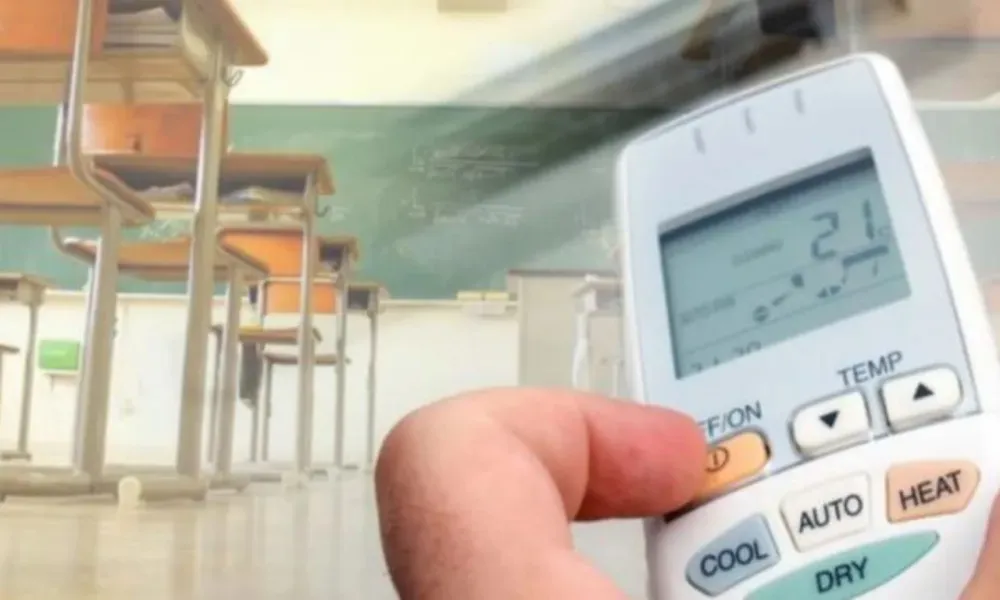

Public schools across Cyprus are preparing for the start of the new academic year with air-conditioning installations at varying stages of completion, while the Education Ministry insists all schools will be equipped with cooling systems "soon."
The ministry says the project remains a top priority, although work is still pending at a small number of schools. At the same time, the new school year will introduce curriculum changes, expanded all-day schooling, strengthened safety measures and further digitalisation.
Air-conditioning rollout progresses
According to data presented on Friday, a significant number of schools already have fully operational air-conditioning systems, while many others are at the final stage of installation.
The ministry attributed delays largely to the need to upgrade electrical infrastructure across roughly 800 schools nationwide, noting that each school presents different technical challenges.
Secondary schools furthest ahead
The rollout is most advanced in lyceums.
In Larnaca, all lyceums have fully operational air-conditioning. In Limassol, 90% are fully operational and the remaining 10% are in the final stage of installation.
In Nicosia, 21% of lyceums have fully functioning systems, while 79% are in the final stage. In Famagusta, the figures are 33% fully operational and 67% in the final stage.
Paphos remains behind, with 33% of lyceums fully operational, 33% in the final stage and 33% still awaiting works.
At gymnasiums, full operation has been achieved in:
- 18% of schools in Nicosia
- 39% in Limassol
- 45% in Larnaca
- 37.5% in Paphos
- 50% in Famagusta
Most remaining gymnasiums are in the final phase of installation.
Slower progress in primary schools
The rollout has advanced more slowly in primary schools.
Fully operational systems are currently in place in:
- 24% of primary schools in Nicosia
- 46% in Limassol
- 39% in Larnaca
- 16% in Paphos
- 65% in Famagusta
Further works are still scheduled at 30% of schools in Nicosia, 25% in Limassol, 51% in Larnaca and 62% in Paphos.
Expansion of all-day schools
The number of optional all-day primary schools will rise to 383 nationwide, up from 220 in 2023.
Free compulsory pre-primary education is also being extended, with the admission age lowered to four years and four months, benefiting approximately 1,925 children this year.
Other measures include:
- More teaching hours for Greek as a second language for children with migrant backgrounds.
- Continued functional literacy support in 80 schools.
- Expansion of the interdisciplinary all-day gymnasium programme.
- Extension of the pilot all-day secondary school model.
- Expansion of technical gymnasiums to two additional schools.
Nearly 108,000 students expected
Public primary schools are expected to enrol 52,186 pupils across 328 schools, supported by 5,232 teachers.
Another 14,398 children will attend 274 public kindergartens, while 8,919 pupils are expected to enter Year 1.
In secondary education:
- 41,280 students are expected in general secondary education.
- 23,270 will attend gymnasiums.
- 17,710 will attend lyceums.
- 300 will attend evening schools.
Technical education is expected to serve 5,150 students with 890 teachers.
€1.7bn education budget
The Education Ministry's proposed 2027 budget stands at €1.699 billion, up from €1.611 billion in 2026, pending the necessary approvals.
Development expenditure is projected at €324.4 million, while recurrent expenditure is budgeted at €1.375 billion.
In digital education, between 2023 and 2026 the ministry distributed:
- 17,000 digital devices
- 2,700 interactive screens
The programme will continue with another 1,300 devices and 2,000 interactive screens.
More than 93,000 students and 12,000 teachers are now registered on the ministry's eDEA electronic administration system, with online enrolments and additional digital services due to expand nationwide this year. Pilot schools will also begin using electronic systems for attendance, assignments, tests, grades and leave management.