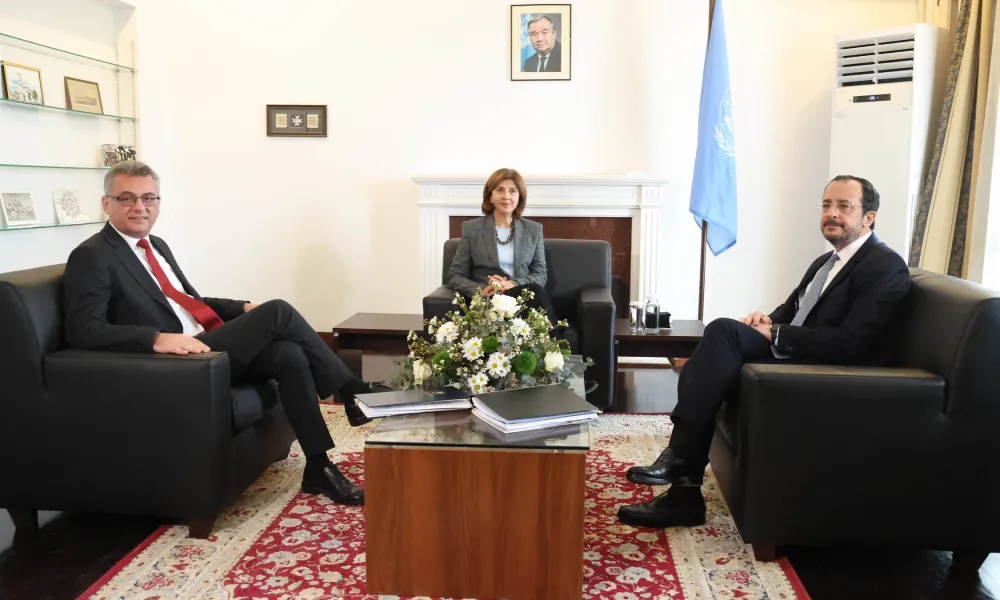

The deadly Filo Jet ferry disaster off Kyrenia interrupted the rhythm created by the Aug. 26 meeting between Turkish Cypriot leader Tufan Erhürman and Greek Cypriot leader Nikos Christodoulides, but it has not derailed the renewed Cyprus effort. The first follow-up meeting was postponed at the Turkish Cypriot side’s request while the leadership concentrated on search operations, the victims’ families and the consequences of the tragedy.
The island-level process is now resuming. The two sides’ representatives, Mehmet Dana and Menelaos Menelaou, are scheduled to meet on Monday, Sept. 7, followed by the leaders on Wednesday, Sept. 9. Greek Cypriot government spokesman Konstantinos Letymbiotis has confirmed that the meeting will proceed despite the political upheaval in the north and the absence of UN Secretary-General António Guterres’ personal envoy, María Ángela Holguín Cuéllar.
Holguín had been expected to consult Guterres in New York, continue to London for a meeting with the new British minister handling the Cyprus file and arrive on the island on Monday evening. A bout of bronchitis has delayed that programme by several days. She is now expected after Sept. 10 and plans to participate in the leaders’ following weekly meeting, expected on Sept. 16.
The postponement is inconvenient during an already compressed diplomatic period, but it should not dominate assessment of the process. More important is whether Erhürman and Christodoulides can use their meetings to move beyond statements of goodwill before briefing Guterres separately on the margins of the UN General Assembly later in September.
Weekly contact, but no breakthrough
The Aug. 26 encounter produced a procedural advance rather than a substantive breakthrough. After nearly three hours under UN auspices, the leaders agreed to meet at least weekly and more often if necessary. They also advanced the steering committee of the previously agreed Civil Society Consultative Body.
Regular direct contact is important in a conflict where long interruptions have repeatedly allowed mistrust and public rhetoric to harden. Yet a denser calendar is not a political result in itself. The leaders remain divided over new crossing points, demining, practical confidence-building measures, the treatment of previous convergences and the ultimate framework of a settlement.
The atmosphere can therefore be described as constructive but stagnant. Communication channels are active and neither leader wants to be blamed for disrupting the renewed initiative. At the same time, there has been little evidence that either side is prepared to make the reciprocal moves needed to unlock the practical agenda.
UN spokesman Stéphane Dujarric has stressed that any future enlarged meeting involving the two Cypriot sides, Türkiye, Greece, Britain and the United Nations must be properly prepared through “serious discussions.” The UN does not want another 5+1 gathering that merely restates incompatible opening positions.
The common-ground inventory
The most consequential development may be the document being prepared under the coordination of Canadian political scientist and UN adviser John McGarry. The exercise seeks to consolidate the convergences recorded during earlier rounds of negotiations into a single inventory.
The document is not a new UN settlement plan and is unlikely to contain an imposed bridging formula. Its purpose is to establish what the UN understands to have been agreed, where partial convergence exists and which issues remain unresolved. Holguín is expected to share it with the two leaders and other stakeholders and seek specific responses before Guterres decides whether another 5+1 conference would be useful.
Such an inventory could bring greater discipline to a process in which both sides invoke earlier negotiations selectively. The Greek Cypriot side argues that formal negotiations should resume within the established bi-zonal, bi-communal federal framework and from the acquis accumulated up to Crans-Montana. The Turkish Cypriot side accepts the preservation of previous convergences but insists that political equality and effective participation cannot be reopened for bargaining.
Erhürman also demands a time-bound process and an assurance that another failure will not simply return Turkish Cypriots to the same indefinite status quo. Christodoulides declares his commitment to federation, while Türkiye and much of the political establishment in the north continue to emphasise sovereign equality and a two-state solution.
The McGarry exercise cannot eliminate that fundamental divergence. It can, however, oblige both sides to identify precisely what they accept, reject or wish to amend. That would provide Guterres with a more reliable basis for deciding whether an enlarged conference could produce movement rather than another clash of narratives.
Crossings remain the practical laboratory
The stalled effort to open new crossing points remains the clearest test of whether intensified dialogue can produce tangible results. Months of discussion have focused on a package involving Mia Milia (Haspolat), Athienou-Pyroi, Louroujina (Akıncılar) and arrangements around Kokkina (Erenköy).
Mia Milia could ease commercial traffic and serious congestion at Agios Dometios (Metehan). The Athienou-Pyroi route addresses a longstanding Greek Cypriot transit concern, while Louroujina and Kokkina involve Turkish Cypriot connectivity priorities.
The UN has attempted to construct reciprocal packages, including a formula pairing Mia Milia with Athienou-Pyroi. The Greek Cypriot side has shown willingness to consider that pairing, while the Turkish Cypriot side remains concerned that separating it from the wider package would allow its other priority routes to be postponed indefinitely.
There is even disagreement over whether the Athienou-Pyroi-Aglantzia links constitute one crossing arrangement or several. This may sound like administrative detail, but on Cyprus geography quickly becomes political arithmetic. Each side calculates reciprocity, territorial implications and the public appearance of who conceded more.
Holguín has described implementable confidence-building measures as an indispensable condition for another enlarged meeting. Her reasoning is straightforward: if the two administrations cannot cooperate on roads, demining, energy, environmental emergencies or everyday movement, it is difficult to believe that they could operate a far more complex common constitutional structure.
The visibility dispute
The crossing-point stalemate is increasingly connected to a broader dispute over Turkish Cypriot visibility. Controversies surrounding an FC Barcelona-linked youth football programme, international cultural events, Turkish Cypriot universities and a diplomatic briefing by Dana have expanded the familiar recognition argument into sport, education, culture and routine international contact.
Erhürman draws a distinction between recognition and interaction. A Turkish Cypriot child participating in an international football programme does not create a state. A university appearing in an academic ranking does not determine sovereignty, and an ambassador listening to a Turkish Cypriot official does not establish diplomatic relations.
Christodoulides approaches the issue through a different political logic. He supports confidence-building measures that contribute to reunification but rejects steps that, in his words, “normalise the current illegal state of affairs.” The Greek Cypriot concern is that greater external connectivity and functionality could make partition more sustainable and reduce incentives for a comprehensive settlement.
This produces the central contradiction confronting the process. The Greek Cypriot side fears normalisation without settlement; the Turkish Cypriot side fears enforced isolation until settlement. Unless room is created between those positions, almost every practical initiative risks becoming another recognition dispute.
Recognition and contact are nevertheless not the same. The international community can continue to withhold recognition from the northern administration without requiring Turkish Cypriots to become culturally, academically or diplomatically invisible. Attempts to obstruct ordinary contacts may strengthen rather than weaken support for a two-state solution by convincing Turkish Cypriots that even limited international interaction remains subject to Greek Cypriot consent.
That contradiction also reinforces Erhürman’s insistence that political equality and effective participation must be secured before another open-ended process begins. It is difficult to build confidence in a future partnership while Turkish Cypriots are simultaneously being told that their visibility outside the negotiating room is politically unacceptable.
Political crisis in the north
The talks are also proceeding against a sudden political crisis in the north. ‘Prime minister’ Ünal Üstel dismissed ‘public works and transportation minister’ Erhan Arıklı amid mounting controversy and internal disputes following the ferry disaster. Arıklı’s Rebirth Party, or YDP, subsequently decided to withdraw from the three-party coalition.
The rupture threatens the coalition’s ‘parliamentary’ position just as it was preparing to legislate for an early election on Dec. 6. Üstel must now determine whether he can reconstruct a working majority, secure outside ‘parliamentary’ support or bring elections forward under conditions of political instability.
The crisis does not directly alter Erhürman’s authority at the negotiating table. He participates as Turkish Cypriot leader rather than head of ‘government’, and his mandate is institutionally separate from the ‘parliamentary’ balance. Prolonged instability could nevertheless distract the administration, weaken decision-making and push parties towards harder positions as they prepare for elections.
An election atmosphere rarely encourages delicate compromises. Any agreement on crossings or other confidence-building measures could be portrayed by opponents as an unjustified concession. Rejectionist forces on both sides would benefit if domestic political competition turned the renewed talks into another test of nationalist credentials.
The test before New York
The Sept. 9 meeting remains important despite Holguín’s absence. Erhürman and Christodoulides can begin narrowing differences over crossings, demining, the Civil Society Consultative Body and the method for reviewing previous convergences. Progress on even one issue would provide Holguín with something tangible to develop when she joins their following meeting.
By the time the leaders brief Guterres in New York, the secretary-general will need to determine whether the weekly format has generated more than improved atmospherics. The decisive question will be whether sufficient common ground exists to justify another 5+1 conference and whether the sides are prepared to treat practical cooperation as something more than a bargaining instrument.
Holguín’s temporary illness changes the travel calendar, not the substance of the challenge. The diplomatic machinery is moving, the leaders are meeting and the UN is preparing a clearer record of what has already been achieved. What remains missing is evidence that either side is ready to turn process into compromise.
There is considerable political space between recognising the northern administration and isolating the Turkish Cypriot community. That is where meaningful confidence-building must take place. If the leaders can begin occupying that space, the current initiative may prepare the ground for credible negotiations. If they cannot, another 5+1 meeting will provide little more than a new venue for the island’s familiar disagreement.