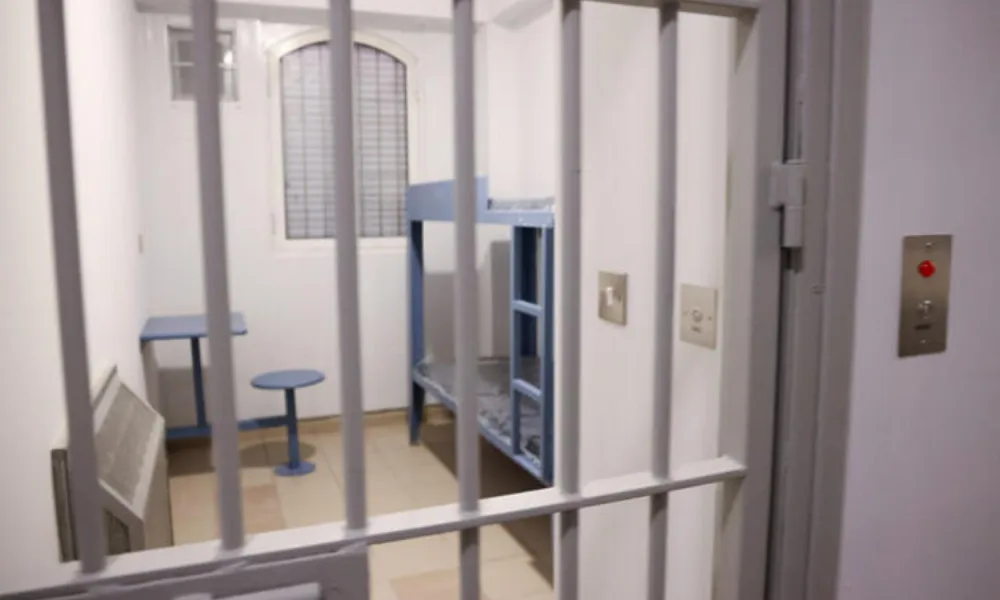

Fifteen people are currently serving prison sentences at the Central Prison for failing to comply with court orders requiring the repayment of debts.
The cases involve unpaid maintenance, social insurance contributions and traffic fines.
Justice Minister Costas Fytiris announced during a recent visit to the Central Prison that inmates sentenced to up to 12 months' imprisonment for offences, mainly of a financial nature, and who have served half their sentence, will be eligible for early release subject to the consent of the Attorney General.
The measure also covers individuals imprisoned for debts owed to the state and for non-payment of maintenance obligations.
While the move is expected to provide some relief to Cyprus's overcrowded prison system, it does not address the underlying problem: the debt remains.
An economically vulnerable debtor may be released from prison without having acquired any realistic means of paying what is owed, creating the possibility of returning to prison if they continue to be unable to meet their obligations.
The vast majority of those convicted over debts are unemployed people, low-income workers, pensioners and recipients of state benefits who often lack the financial capacity to meet court-ordered repayments.
This raises an obvious question: how can someone with no income, no significant assets, or dependent on state assistance repay debts owed to the very state supporting them? Will they be imprisoned, released and then eventually return to prison again?
Debts do not disappear
Imprisonment does not settle a debt.
A person may be jailed for failing to pay, but incarceration neither generates income nor eliminates the outstanding obligation.
After serving a sentence, debtors return to exactly the same financial reality they faced before imprisonment.
The prison sentence serves as a punishment for failing to comply with a court order and as a coercive measure intended to encourage payment. It does not erase the debt.
Following release, both the state and private creditors retain the right to pursue repayment through available enforcement mechanisms, including:
- Registration of charges against immovable property.
- Measures against movable or immovable assets.
- Restrictive court orders where provided for by law.
In short, prison punishes disobedience of a court order, but it does not extinguish what is owed.
Once there were many more
The current figure of 15 inmates represents a significant decline compared with previous years, partly because several debtors have already been released since the beginning of 2026.
However, long-term statistics reveal the scale of the issue.
Approximately 1,700 people have passed through the gates of the Central Prison in recent years to serve sentences related to debts owed to the state or for failing to pay maintenance.
Between 2014 and 2020, the number of people imprisoned annually for such offences remained in the triple digits:
- 2014: 353 people
- 2015: 316 people
- 2016: No available data
- 2017: 148 people
- 2018: 213 people
- 2019: 192 people
- 2020: 107 people
These prison terms were imposed for failure to comply with court-ordered repayment plans, even when the debts involved amounted to only a few thousand euros.
In many other European countries, imprisonment for debt is generally associated with significantly larger liabilities, often exceeding €50,000 or €100,000, while smaller debts are dealt with through alternative sanctions such as community service.
The forgotten proposal
The issue is not new.
In the past, parliament examined proposals intended to prevent financially vulnerable debtors from going to prison by allowing them instead to participate in paid community work programmes within municipalities and government services.
The concept was straightforward.
Instead of serving a prison sentence, the debtor would work, receive a salary and have part of that income deducted to repay debts owed either to the state or to maintenance recipients.
The proposal was discussed by the House Legal Affairs Committee but was never translated into legislation.
Community work exists, but without pay
Cyprus already provides for community work as an alternative to imprisonment, but it is unpaid.
The measure has been in force since 22 March 2005 under the Probation and Other Ways of Dealing with Offenders Law, originally enacted in April 1996.
The legislation allows courts to issue probation orders that include unpaid community work.
Individuals can be ordered to complete a specified number of hours serving non-profit organisations.
According to official statistics, approximately 6,000 people were sentenced to community work instead of imprisonment between 2005 and the end of 2025.
Community work placements may be carried out:
- In state welfare institutions for adults.
- In social welfare NGOs.
- In community and district volunteer councils.
- In municipalities and local communities.
For implementation purposes, the Social Welfare Services and the Pancyprian Volunteerism Coordinating Council assign supervisors who monitor compliance and oversee the completion of required hours.
The unanswered question
The Justice Ministry's early-release policy addresses one real problem: prison overcrowding.
What it does not answer is a more fundamental question.
What serves the state better?
Imprisoning a financially vulnerable debtor while recovering none of the money owed, or allowing that person to work legally under a regulated paid community employment scheme where part of their earnings is directed towards repaying debts?
It is a question that occupied parliament for years, generated considerable discussion and, so far, remains unanswered.