We live in a world where geopolitics and technology are inseparable. Those who champion technological innovation will shape the future - and we must ensure that Europe plays a leading role in this.
Europe has great strengths to build on. I have seen these strengths firsthand. Our companies are tackling industrial digitalization and anchoring the global tech supply chain. Meanwhile, our top-tier researchers and AI pioneers are pushing frontiers, fueled by our growing network of AI factories.
But our strengths, taken individually, are no longer enough. The EU relies on non-EU providers for over 80% of its digital products, services and infrastructure.
This situation did not emerge overnight. It is the result of decades of individually rational decisions: it was cheaper to buy than to build, faster to adopt than to develop, easier to integrate into global platforms than to invest in our own alternatives.
The 2024 Draghi report put it clearly: The key driver of the rising EU–US productivity gap is digital technology. If you strip out the main ICT sectors, Europe’s productivity has broadly been at the same level with the US.
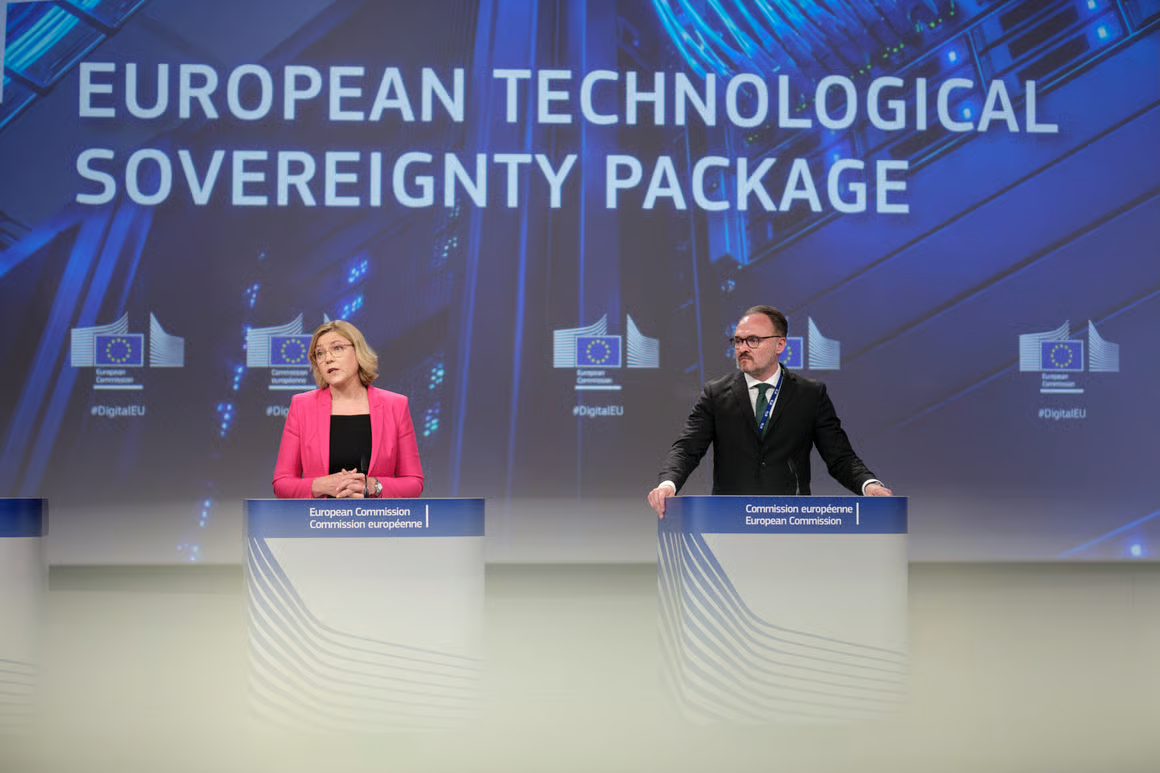
This is why the European Commission has put forward a technological sovereignty package for Europe, moving us from regulation to innovation, from caution to competitiveness, from consumption to creation.
With this initiative, we define what technological sovereignty means to clarify once for all that Technological sovereignty does not equate protectionism and that Europe remains grounded in openness, partnership, and fair competition.
And we underline that Europe needs to be in the position to make its own choices and avoid dependence from single dominant suppliers, particularly in case of not like-minded countries.
In short, a technologically sovereign Union should effectively manage global technological interdependence, without necessarily having to put an end to it, since in some case this can be extremely costly.
This does not mean that we will have to do everything by ourselves. Sometimes we may decide to invest in home grown technologies, some other times, this might not be the most cost-efficient solution and we will have to cooperate with our partners and diversify.
This approach will bring real alternatives, so that European companies and citizens have a genuine choice – including for European solutions.
The package sets out three urgent priorities that form the building blocks for Europe’s digital future.
Firstly, it lays out a new approach to semiconductors - tiny components which power all digital technology: smartphones, cars, trains, medical devices, drones, defence equipment, aircraft, or even data centres. The Chips Act 2.0 will take the EU to a new level in the global market for powerful semiconductors, enabling us to meet new demands, including AI Chips, while ensuring a stable supply of mainstream chips to keep production steady and technological capabilities in place across Europe.
Secondly, through the Cloud and AI Development Act, the package takes another major step towards making Europe an AI continent.
This will help triple Europe’s sustainable data centre capacity by 2030 to meet increasing demand. As we produce more and more data, we need to be able to store it in a secure and reliable way – especially where critical applications and sensitive data is concerned.
Third, through a new EU Open Source Strategy, the package harnesses the potential of Europe’s more than three million open source contributors. Public administrations and businesses share the need to better control, maintain and adapt the tech on which they rely.
Underpinning these three pillars is the energy that is needed to power them in a clean, sustainable way.
The challenge is not just how we can make digital technologies greener, but also how digital technologies can accelerate the green transition - using cutting-edge solutions to lower energy bills. We also need to ensure that Data Centres are not only “consumers” of energy, but are also part of the solution by contributing to build additional clean energy capacity to the benefits of local communities and our economy in general. This is the ambition behind the Strategy Roadmap for Digitisation and AI in the Energy Sector.
This package is a building block for our future.
A future where our factories can run on European industrial software, where our hospitals are free to choose AI developed in Europe, where our innovators can use European software to develop ideas, and our startups can grow into global champions – right here in Europe.
This is not just a fantasy; it is a choice. And it is a choice we must make now, together.

Henna Virkkunen, Executive Vice-President of the European Commission
and Commissioner for Tech Sovereignty, Security and Democracy