

By Yusuf Kanlı
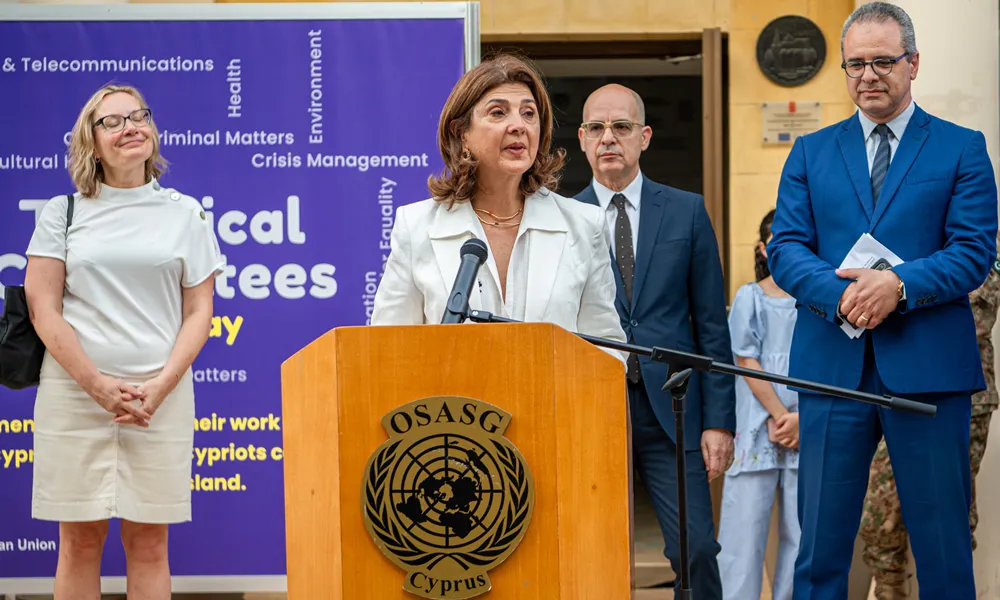
For the first time since the United Nations relaunched efforts to revive the Cyprus peace process, María Ángela Holguín’s diplomatic strategy is facing its first serious political stress test. The question confronting the initiative is no longer simply whether the parties can be persuaded to return to another informal five-plus-one meeting. Rather, it is whether the initiative itself can survive Cyprus’ familiar mixture of selective leaks, nationalist pressure, domestic political calculations and competing historical narratives long enough to reach that stage. Before constitutional formulas can even be debated, Holguín must first determine whether sufficient political confidence still exists to justify another attempt at comprehensive negotiations.
Holguín’s mandate has frequently been misunderstood. Unlike several previous UN envoys whose primary objective was to persuade the parties to return to formal negotiations, she has adopted a more cautious, sequential approach. According to diplomats familiar with the process, she has not been drafting a comprehensive settlement blueprint. Instead, she has been assembling what increasingly resembles a strategic assessment designed to answer a more fundamental question: are the political conditions sufficiently mature for another serious negotiating effort? Only if that answer proves positive would detailed discussions on governance, territory, security and guarantees realistically follow.
Until only a few days ago, that carefully calibrated strategy appeared to be progressing largely according to plan. Holguín had completed another intensive round of consultations with Turkish Cypriot leader Tufan Erhürman, Greek Cypriot leader Nikos Christodoulides, Turkish Foreign Minister Hakan Fidan and Greek Foreign Minister Giorgos Gerapetritis, while maintaining contacts with senior European Union officials. The purpose was not to negotiate substantive chapters but to gauge political intentions, identify possible incentives and determine whether enough mutual confidence existed to justify moving toward another informal five-plus-one meeting involving the two Cypriot leaders and the three guarantor powers.
That carefully managed sequence was abruptly disrupted when reports appeared in the Greek Cypriot press suggesting that Holguín was discussing possible elements of a future settlement involving a looser constitutional structure, territorial adjustments, Varosha, guarantees, Turkish troop reductions and new institutional arrangements. Exploring ideas is part of every mediator’s job. What transformed the story into a political crisis was the impression that highly sensitive questions, including Varosha, territorial concessions, Turkish troop withdrawals, guarantees and the future constitutional architecture, had moved beyond exploratory discussions and into the realm of actual bargaining. That perception, rather than the discussions themselves, ignited the political backlash. Within hours, Holguín’s discreet shuttle diplomacy had ceased to dominate the discussion. Rumours, accusations and speculation took its place, creating precisely the political atmosphere her strategy had sought to avoid.
What the leak actually claimed
The original report published by Politis did not claim that a new UN settlement plan had been agreed or formally tabled. Rather, it suggested that Holguín had been testing reactions to possible future negotiating ideas during her consultations. According to the newspaper, these exploratory discussions included a more decentralised federal structure with fewer common competences, a rotating collective presidency, a leaner federal administration, possible confidence-building measures involving Varosha, territorial adjustments, new security arrangements replacing the existing guarantee system and a reduced Turkish military presence after a settlement. The report also linked these discussions to broader European incentives for Türkiye and measures aimed at easing the isolation of Turkish Cypriots. None of those elements were presented by the United Nations as official proposals, yet publication of the story generated immediate political controversy, particularly among nationalist circles in Türkiye and Northern Cyprus, where many interpreted the report as evidence that sensitive compromises were already being explored behind closed doors.
One senior diplomatic source familiar with the process argued that the controversy revealed something more fundamental than disagreement over constitutional formulas.
“What this discussion actually demonstrates is the fear of a possible solution on both sides,” the source said. “That fear prevents many political actors from seeing the real picture. Instead of assessing whether a proposal exists or whether negotiations have even reached that stage, they react to imagined outcomes before they materialise.”
From Brussels to New York
Holguín’s subsequent journey to New York offered the clearest indication yet that the initiative had entered a more delicate political phase. Rather than merely briefing Secretary-General António Guterres on the consultations she had conducted in Cyprus, Ankara and Athens, diplomats say the central purpose of the meeting was to determine whether sufficient political space still exists to continue preparing another informal five-plus-one meeting, tentatively envisaged for late July or early August. The discussion therefore extended well beyond constitutional questions. It focused on whether the initiative itself remains politically viable after the turbulence generated by the recent leak.
Her consultations with Guterres also came at a particularly sensitive moment. Under Security Council Resolution 2815, the Secretary-General must submit his regular reports on Cyprus by July 6. Those reports are expected to contain the first formal assessment of whether Holguín’s renewed diplomatic effort has generated sufficient momentum to justify another phase of negotiations. Diplomatic sources indicate that the Secretary-General’s own political judgement, rather than any procedural timetable, will largely determine whether Holguín proceeds with another round of shuttle diplomacy.
Despite the political storm, however, there is little indication that the United Nations has abandoned the initiative. According to diplomats familiar with the process, Holguín remains expected to return to Cyprus unless Guterres concludes that the political environment has deteriorated beyond repair. In that sense, the operational timetable has proved more resilient than many observers initially assumed.
Brussels becomes indispensable
Recent developments have also reinforced another reality that has been gradually emerging throughout Holguín’s mission: no renewed Cyprus process is likely to succeed without meaningful European involvement.
Within the United Nations there is growing recognition that simply inviting the parties to “return to the negotiating table” no longer provides sufficient political incentive. Ankara increasingly expects renewed negotiations to be accompanied by tangible progress in Türkiye-EU relations, including customs union modernisation, visa liberalisation and closer defence cooperation. The Turkish Cypriot side, meanwhile, expects practical measures reducing its international isolation through increased contacts, trade and economic engagement.
This explains why Holguín’s planned consultations with European Council President António Costa and European Commission President Ursula von der Leyen have assumed growing strategic importance. According to diplomatic sources, Guterres himself has encouraged greater European engagement, recognising that Brussels may now be as important as New York in creating the political conditions necessary for another informal five-plus-one meeting.
The NATO Summit in Ankara on July 7-8 therefore acquires significance extending well beyond alliance affairs. Although Cyprus does not formally appear on the agenda, the summit will bring together Erdoğan, Costa and von der Leyen for the first time since Holguín’s latest round of consultations, creating an unusually favourable setting for parallel discussions linking Cyprus, Türkiye-EU relations and broader European security.
The constitutional question behind the controversy
Ironically, the controversy generated by the leak did not create an entirely new political dilemma. It merely accelerated one that experienced Cyprus observers believed would eventually emerge. From the outset of Holguín’s renewed initiative, diplomats and long-time negotiators quietly asked not whether President Nikos Christodoulides would eventually reach his political red line, but where that line would be drawn.
The reason lies at the constitutional heart of the Cyprus question: political equality. Every serious attempt to reach a comprehensive settlement ultimately arrives at precisely the same point. However innovative the institutional architecture may become, whether labelled a loose federation, a decentralised federation, a confederation or another partnership model, the Turkish Cypriot side insists that political equality and effective participation in governance must form the foundation of any future arrangement. Without those principles, Turkish Cypriots argue, there can be no genuine partnership, only majority rule operating under a different constitutional label.
That reality presents every Greek Cypriot leader with an unavoidable political dilemma. If negotiations advance sufficiently far, would Christodoulides ultimately be prepared to defend before his own electorate a constitutional arrangement in which the elected president of the Turkish Cypriot constituent state sits across the table from the elected president of the Greek Cypriot constituent state as an equal member of a joint Cyprus Council exercising the limited common powers of a future loose federal partnership? Would he be willing to explain that equality is not merely symbolic but institutional? Or would it become politically more convenient for the process to stall before reaching that decisive constitutional moment?
Those questions have quietly accompanied Holguín’s initiative from its earliest days. Whether the latest leak was intended to trigger such an outcome cannot be established. What can be observed, however, is that public discussion shifted away from methodology and confidence-building toward precisely those issues most likely to provoke nationalist reactions before political equality itself became the central subject of negotiation. Instead of debating how two constituent states might jointly exercise limited federal competences, attention returned immediately to guarantees, Turkish troops, territory and Varosha. The constitutional discussion was postponed. The emotional debate resumed.
One senior diplomat argued that the very purpose of exploratory diplomacy is often misunderstood.
“From a strategic point of view, it is good to know the reaction before something happens,” the diplomat observed. “That is precisely what exploratory consultations are for. You test political reactions before any proposal reaches the negotiating table.”
The leak and the nationalist backlash
The consequences were immediate. Among Turkish nationalist circles in both Türkiye and Northern Cyprus, the reports were widely interpreted not as speculative journalism but as evidence that unacceptable concessions were already being explored behind closed doors. Political commentators began accusing Erhürman of participating in a process that might reopen questions considered settled by nationalist opinion. Some demanded that he withdraw immediately from Holguín’s initiative, while others argued that Ankara should simply declare the entire effort politically dead before any informal five-plus-one meeting could even be convened.
For several days there was genuine concern among diplomats that the political controversy itself, rather than any substantive disagreement, might derail the initiative before it reached New York, Brussels or another negotiating table. One senior official privately remarked that Holguín “talks to everyone and discusses everything,” adding that she had not yet fully appreciated that “this is Cyprus,” where every exploratory conversation rapidly becomes a rumour, every rumour becomes a headline and every headline quickly turns into ammunition in domestic politics. The observation was less a criticism of the envoy than recognition of the uniquely fragile political environment in which Cyprus diplomacy continues to operate.
Diplomats also rejected another narrative that quickly gained traction following the leak: the suggestion that Holguín had been “talking to everybody” and floating settlement ideas indiscriminately. According to several sources familiar with her contacts, that portrayal was inaccurate and appeared designed to undermine confidence in her mission.
“The claim that she has been talking to everybody has been floating around, but it simply is not true,” one diplomatic source said. “It has been spread with bad intentions.”
Significantly, despite the controversy generated by the original publication, Holguín’s diplomatic timetable has remained largely intact. According to well-placed sources, she continues to pursue preparations for another informal five-plus-one meeting while awaiting the Secretary-General’s political assessment after their New York consultations. That continuity reinforces the view among diplomats that the leak created a political storm but did not fundamentally alter the United Nations’ operational planning. Instead of signalling the collapse of the initiative, the developments of the past week appear to have shifted the process into a more cautious and politically sensitive phase, where the Secretary-General’s judgement will become decisive before the next steps are taken.
Ankara holds the line, but not the door
The political pressure did not remain confined to media commentary or nationalist rhetoric. As speculation continued to dominate public debate, Türkiye’s Ministry of National Defense issued a carefully worded but unmistakably firm response to reports suggesting that the UN Secretary-General’s Personal Envoy was preparing a new Cyprus settlement framework.
Without referring directly to Holguín or challenging the legitimacy of her mission, the ministry reaffirmed Ankara’s long-standing position that a permanent, just and sustainable solution is possible only on the basis of the sovereign equality and equal international status of the Turkish Cypriot people. Any initiative ignoring those principles, it said, would neither reflect the will of Turkish Cypriots nor provide lasting peace and stability in the Eastern Mediterranean.
Equally important, however, was what the statement did not say. It did not reject Holguín’s initiative, nor did it call for suspension of the current diplomatic effort. Instead, it reaffirmed Türkiye’s strategic parameters while deliberately avoiding language that would prematurely close the door on the Secretary-General’s initiative. Diplomats familiar with the process interpreted the wording as carefully calibrated: sufficiently firm to reassure domestic opinion while leaving enough political space for Holguín to continue her consultations and for Guterres to complete his assessment.
That distinction became politically significant because it contrasted sharply with demands emerging from nationalist circles. While some commentators urged Ankara to declare the initiative dead and withdraw entirely from the process, the Turkish government adopted a more disciplined approach. It drew its red lines clearly but declined to pronounce the effort beyond rescue. That nuance suggests Ankara remains prepared to evaluate Holguín’s assessment rather than react solely to speculation generated through media leaks.
Erhürman’s measured response
If Ankara sought to preserve diplomatic room for manoeuvre, Erhürman attempted to prevent the controversy from consuming the process altogether. His response differed markedly from the increasingly emotional public debate. He neither denied that broad discussions had taken place nor attempted to answer every allegation with counter-allegations. Instead, he shifted the discussion away from newspaper headlines and back toward first principles.
“We do not engage in manipulation through the media, and we will not do so,” he declared in a carefully measured statement directed as much at Ankara and the international community as at his own constituents. Rather than allowing anonymous leaks to define the political agenda, Erhürman questioned both the source of the information and the motives behind it. He suggested that some reports appeared designed simultaneously to reassure Greek Cypriot public opinion that long-standing demands remained alive while provoking Turkish Cypriots into an emotional reaction that could ultimately derail the process.
More importantly, Erhürman reminded all parties of what he described as the political reality underlying the current initiative: no proposal concerning Cyprus can advance unless both the Turkish Cypriot side and guarantor Türkiye explicitly agree to it. That message was intended not merely to reassure Turkish Cypriots but also to remind the United Nations, the European Union and the Greek Cypriot leadership that no diplomatic formula can be imposed on either Ankara or the Turkish Cypriot side. Whatever ideas Holguín may explore during her consultations, they remain exploratory until both parties decide otherwise.
He also reaffirmed that the Turkish Cypriot side would not enter another process that merely recreated the conditions that had produced repeated failures in the past. There would be no retreat from political equality, no compromise on security, no return to open-ended negotiations without a defined methodology and no acceptance of arrangements that would ultimately restore the constitutional imbalance Turkish Cypriots believe characterised the Republic of Cyprus before 1963. Engagement, Erhürman argued, should not be confused with concession, nor should patience be interpreted as political weakness.
His actions matched his words. Rather than conducting daily media appearances or responding to every rumour, he convened the Political Parties Council, met the Youth Coordination Board and initiated consultations with trade unions, business organisations and groups of journalists. The objective, according to his office, was to provide accurate information through institutional channels rather than allow speculation to define public understanding of the process.
Looking back, that restraint may have proved one of the most consequential developments of the past week. Had Erhürman answered nationalist rhetoric with equally confrontational language, domestic pressure inside Türkiye could have intensified further, potentially forcing Ankara to distance itself from Holguín’s initiative before the Secretary-General had even received her assessment. Instead, both Ankara and the Turkish Cypriot leadership gradually redirected attention toward the same central principle: no Cyprus settlement can move beyond discussion unless it receives the explicit consent of both Türkiye and the Turkish Cypriot side.
The next political test
Whether Holguín returns to Cyprus in the coming days to resume contacts with the parties ahead of the next major diplomatic milestone, the NATO Summit in Ankara on July 7-8, now largely hinges on the outcome of her consultations with Secretary-General António Guterres. According to the diplomatic sources her meeting with the Secretary-General was not intended to determine whether the initiative should be abandoned, but whether sufficient political conditions still exist to proceed toward another informal five-plus-one meeting, tentatively envisaged for late July or early August.
That distinction is important. Rather than marking the end of the process, the New York consultations appear to represent a decision point at which Guterres must determine whether the current political environment justifies another diplomatic push. Diplomatic sources indicate that Holguín herself remains expected to return to Cyprus unless the Secretary-General concludes that the political atmosphere has become too polarised to sustain further shuttle diplomacy.
The significance of the NATO Summit in Ankara has also grown considerably. Although Cyprus does not appear formally on the agenda, the summit is expected to bring together President Recep Tayyip Erdoğan, European Council President António Costa and European Commission President Ursula von der Leyen in what may become the first high-level opportunity to discuss the Cyprus process since Holguín’s latest consultations. Diplomats increasingly view that meeting as an opportunity to examine not merely Cyprus itself but the broader package of incentives that could accompany renewed negotiations.
For Ankara, participation in another informal five-plus-one meeting cannot be viewed in isolation from the broader state of relations with Brussels. Progress on customs union modernisation, visa liberalisation, defence cooperation and practical measures easing the isolation of Turkish Cypriots are all likely to influence Turkish calculations. From the United Nations’ perspective, this is precisely why the European dimension has become an increasingly important component of Holguín’s strategy. A negotiating process without meaningful political incentives is unlikely to look fundamentally different from those that have already failed.
Another senior diplomat suggested that the Secretary-General’s own political judgement has now become the decisive variable.
“Ultimately, the question is whether he wants to spend the final months of his term trying to advance Cyprus diplomacy in this political atmosphere,” the diplomat observed. “Only the Secretary-General can answer that.”
The decisive weeks ahead
The coming weeks therefore represent far more than another round of shuttle diplomacy. Guterres’ reports due on July 6 will reveal whether the United Nations believes sufficient political space remains to continue preparing another informal five-plus-one meeting. The NATO Summit in Ankara may demonstrate whether Türkiye and the European Union are prepared to create a more favourable strategic environment through practical political and economic incentives. Holguín’s expected return to the island would then become the first step toward another structured diplomatic phase rather than merely another cycle of exploratory contacts.
Yet none of those milestones will answer the central question by themselves. The greatest obstacle before Cyprus today is no longer constitutional engineering, territorial maps or security formulas. It is whether political leaders and their societies are prepared to overcome their fear of discovering what a genuine settlement might actually require. The past week’s controversy has demonstrated once again that, on both sides of the island, perceived political risks can overshadow diplomatic opportunities long before negotiations begin.
Paradoxically, the events triggered by the leak may also have demonstrated the resilience of Holguín’s approach. Despite days of political turbulence, neither Ankara nor the Turkish Cypriot leadership withdrew from the process. Guterres continues to receive Holguín’s assessments. Preparations for another phase of diplomacy have not been abandoned. According to the latest information emerging from New York, the initiative remains alive, even if it has entered a considerably more delicate political stage.
Whether Holguín’s strategy eventually becomes the foundation for renewed negotiations or joins the long list of well-intentioned but unsuccessful UN initiatives will ultimately depend not only on diplomacy in New York, Brussels, Ankara and Nicosia. It will depend on whether the political leadership on both sides is prepared to confront, rather than postpone, the constitutional reality that every serious Cyprus negotiation eventually reaches: a settlement cannot succeed unless both communities are willing to accept genuine political equality as the basis of a shared future.
If the poisonous ivy of fear once again wraps itself around the negotiating table before negotiations even begin, the failure will not belong to Holguín, Guterres or the United Nations. It will belong to Cyprus itself.