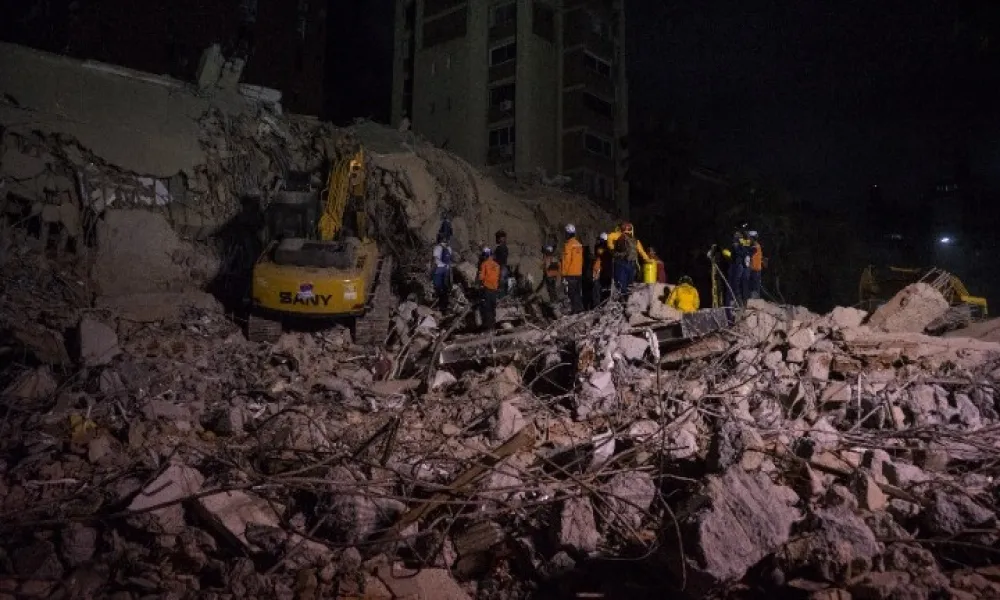


Rescue teams and desperate residents were still digging through rubble with their bare hands on Friday, nearly two days after twin earthquakes killed at least 920 people across Venezuela and left vast stretches of Caracas and the surrounding coastal region in ruins.
The country's National Assembly president, Jorge Rodríguez, confirmed on Friday that 920 people had died and 3,360 were injured, with at least 172 people still trapped under collapsed structures. More than 50,000 names have been registered on a government website set up to track the missing.
The two earthquakes, measuring magnitude 7.2 and 7.5, struck in quick succession on the evening of 24 June, with epicentres near San Felipe in Yaracuy state. The 7.2 tremor hit first and was later classified as a foreshock, followed 39 seconds later by the more powerful mainshock, which was the strongest earthquake to strike Venezuela in more than a century. The ground shook again on Friday afternoon, a 4.9 aftershock felt across Caracas and nearby Maracay.
The hardest-hit area has been La Guaira state, the coastal region north of the capital, where residents and volunteers have been working without adequate heavy machinery and with minimal official presence. Jennifer Palacios, 25, told Reuters her six-year-old son and five other relatives remained buried in the eight-tower Hugo Chávez housing complex in La Guaira city. "It's the community that has managed to get people out alive," she said. "We need them to bring cranes to move the slabs. There are still people trapped."
International help arrives, but shortages persist
Rescue convoys from Mexico, El Salvador and the Dominican Republic arrived on Friday, joining firefighters, military personnel and police civil protection units, whose presence remained limited across much of the affected area even a full day after the earthquakes. Acting President Delcy Rodríguez and other officials eventually urged volunteers to stay away from La Guaira city, warning that clogged roads were hampering official operations, and announced road closures from 8pm local time for all but registered response teams.
The first US search and rescue plane also arrived in Venezuela on Friday, carrying an 80-member team from Virginia Task Force 1, including firefighters, doctors, structural engineers and six canine units. Washington announced it was mobilising $150 million in aid and easing sanctions, while the US military dispatched two ships and said aircraft and helicopters would support the operation. Rodríguez spoke by phone with President Donald Trump and Secretary of State Marco Rubio on Friday.
In the beachside neighbourhood of Los Corales, 50 members of El Salvador's rescue team were searching the ruins of three ten-storey buildings using drones, heat scanners and dogs. Team leader Roberto Gavidia told Reuters that residents had reported hearing people still alive in the rubble. Salvadoran President Nayib Bukele shared a video on Friday of the team working to reach a 15-year-old girl trapped with her pet on the ninth floor of a collapsed building.
A nation already under strain
The last earthquake of comparable scale to hit Caracas occurred in 1967, when more than 200 people died. The disaster has now struck a country already weakened by decades of economic collapse and political turmoil that has driven millions of Venezuelans abroad and left infrastructure severely degraded. Hospitals, chronically underfunded even before the quakes, are struggling to absorb the surge of casualties. Thirteen hospitals were reported damaged across the country.
Reuters witnesses reported looting of a damaged store in Catia la Mar, with police and national guard personnel present but not intervening. Bodies in some areas remained uncollected. Ricardo Trias, 73, a lawyer trying to obtain a death certificate for his godson whose body was pulled from rubble in Caraballeda, told Reuters: "No forensic authority has come."
The US Geological Survey's assessment system estimated the disaster could ultimately kill more than 100,000 people, and projected that nearly 7 million could be affected. Venezuela's oil production was reported unaffected.
Source: Reuters, CNN, NPR, ABC News