
A new international study involving researchers from The Cyprus Institute has identified a major natural driver of cloud formation over remote oceans, offering fresh insight into one of the persistent uncertainties in climate science.
The study, published in Nature, focuses on methanesulfonic acid, or MSA, a compound formed when emissions from marine phytoplankton undergo chemical reactions in the atmosphere. Researchers found that MSA can play a role similar to sulfuric acid in the creation and growth of tiny atmospheric particles that act as “seeds” for clouds.
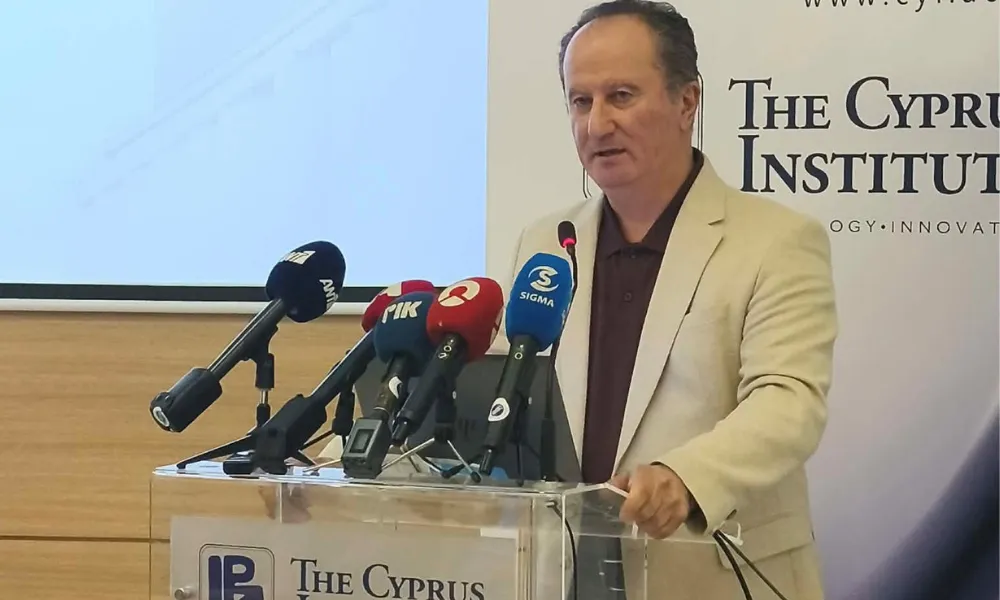
The findings were presented at a press conference at The Cyprus Institute, where officials said the work underlines Cyprus’ growing contribution to international climate and atmospheric research.
The research was carried out through the CERN CLOUD experiment, a leading laboratory facility designed to recreate atmospheric conditions and examine how new particles form. Scientists simulated the cold, clean air found over remote oceans and studied how gases released by plankton are transformed into particles capable of supporting cloud formation.
For decades, sulfuric acid was considered the main driver of new particle formation in the atmosphere. The new study shows that MSA, which is also produced from natural marine emissions, is especially effective in colder conditions. When MSA and sulfuric acid act together, they can sharply increase the formation of cloud-forming particles compared with either compound acting alone.
The discovery helps explain why observations over remote ocean regions, particularly in colder marine environments, have often shown more cloud-forming particles than global climate models predicted. Researchers say better representation of this mechanism could lead to more accurate climate projections.
Dr Stavros Malas, President of The Cyprus Institute, said the discovery highlights the institute’s role as a centre of excellence and shows the value of sustained investment in research.
Dr Theodoros Christoudias, one of the study’s authors, said the work examines how emissions from ocean organisms such as phytoplankton are transformed through atmospheric chemistry into substances that contribute to particle formation. He said the findings strengthen understanding of the climate system at a time when Cyprus and the wider region are already facing severe climate pressures.
Dr Rima Baalbaki, a researcher at the Climate and Atmosphere Research Center of The Cyprus Institute and first author of the study, said the findings show that oceans influence cloud formation more strongly than previously understood. A clearer picture of this process, she said, can help improve climate projections and support more reliable assessments of the human role in climate change.
The publication in Nature and The Cyprus Institute’s participation in the CERN CLOUD collaboration place Cyprus’ research community within a major international effort to better understand how ocean biology, atmospheric chemistry and cloud formation are connected. The findings are particularly relevant for the Eastern Mediterranean, where improved climate modelling is considered essential for future resilience.