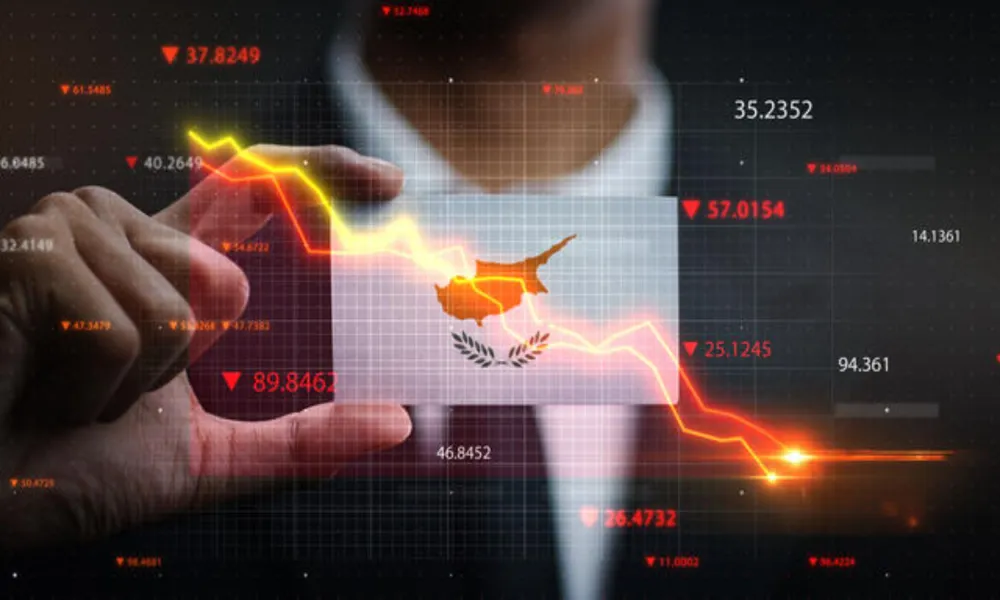

Climate change and Cyprus’ energy system pose risks to the sustainability of public debt, Fiscal Council President Andreas Charalambous has warned, highlighting delays in energy storage, the energy transition and support for vulnerable households.
Speaking during a discussion at the Cyprus Forum in Nicosia, Charalambous said the situation was generally a cause for concern, with Cyprus also lagging behind in recycling, waste management and energy efficiency.
Climate change raises fiscal risks
Charalambous said the Fiscal Council’s recent interim report placed significant emphasis on the effects of climate change because of its implications for public debt sustainability.
He said Cyprus had fallen behind in energy storage, which is particularly important for increasing the penetration of renewable energy sources.
Professor Theodoros Zachariadis said Cyprus was currently the only EU country where greenhouse gas emissions were still rising, linking this primarily to the electricity sector’s heavy dependence on fossil fuels.
According to Zachariadis, renewables account for around 25% of electricity generation. Despite the relatively low share, he said their use had saved Cyprus more than €500 million over the past decade.
Eastern Mediterranean warming faster
Zachariadis described Europe as a climate hotspot and the Eastern Mediterranean as an even more exposed region.
“We are warming much faster than the global average,” he said.
Temperatures in the region have already increased by 1.5C to 2C, while rainfall is declining.
Higher temperatures and longer periods of extreme heat are expected in future, with economic and social consequences.
Charalambous said Cyprus was also behind in meeting the targets it had set, which were already less ambitious than the European Union’s targets.
Even those targets were not supported by the necessary infrastructure projects, he said, pointing to “a planning deficit in achieving the lower targets we have set”.
He said the shortfall remained particularly evident in energy and the energy transition.
Targeted support for vulnerable households
Turning to poverty and assistance for vulnerable households, Charalambous said governments usually seek to provide help by reducing taxation.
However, he argued that this was not the most appropriate approach.
“The more effective way is through expenditure,” he said, advocating targeted support for households in need because “it is not at all easy to target through taxation”.
Zachariadis said more precise targeting often encounters administrative obstacles.
As an example, he noted that although criteria for energy poverty have been established, authorities do not know precisely which households meet them.
“So I understand that targeting often has this difficulty,” he said.
Direct payments could improve targeting
Charalambous said the problem could be addressed, even if not completely, referring to an earlier University of Cyprus study aimed at identifying vulnerable households.
He said modern technology provided greater opportunities to identify vulnerable groups and direct assistance more precisely.
“It is a difficult path, but it is good to try to move in this direction,” he said.
Asked by Zachariadis whether support could be delivered through direct transfers rather than changes to energy taxation, Charalambous replied: “That is the way to achieve targeting.”
He explained that tax reductions also benefit higher earners who do not belong to vulnerable groups.
“It is a direction we need to take,” he said, adding that Cyprus also lags significantly in targeting social expenditure.
According to Charalambous, the Guaranteed Minimum Income is essentially the only genuinely targeted measure, while other forms of support may contain certain criteria without being fully targeted.
Charalambous distinguishes energy costs from inflation
Addressing inflation, Charalambous described it as a continuous increase in prices and distinguished it from changes in relative prices.
He said that if geopolitical tensions resulted in a permanent energy problem and prices increased to reflect the new conditions, “that is not inflation. That is a change in relative prices.”
Persistent inflationary conditions can instead be created by factors including expansionary fiscal policy, inappropriate monetary policy and wage increases exceeding productivity, he said.
Delayed climate adaptation could undermine investments
Asked about climate resilience and investment, Charalambous warned that the longer adaptation is delayed, the shorter the period in which investments made today can remain viable without further adjustment.
Those investments would later need to be adapted to meet the requirements of the transition.
“The longer we continue investing in the way we are investing, there will come a point when the investments themselves will no longer make economic sense,” he said.
Source: CNA