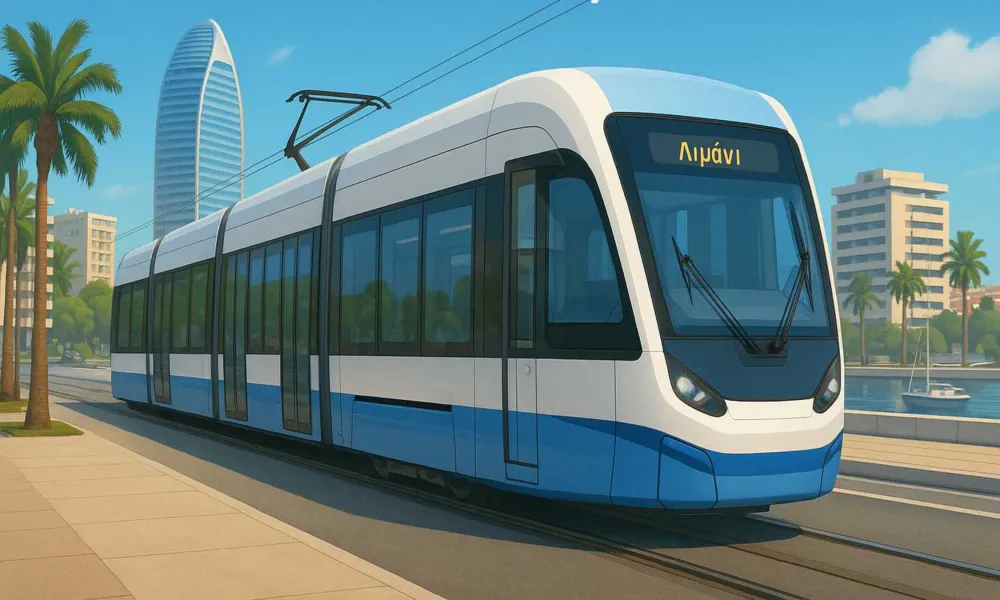

Yesterday I was reading various reports about coordination between the mayors of Limassol and Nicosia to promote the idea of a tram in their cities, which could potentially, at some point, form part of a broader system connecting the two districts.
The strange thing about this story is that, while most citizens more or less agree on the need for such a project, those who are supposed to study it and make the decisions usually treat it as something outside the Cypriot reality. In any case, this is not the first time the mayors have raised the idea.
The fundamental question, however, is different: how realistic is it to believe that we will solve the traffic problems of Limassol and Nicosia by following the same formulas that brought us to where we are today?
How many more roads can this country accommodate, and how many millions are we prepared to spend on new lanes, junctions and bypasses before discovering once again that, within a few years, they too will be full of cars?
At the same time, we have unofficially declared war on micromobility, with our police confiscating scooters on a daily basis and our MPs regarding delivery riders’ bicycles as a major problem.
Our cities have changed
Limassol and Nicosia are no longer the cities we knew 20 or 30 years ago.
They have grown in population, expanded geographically and changed economically, yet the model of transport has remained almost entirely unchanged: one car for every journey.
And this is where we have to ask ourselves whether we really cannot accommodate a tram, or whether we simply do not dare to change the model.
A tram is not simply another bus on rails. It is fixed infrastructure, with a specific route, frequency and timetable, which can genuinely become competitive with the car.
It has high capacity, is electrically powered and, for better or worse, also has a certain “prestige” that makes it more attractive as a means of transport.
Passengers know where it passes, when it will arrive and where it will take them. And provided it has its own dedicated corridor, passengers are not waiting for the tram while stuck in the same queue as they would be in their cars.
A chance to redesign our cities
Above all, however, such a project is an opportunity to redesign our cities.
To take space away from cars and give it back to pedestrians, bicycles, greenery and public space.
Instead of continually spending millions on more asphalt, we could invest that money in better cities, with fewer cars, lower emissions, less noise and fewer square metres devoted exclusively to parking.
Studies put the cost of a tram at around €25 million to €30 million per kilometre.
The contradiction in Cyprus’ green transition
There is another Cypriot contradiction.
On the one hand, we constantly talk about the green transition. On the other, we are forced to “throw away” electricity generated from renewable energy sources because our system cannot absorb it.
For 2026, the Cyprus Transmission System Operator estimates renewable energy curtailments at 458 GWh.
That does not, of course, mean that all this energy could magically be used to power trams.
An electrified public transport system, however, creates exactly what we need: greater electricity demand in a sector where we currently burn imported fuels.
The economy built around cars
And then, of course, there is the elephant in the room.
A country that relied on cars for decades created an entire economy around them.
Vehicle importers, petroleum importers and a range of other businesses clearly have an economic interest in maintaining a model in which almost every adult needs their own car.
There is no need to invent a conspiracy theory.
It is enough to acknowledge that every major change in transport creates winners and losers and, consequently, encounters resistance.
Cities of a similar scale have invested in trams
Nor are we as small as we often like to believe.
Tampere in Finland, a city of a comparable scale, introduced its modern tram system only in 2021.
Five years later, the system was recording 20.6 million passenger boardings in a single year, while 91% of residents said they had a positive view of it.
Bergen in Norway, with a population of around 280,000, inaugurated its modern light rail system in 2010 and has continued expanding it ever since.
They did not wait until they became cities of millions before investing in rail-based public transport.
They did exactly the opposite: because their cities were growing, they decided to get ahead of the problem.
How much longer do we continue with the same model?
Perhaps, then, the question is not whether we need a tram.
The question is how many more hours we have to lose in traffic, how many more roads we have to build and how many millions we have to spend on solutions that return us to exactly the same point before we admit that we need something genuinely different.