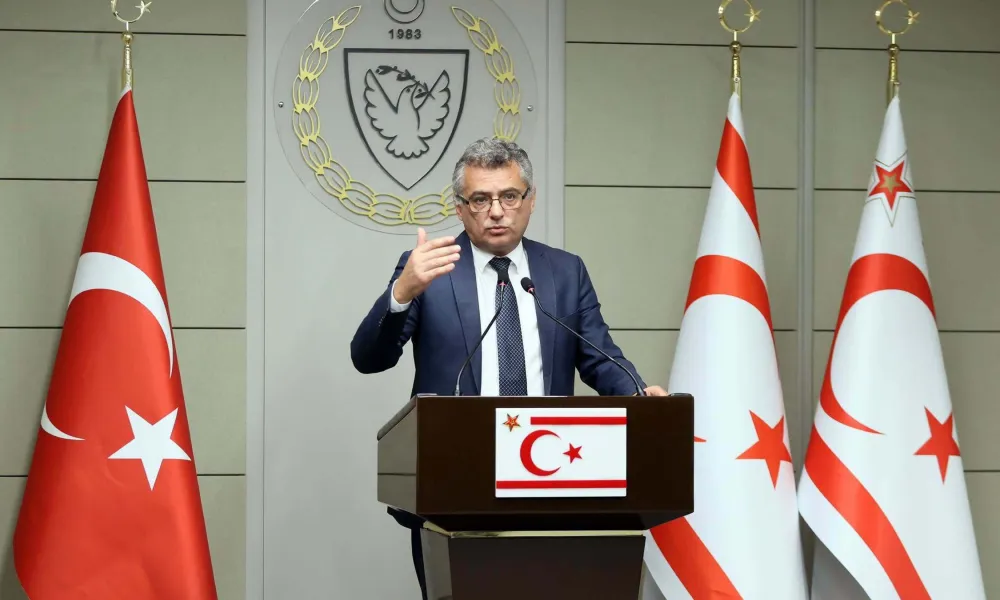

The New York debate has centred on whether Turkish Cypriot leader Tufan Erhürman refused a meeting. But UN envoy Maria Angela Holguín said a trilateral was not on Secretary-General António Guterres’s programme, which had included separate meetings with the two leaders. Greek Cypriot leader Nikos Christodoulides proposed the trilateral. Erhürman asked whether he had a new proposal that could make the meeting productive; according to Holguín, Christodoulides repeated proposals he had already made. Erhürman’s concern, as she recounted it, was that a meeting without fresh grounds for progress would be unlikely to yield a positive result.
Erhürman later said he had not rejected the meeting outright. He was prepared to attend if there was a chance to agree on some confidence-building measures and the UN secretary-general’s schedule allowed. Of the seven measures António Guterres put forward during his visit to Cyprus, Erhürman said the Turkish Cypriot side accepted six; crossing points remained unresolved. His account complicates the portrayal of a simple veto: he objected to holding a summit for its optics without prior work to make it meaningful.
Erhürman’s distinction between a meeting and a process is central to the Turkish Cypriot position. He says he wants talks that can lead to a settlement, not a photograph that creates an appearance of movement while leaving the underlying disputes untouched. This is a procedural argument, but it reflects a deeper concern: that talks could restart without first settling how the two communities would participate as political equals.
Thirteen incidents, one worsening climate
At his press conference after returning from New York, Erhürman said his office had documented 13 actions or decisions during his 11 months in office that the Turkish Cypriot side considers trust-eroding. He listed property-related arrests, initiatives by Greek Cypriot members of the European Parliament, military agreements, moves affecting the Immovable Property Commission, cancelled festivals and sports events, and efforts to limit Turkish Cypriot representatives’ international contacts, including during the New York visit. He also cited objections to technical committee members listing universities in the north in their biographies and a dispute over the title used for Nicosia mayor Mehmet Harmancı at the Cyprus Forum.
The significance of Erhürman’s list lies in what it says about the climate facing the Turkish Cypriot side: even as leaders discuss confidence-building, Turkish Cypriot representatives say their international contacts are being constrained and cultural, sporting and institutional ties remain vulnerable to political pressure.
That concern was evident in New York, where Erhürman said the Greek Cypriot mission had circulated a letter to permanent missions urging them not to meet Turkish Cypriot officials it described as “secessionist.” It also surfaced at the Cyprus Forum, where Mehmet Harmancı, the Turkish Cypriot mayor of Nicosia, had participated in previous years and was due to present the Peace and Democracy Awards with Greek Cypriot mayor Charalambos Prountzos. After the far-right ELAM party objected to Harmancı’s title in the programme and organisers changed it, Harmancı withdrew; Prountzos followed in solidarity. A Politis commentary condemned the organisers’ retreat under ELAM pressure and the resulting withdrawals. These episodes do not represent a single Greek Cypriot public position, but they raise a direct question: can political equality be built while contact with Turkish Cypriot representatives is treated as a concession or a threat?
Holguín has offered a broader warning. In her interview with ANKA, she said that efforts to restrict Turkish Cypriot international contacts and other hostile actions made a favourable atmosphere impossible, adding that negotiations do not emerge from a hostile environment. She has also argued that confidence-building measures require political will and that the window for progress is narrowing. Her assessment reinforces the relevance of Erhürman’s complaint, but it does not verify each item on his list.
Confidence-building must lead somewhere
The immediate dispute over confidence-building measures is now also a dispute over sequencing. The seven items associated with the UN secretary-general include crossing points, demining, joint responses to disasters, irregular migration, civil-society engagement, sports and the rights of children from mixed marriages. Holguín has pointed to possible new crossings and said the Haspolat crossing could support trade. Erhürman says six measures are acceptable to the Turkish Cypriot side, while crossing points remain unresolved.
Christodoules’ presentation of 19 additional proposals has become another point of friction. Erhürman argues that expanding the agenda before progress on the existing seven risks scattering attention and postponing implementation. The Greek Cypriot leader may see a wider package as a way to address more concerns at once. But unless both sides agree on how new proposals relate to the measures already identified, the list itself becomes another negotiation about negotiations.
Confidence-building measures matter because they can show whether cooperation is possible in practical areas. They cannot, however, substitute for agreement on the constitutional basis of a settlement. For Turkish Cypriots, political equality means effective participation in shared governance, including a rotating presidency and safeguards that prevent decisions from being imposed by a permanent majority. These are not benefits to be offered after trust has been built. They are part of the framework needed to make trust and common government credible.
That is why Erhürman insists that political equality must be part of the methodology from the outset. He rejects the suggestion that raising the rotating presidency means prematurely bargaining over the substance of a settlement: postponing equality risks leaving the Republic of Cyprus existing international status as the default framework, with Turkish Cypriot participation still to be negotiated. The Turkish Cypriot side has said it is ready to accept six of the seven UN confidence-building measures. Probably taking the initiative to advance one of those measures could further increase pressure on Christodoulides to respond, while demonstrating that Erhürman’s call for preparation is intended to produce practical progress. Such a step would complement, not replace, the need to address political equality in the negotiating framework.
State continuity and equal partnership
Some Greek Cypriot commentary has urged Christodoulides to accept Holguín’s persistence and act on confidence-building measures, arguing that practical cooperation could demonstrate the communities’ capacity to live within a federal state. Other voices have taken a more defensive line. DIKO leader Nikolas Papadopoulos has warned that the Republic of Cyprus statehood must be preserved after any settlement, presenting it as the protection available to Greek Cypriots. A Cyprus Mail editorial, meanwhile, described New York as producing confusion rather than clarity and criticised the leaders’ handling of the episode.
State continuity and Turkish Cypriot equality need not be treated as mutually exclusive. But continuity cannot mean that one community retains the state’s authority while the other is incorporated as a minority. A federal/confederal settlement would require meaningful power-sharing, agreed competences and safeguards that give both communities a real stake in decisions. The Turkish Cypriot demand for political equality is rooted in the breakdown of the 1960 partnership and the exclusion of Turkish Cypriots from governing institutions beginning in 1963. That history makes assurances of inclusion insufficient without institutional guarantees.
The debate over the Cyprus Forum also fits into a wider argument about the instrumentalisation of the Cyprus problem for domestic political purposes. One Politis commentary has suggested that political actors use the issue to serve electoral or personal strategies. That remains an interpretation, not an established explanation for any particular decision. Still, when contact with Turkish Cypriot officials becomes politically costly, or summit proposals are announced without groundwork, it is reasonable to ask whether diplomacy is being driven by the needs of negotiation or by the demands of domestic positioning.
October’s test
Holguín is expected to return in October to discuss the substance and method of renewed negotiations. She has said the UN is working on a record of points of convergence to be used once talks begin, and that a useful process needs agreed rules, short-, medium- and long-term goals, and a commitment to seek mutual benefit. She has also cautioned that the diplomatic opening is narrowing.
That makes the next phase a test of whether the parties can move beyond competing narratives about who refused what. The Turkish Cypriot side needs to show that its demand for preparation will lead to engagement, not become an indefinite condition. The Greek Cypriot leadership, in turn, must show that its calls for talks are compatible with practical steps that enable Turkish Cypriot participation and recognise political equality as a starting principle.
The 13 incidents Erhürman cites will remain contested. Yet the underlying issue is not resolved by disputing the number. A process cannot gain credibility if one side sees confidence-building measures advancing while the other experiences exclusion and pressure on its international contacts. Nor can it succeed if practical cooperation is asked to carry the weight of unresolved questions about political status, governance and security.
The way forward is concrete: implement the measures on which there is already common ground, address the crossing-point dispute directly, and agree on a method for substantive talks that protects previous convergences and sets clear expectations. A prepared meeting can then serve a purpose. Without that work, another summit risks confirming the very mistrust it is meant to overcome.