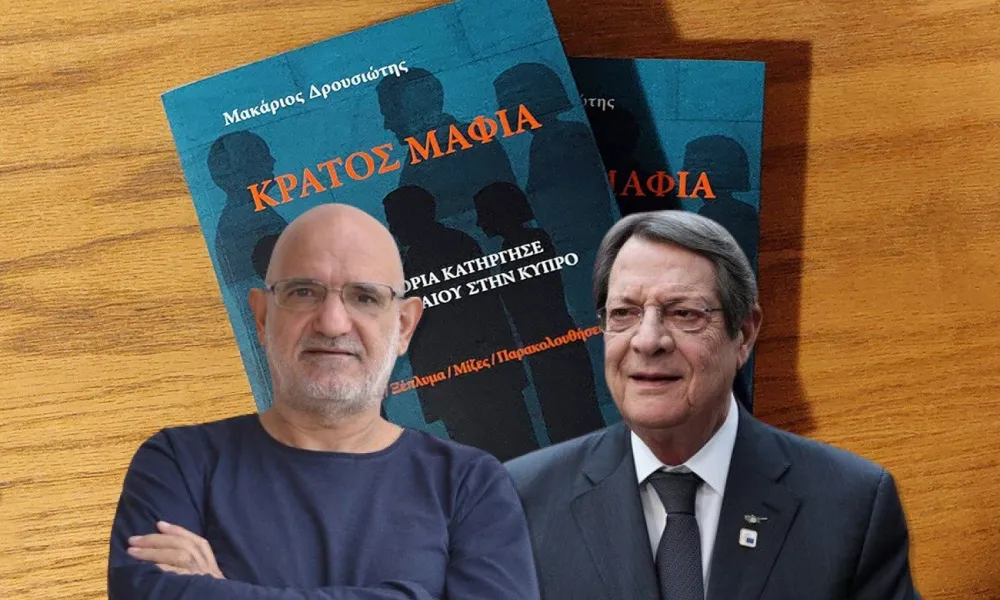



After almost two and a half years of investigation, 129 witness statements and more than 550 pieces of evidence, the Anti-Corruption Authority is due to publish its findings on the so-called "Mafia State" case next Tuesday. Attention is now turning to the possible criminal, legal and political consequences that could follow. In an interview with Politis, the criminal lawyer Ilias Stefanou discusses the need to guarantee impartiality in how the case is handled, proposes the involvement of independent legal experts in criminal cases that touch on the leadership of the Law Office, such as this one, and explains why he believes the Anti-Corruption Authority should be given investigative powers.
If the Authority finds that criminal offences may have been committed, the attorney general and deputy attorney general would need to recuse themselves, since former president Nicos Anastasiades, who appointed them, is under scrutiny. Is recusal alone enough to guarantee impartiality, given the case would then pass to their subordinates at the Law Office?
Whatever findings emerge, whether they recommend investigating possible criminal offences by any individual or conclude there is no case to pursue, are submitted for a decision to the attorney general of the Republic. It's worth noting that members of the Anti-Corruption Authority can accept or reject, in whole or in part, the recommendations of the investigators appointed to assist their work in gathering the necessary evidence. They can also request additional investigative steps. Because both the attorney general and the deputy attorney general served as members of the Anastasiades government in this particular investigation, they should recuse themselves from any decision. Given that all Law Office staff are subordinates of its leadership, I believe it would be more appropriate for any Law Office officials reviewing the Authority's recommendations and the material gathered to be supported by legal experts of recognised standing, whether former judges or experienced lawyers, such as current or former presidents of the Cyprus Bar Association, who could provide the external assurance of independence and objectivity needed for the decision on whether to bring criminal proceedings.
The Sandy case
A similar issue arose in the high-profile Sandy case. The attorney general and deputy attorney general recused themselves, since one of the messages at the centre of the controversy concerned them directly, but oversight passed to the head of the Law Office's Criminal Department, prosecutor Elena Cleopa, rather than to independent investigators. How do you assess that decision?
I believe that, for the sake of objective impartiality, the work of the police investigative authorities should have been supported by an independent criminal investigator, who could act independently of the investigators while also safeguarding the impartiality of the process. By not assigning the case to independent criminal investigators, the government's aim was to demonstrate that the institutions of the Republic of Cyprus can function effectively without outside assistance. That is a legitimate position. However, it cannot be ignored that we are living through a prolonged period in which citizens are questioning the institutions. This particular case sat at the heart of that questioning, since it concerned the judiciary, one of the most important institutions of the Republic, while also implicating the leadership of the Law Office. As such, it should have been, and should be, treated with the seriousness and institutional weight it deserves, regardless of whether the allegations made eventually prove well founded. Consequently, decisions on whether to bring criminal proceedings, given the references to the case and to the leadership of the Law Office, should be taken not only by subordinates of the heads of the Law Office, but also by lawyers from outside the Law Office, who could be appointed by the attorney general. A similar approach was followed by former attorney general Costas Clerides during the prosecution of a former deputy attorney general, a practice whose correctness was upheld by a Supreme Court ruling.
No investigative powers
The case has renewed calls to give the Anti-Corruption Authority investigative powers, so it can carry out full investigations and produce complete reports rather than simply flag possible offences. What is your position?
As far back as 2017, during the public debate on the law that was expected to be discussed in the House of Representatives, I argued that for the Anti-Corruption Authority to be effective, it should have been given investigative powers, should have had experienced investigators seconded from the police as part of its staff, and should have had its own budget to ensure its independence from any interference by the executive. Any findings drawn up simply to record the views of Authority members on whether criminal offences may have been committed remain an empty exercise unless they are also backed by the documentation needed to stand up in a criminal court. The purpose of a police investigation, which aims to gather evidence to prove a defendant's guilt beyond reasonable doubt, is different from the purpose of a report that merely recommends that the relevant authorities investigate possible criminal offences. References by the Anti-Corruption Authority to the possible commission of criminal offences, as set out in its findings to the attorney general, may be perceived by the public as an indication of guilt on the part of those involved, when in reality the investigative work needed to establish guilt or innocence has not yet begun. Seen in this light, the absence of investigative powers at the Authority affects not only the effectiveness of the investigation and the search for the truth, but also how the process itself is perceived by those involved and by society more broadly.
Double the work, serious delays
Parliament's majority has rejected giving the Authority investigative powers. Do you see this as tied to keeping control of prosecutions involving officials with the attorney general, and does the refusal raise questions about the motives behind it?
The view that prevailed in parliament, following consultation with the Law Office, was that granting investigative powers to the Anti-Corruption Authority could raise questions of unconstitutionality, since it might exceed the constitutionally guaranteed powers of the attorney general, who is the institution responsible above all others for bringing criminal prosecutions. It is beyond dispute that the final say on whether to bring a criminal prosecution rests with the attorney general. That does not mean, however, that the investigative file cannot be fully prepared by an independent body, such as the Anti-Corruption Authority, and handed over ready for prosecution. If the Authority were to fully prepare the investigative file, it would not be necessary for the police to take statements all over again, something that leads to unjustified delays and, at the same time, affects the investigative work itself. The attorney general, while remaining the final arbiter on prosecution, would then decide with not only a complete investigative file in hand, but also a report from the Anti-Corruption Authority, which, if rejected, would need to be adequately justified. A further reason for caution is uncertainty over how members of the Authority would operate in practice if given expanded investigative powers, and what framework would govern their work. Whatever the case, what we need as a society is a separation and oversight of powers, rather than a concentration of power in the hands of a single person.