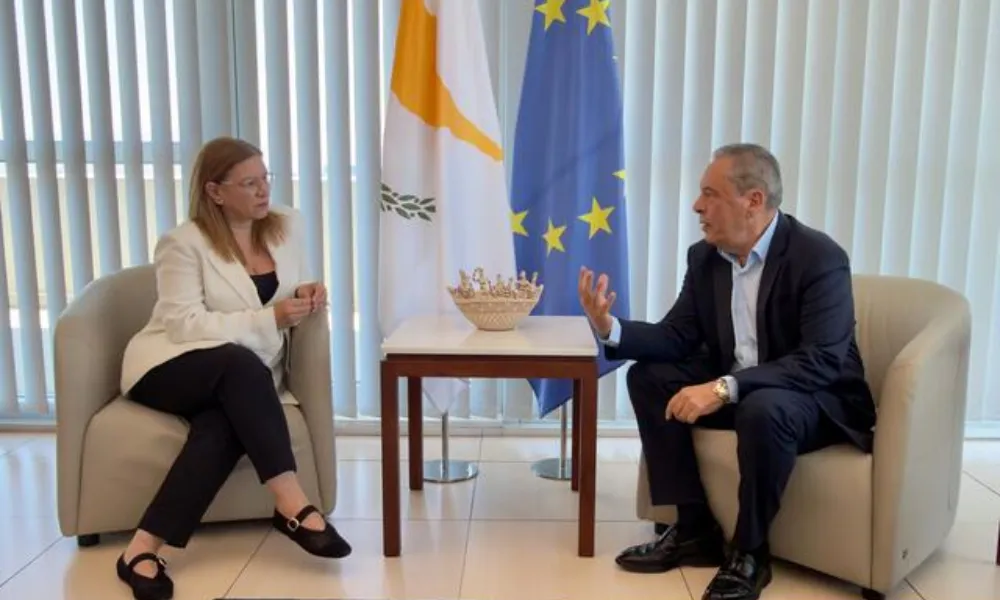



At a time of heightened geopolitical challenges and rapid developments in European defence, Defence Minister Vasilis Palmas spoke to Politis about what the SOFA agreement with France means in practice, the government's plans for making use of the EU's SAFE programme, and efforts to strengthen the operational capabilities of the National Guard. He also addressed the development of Cyprus's defence industry, the participation of women in the National Guard, and the political developments surrounding DIPA and the broader centre ground.
What does the SOFA cooperation agreement with France that you recently signed involve? What benefits will it bring for the Republic, and how do you respond to those concerned about a foreign military presence on the island?
Cooperation with one of Europe's most powerful military forces certainly strengthens the operational readiness of the National Guard. At the same time, it expands the training opportunities available to our personnel and reinforces the Republic's role as a factor of stability and security in the wider Eastern Mediterranean. I want to be absolutely clear: the SOFA agreement is not a "blank cheque," nor does it provide for the permanent stationing or presence of French military forces in the Republic. Any activity that may take place under the agreement will fully respect the Republic's sovereignty. This is an agreement that clearly sets out the terms and procedures governing the presence of one country's military personnel on the territory of another, when that takes place within the context of agreed cooperation activities, such as joint exercises, training, the exchange of personnel and expertise, training programmes, the exchange of information and experience, and mutual logistical support. SOFA, therefore, is not about a permanent French military presence in Cyprus, but about creating a clearly defined framework of cooperation that will allow the two countries to develop joint activities more effectively, for the benefit of their security, stability and strategic interests.
Agreement with ESA
You're travelling to Paris this week. Will you be signing any new agreements?
I will be taking part in the EUROSATORY international exhibition, where the Republic has a national pavilion showcasing the capabilities and prospects of our domestic defence industry. While in Paris, I will sign the agreement on the exchange and mutual protection of classified information between the Republic and the European Space Agency (ESA), an important step in further strengthening our cooperation with the agency in areas of strategic importance. The agreement establishes the necessary security framework for the exchange and mutual protection of classified information and creates the conditions for more substantive participation by the Republic in ESA's programmes.
The SAFE programme
The EU's SAFE programme is expected to provide Cyprus with significant funding to strengthen its defences. How will this be used?
Our participation in the programme is expected to become an important pillar in strengthening our defences, offering the opportunity to make targeted investments in key areas of the Republic's defence. Our main priorities, as defined by the operational needs of the National Guard, are focused on upgrading operational readiness, strengthening surveillance and early warning capabilities, and acquiring and developing modern technological systems suited to new forms of threats. Internationally, there has been particular emphasis recently on developing and using unmanned systems, drones, and counter-UAS capabilities, which have become a decisive element of modern defence and of protecting critical infrastructure. In this context, we are promoting the involvement of our domestic defence industry as a key element of the cooperation arrangements being developed under SAFE, with the aim of integrating Cypriot entities into the production process for the systems being procured, wherever feasible. This ensures both the operational effectiveness of the programmes and a meaningful strengthening of our domestic defence industrial base.
Exporting defence products
Is the Cypriot defence industry in a position to export defence products?
It has the capacity to develop high added value products and technologies, and it is steadily expanding its capabilities. The domestic defence industry is now treated as an integral part of national security, economic development and technological progress. Our strategic goal is to move from being a consumer of defence systems to becoming an active partner, co-producer and provider of innovative solutions within the European defence ecosystem. There are already Cypriot companies exporting defence products and technologies, and several others are at an advanced stage of developing their own products. As the defence ministry, we are actively supporting this effort, making use of all available tools and programmes at national and European level, to further strengthen the competitiveness and international presence of the Cypriot defence industry.
The Centaur system
What stage have procedures reached for acquiring the Centaur anti-drone system, and how will it change the National Guard's operational capabilities?
The acquisition of Centaur falls under SAFE. The Greek defence industry has already activated its production line in order to meet the agreed specifications and timelines for the programme. Acquiring this system will substantially strengthen the National Guard's operational capabilities in air defence and the protection of critical infrastructure, upgrading the Republic's deterrence and operational readiness in this area. The acquisition of Centaur fits within the broader effort to strengthen the National Guard's existing air defence network. It does not replace existing air defence systems, but operates as an additional, final layer of protection against modern threats. Overall, the value of adding this system, which incidentally has already been successfully tested in the EU's ASPIDES operation, lies in the fact that it contributes to a more comprehensive, multi-layered system of air defence and critical infrastructure protection for the Republic.
Geopolitical tensions
At a time of escalating regional tensions, how is Cyprus's deterrent capability ensured without becoming embroiled in foreign conflicts?
Our approach is firmly oriented towards actively contributing to de-escalating tensions, strengthening dialogue, and promoting conditions of security, mutual understanding and cooperation across the wider region. In this context, we continue to strengthen our bilateral and multilateral partnerships with countries in the region, with the aim of deepening regional stability and developing frameworks for substantive cooperation in areas of mutual interest. At the same time, we are pursuing a meaningful upgrade of our deterrent capability, in order to ensure we are able to effectively defend the Republic's sovereign rights and territorial integrity.
Women in the National Guard
The voluntary enlistment of women in the National Guard has not been considered a success, with only one woman having joined. Will the incentives be revised to increase women's participation?
We did not manage to achieve the targets we had set, as interest in voluntary enlistment among women fell short of expectations. Of course, we cannot overlook the fact that this initiative served as the starting point for the wider process that led to the introduction of a legislative framework. A meeting with the relevant bodies is planned for the coming period, in order to put forward proposals for improving and upgrading the framework where this is considered necessary. That said, international experience shows that the success of such institutions requires time, long-term planning and broad social acceptance. In any case, the foundations have been laid to continue this effort, with the aim of gradually improving and strengthening women's participation in the National Guard.
Measures were recently announced to address unequal treatment of women non-commissioned officers. What stage has your proposal reached?
The matter is at a very advanced stage of consultation and review of the proposed measures, with the aim of reaching a commonly accepted solution. We expect concrete, tangible results in the near future towards resolving an issue that has remained outstanding for years.
DIPA, the ministers and uniting the centre
You come from DIPA, a party that failed to win seats in parliament. Will the party's ministers remain in government?
A great deal is changing, and it is to be expected that difficulties will arise, both politically and economically. We have faced difficult circumstances and problems in the past, and we are called upon to respond again today in the same way. DIPA will continue to play an active role in the country's political life. The ministers will continue to serve in government for as long as they enjoy the confidence of the president.
What do you think DIPA's political identity should be in the coming years?
We must maintain a clear political and ideological position, with moderate, well-reasoned approaches to major political issues. Consistency between words and actions is a fundamental principle of our political presence and credibility.
Would a central role in the party's leadership interest you?
I am fully committed to the honour of serving as defence minister in the government of Nikos Christodoulides, and I have given no thought to anything else.
How do you view the prospect of cooperation among centrist forces, a proposal that has come from the president of DIKO?
Fragmented approaches to reuniting the centre ground after an election are not, on their own, enough. I agree that this issue can move forward, but only under specific conditions. If there is genuine political will for a substantive reunification of the centre, a serious and structured discussion on the substance is needed. A clear roadmap should be drawn up, setting out the main policy directions on key areas such as the Cyprus problem, the economy, education, health and broader social policy issues. At the same time, this process should gradually create the right political conditions for starting a substantive and comprehensive discussion on this undertaking.