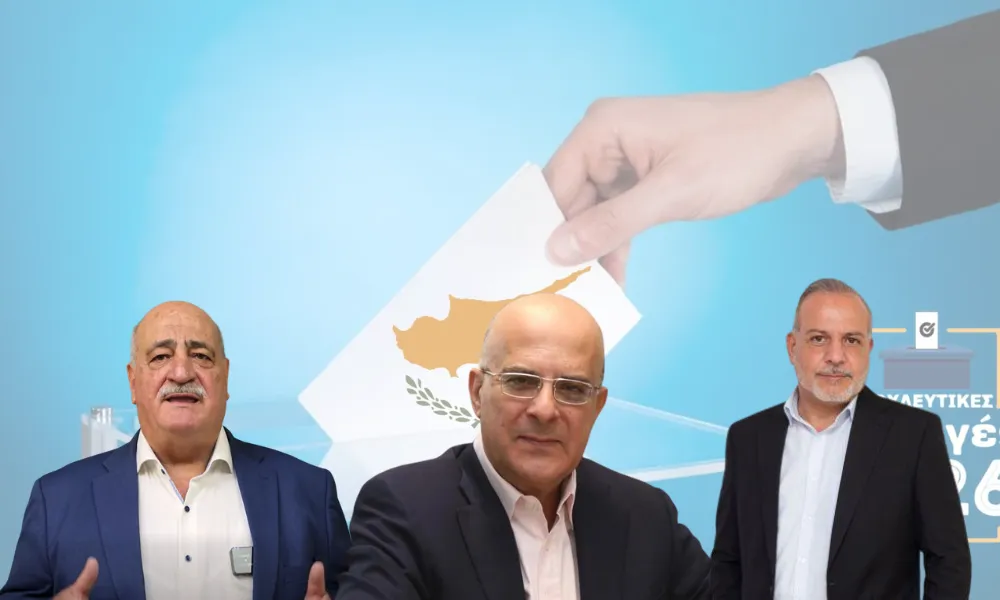

The three parties that failed to win seats in the new parliament are now heading towards internal leadership elections. EDEK and the Greens, formally the Movement of Ecologists – Citizens' Cooperation, are preparing for extraordinary party congresses in the autumn, while DIPA will hold its regular congress in December, when the term of its current leadership also expires. All three parties now face a serious existential challenge after losing both state funding and their status as parliamentary forces. Even so, each is searching for a path back into political relevance, and the 2028 presidential election is seen as a key milestone for their future. To remain politically active until the 2031 parliamentary elections, all three will need to be on the winning side in 2028, securing a role in the next government.
Combined, the three parties received a total of 31,056 votes in the recent election, a figure that matters given that Nikos Christodoulides was elected president in 2023 by a margin of 15,532 votes over Andreas Mavroyiannis. It is no coincidence that President Christodoulides has already been in contact with the leaders of all three parties since the election, nor would it be a surprise if officials from DIPA, the Greens and EDEK were appointed to semi-governmental organisations in July.
The three parties are likely to become an apple of discord among candidates for the 2028 presidential race, and Christodoulides is unlikely to overlook EDEK when he carries out a reshuffle. Agriculture Minister Maria Panayiotou has already accepted an appointment to secondary education from September, and if she is not replaced by an EDEK figure, the socialist party will find itself outside government altogether.
EDEK's shock
EDEK's election defeat on 24 May has shaken both party officials and voters, ending 56 years of unbroken parliamentary representation. Founded in 1969, the party first contested elections in 1970. In this election it won 3.3% and 12,099 votes, roughly half its result from 2021, when it took 24,024 votes and 6.72%.
Years of internal rivalries and an inward-looking culture are widely seen as having contributed to the defeat. A year before the election, EDEK president Marinos Sizopoulos resigned amid a corruption investigation, and the party went into the campaign with an interim leader and ongoing internal divisions. Last Sunday, the Central Committee met for an initial assessment of the result, with various views set to be consolidated and put to the body for approval at a further meeting scheduled for 28 June.
Two camps
The party's leader, Nicos Anastasiou, offered his resignation to the Central Committee, but it was not accepted, on the grounds that responsibility for the result was collective. The Central Committee's secretary general, Lefteris Georgiou, did resign. The committee ultimately decided to hold both a statutory congress and a leadership election congress. According to Politis information, two camps have emerged within the party. The first wants younger members to take over the leadership. The second, more cautious camp believes it is too early for younger figures to lead, and that more experienced officials should remain part of any new leadership team.
The election result itself suggested EDEK voters had already turned towards the party's youth wing, signalling a desire for renewal. The candidates who topped the preference vote in Nicosia, Famagusta and Kyrenia were all members of the youth wing. In Nicosia, 27-year-old youth wing president Sofia Christodoulou came first, in Famagusta youth wing secretary Andri Demetriou Steka topped the list, and in Kyrenia it was Marios Leonidou. In Nicosia, former youth wing president and party vice-president Pampos Christodoulou came third. If the camp favouring a younger leader prevails, the most likely candidates for the presidency would be either Pampos Christodoulou or Sofia Christodoulou.
According to Politis information, the current president will not seek re-election, while former Paphos MP Ilias Myrianthous is said to be interested in the post. Lefkara mayor Sofoklis Sofokleous could also put himself forward. However, a party source said the election result does not favour either Myrianthous or Sofokleous, noting a significant drop in support in Pano Lefkara and Paphos. Morfakis Solomonidis, who came fourth in the preference vote in Nicosia, also emerged from the election in a weaker position, in contrast to Marios Hannidis, who came second by a wide margin and emerged strengthened. Both men had been positioning themselves as potential leadership candidates in 2025, though it remains unclear whether either will now stand.
Presidential considerations
The party's congress is expected to take place in November and will combine organisational and ideological elements. A debate over EDEK's ideological positioning on the centre-left is expected, with several party figures arguing that the absorption of the Citizens' Alliance and Sizopoulos's positive stance towards the Anastasiades government pulled the party towards the right.
The more significant question for the congress, however, will be the party's political direction ahead of the presidential election. Before the vote, an estimated 60% of EDEK members supported participation in the Christodoulides government, a position also held by the youth wing, which now looks set to play a more prominent role. However, the election result may have shifted the balance of opinion within the party, and support for EDEK aligning instead with progressive forces such as AKEL may have grown.
DIPA's defeat
DIPA was founded in 2018 by former DIKO members and officials who had either been expelled or left the party, largely over disagreements with Nicolas Papadopoulos's decisions during that year's presidential election. Ahead of the 2021 parliamentary elections, it merged with the Cooperation of Democratic Forces, led by figures including Alecos Tryfonides, Marinos Mousiouttas, Angelos Votsis and Giorgos Prokopiou, and entered parliament with four MPs, winning 21,834 votes and 6.10%.
However, a serious dispute arose between the two merging groups after DIPA leader Marios Karoyian declined to give up a seat in Limassol to Angelos Votsis. The informal agreement underpinning the merger broke down, since the other three elected MPs belonged to the Cooperation of Democratic Forces, and DIPA officials put considerable pressure on Karoyian to retain the seat in order to maintain balance within the new grouping. Votsis eventually left and backed DIKO in this election, as did former Famagusta MP Michalis Yiakoumis.
In this election, DIPA won only 11,693 votes and 3.1%. The perception that a vote for the party would be wasted, given its low standing in opinion polls, and its exclusion from leaders' debates, are among the reasons cited for the defeat. The appointment of MP Marinos Mousiouttas as a minister shortly before the election, which removed a figure who could have significantly strengthened the party's list in Nicosia, is also seen as a contributing factor.
The defeat has left the party disappointed and looking for renewal. Party leader Marios Karoyian offered his resignation to the Political Bureau, which met recently for an initial assessment of the result. His resignation was not accepted, and the bureau instead decided to hold a Pancyprian Conference in July for a fuller assessment of the result and to decide on next steps.
According to Politis information, the Political Bureau has also decided to hold its regular leadership congress in December. Karoyian is expected to seek re-election as party president and faces no serious challenger. He remains the only figure in the party with broad acceptance across its different factions, and there are concerns the party could split if he were to step aside. As a result, the prevailing view within DIPA is that he should lead the party into the presidential election.
New faces
According to Politis information, the party's two vice-presidents, Marinos Kleanthous and Giorgos Lakkotrypis, will not seek to remain in the leadership. A new deputy leader position may be created, with former Nicosia MP Alecos Tryfonides expected to be a candidate for the role. The party is also expected to try to make use of its 56 election candidates as part of a broader effort to renew and reorganise itself, with some likely to be elected to leadership positions. Names already being mentioned include Despina Papadopoulou, who topped the preference vote in Larnaca, Giorgos Kouma, who came second there, Loizos Michael, who came fourth in Limassol, and Ari Hapeshian, who came third in Nicosia.
The role of the presidential palace
DIPA no longer has MPs in parliament but remains part of government through two ministers, Defence Minister Vasilis Palmas and Labour Minister Marinos Mousiouttas. After the election, party vice-president Marinos Kleanthous publicly complained about the conduct of figures close to President Christodoulides during the campaign, accusing them of favouring candidates from ELAM, DISY and DIKO with an eye on the 2028 presidential race.
According to Politis information, this view is not Kleanthous's alone but is shared by a number of party officials. A party source told Politis that relations between Karoyian and President Christodoulides are no longer what they once were, though this does not appear likely to lead to DIPA's ministers leaving government. Another party figure said continued support for the president cannot be taken for granted, but acknowledged that remaining in government is effectively the only viable option, since leaving would mean losing any remaining political role.
What is clear is that DIPA wants to play a significant role in the upcoming presidential election, and above all to be on the winning side, in order to secure the political space it needs to survive until the next parliamentary election.
The Greens
The Greens, formally the Movement of Ecologists – Citizens' Cooperation, are attempting to rebuild themselves after losing parliamentary representation for the first time in 25 years. The defeat in the 24 May election has created an existential crisis for the party, founded in 1996 to represent the political ecology movement in Cyprus, with a real risk that it could now collapse entirely. The Greens won 7,264 votes and 2%, roughly half their result from 2021, when they took 15,762 votes and 4.41%.
Last Sunday, the Central Committee approved a financial operating plan for the next five years, which includes reducing salaried staff from ten to two and closing the party's offices in every district except Nicosia. It also decided to hold an extraordinary leadership congress in October, after the party's leadership offered its resignation, and agreed to set up an ad hoc committee to draw up a strategic plan for the party's activities over the next five years, alongside a separate committee tasked with analysing the reasons for the defeat.
According to Politis information, the Central Committee acknowledged that the party's candidate lists had been strong, and that the defeat was instead due to organisational weaknesses, particularly the party's failure to build a presence in villages, which contributed to the loss of around 5,000 votes in Nicosia. The committee also recognised the damage done by years of internal divisions, including the departure of Alexandra Attalides, who had been elected as a Green MP in 2021, the resignation of party leader Charalambos Theopemptou, and the departures of figures such as Efi Xanthou and Natasa Ioannou.
Papadouris
According to Politis information, party leader Stavros Papadouris remains genuinely undecided about whether to seek re-election. "It will all depend on the strategic plan for the coming years," a party source familiar with his thinking said. The 2028 presidential election is seen as critical to the party's future, and some within the party believe its rules need to change.
One possibility is scrapping the requirement that any decision to back a presidential candidate needs the support of 60% of the Central Committee. This high threshold has repeatedly prevented the party from reaching decisions, with officials backing different candidates each time, weakening the party's negotiating position.
This time, the party cannot afford to stay outside any governing alliance, since participation in the next coalition would give it both a political role and the time it needs to recover before the following parliamentary election.
New leadership
The Greens are facing an ageing leadership, after founding members failed to bring through a new generation of officials. Renewal will only be possible if Article 61 of the party's statutes is activated, allowing allied candidates who stood on the party's lists to seek leadership positions.
Papadouris succeeded in building lists that included such allied figures, several of whom could now play a prominent role, including academic Andreas Theophanous, criminal lawyer Andreas Christou, Virginia Christou, Yiannos Economou, Valerios Danielidis and Zinonas Michaelides. These names look likely to form the core of the next leadership team around Papadouris, should he decide to seek the presidency again.