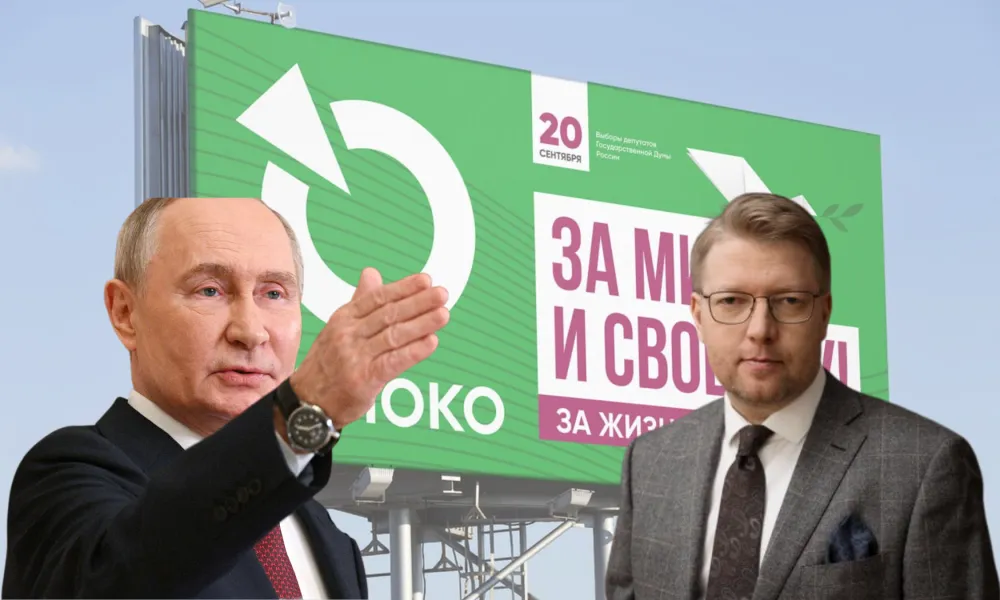

Yabloko leader Nikolai Rybakov says his party will continue pursuing political change inside Russia, despite mounting pressure from the authorities and a Supreme Court ruling preventing it from contesting September’s parliamentary election.
He argues that the decision reflects official concern that the party’s call to end the war in Ukraine is resonating with voters.
Supreme Court ruling under appeal
Russia’s Supreme Court ruled on Monday that Yabloko, a post-Soviet liberal party whose name means “apple” in Russian, could not take part in the September election.
Rybakov told Reuters that the authorities were concerned because the party’s appeal to end the war, now in its fifth year, reflected the expectations of many voters.
“For us, the support of the people that exists today, which is completely obvious and impossible to conceal, is far more important than the court’s decision,” he said during an interview at the party’s headquarters in Moscow.
Rybakov said hundreds of supporters chanted “Shame!” following the ruling, loudly enough to be heard inside the courtroom.
Yabloko has appealed against the Supreme Court’s decision. The ruling followed a lawsuit alleging, among other claims denied by the party, that it had received undeclared support from Western sources for its election campaign.
September’s parliamentary election
Yabloko holds only a small number of regional seats and has no representation in the State Duma, the lower house of Russia’s parliament, which is dominated by President Vladimir Putin’s United Russia party.
All 450 seats in the State Duma will be contested in September. United Russia is considered almost certain to retain its dominance, although Rybakov said Yabloko would have presented a stronger challenge than expected had it been allowed to stand.
Rybakov vows to remain in Russia
“I tell everyone that this is only the beginning, because many people have only now started paying attention,” Rybakov said.
A handwritten sign in his office read: “People, do not kill one another.”
“One of the things the authorities would very much like to see is for people to become disappointed and conclude that they are alone, that there is nobody around them who thinks as they do,” he added.
The 47-year-old opposition veteran said he had no intention of leaving Russia, despite strict censorship laws and other wartime legislation. The measures have prompted many opposition figures and activists either to flee the country or risk prosecution for expressing anti-war views and other forms of dissent.
“I am in Russia and I will remain in Russia,” said Rybakov, who wore a peace-dove pin on his lapel.
“The only way to change the situation in Russia, to change the political situation in Russia, is to be inside the country.”
Public attitudes towards the war
Public opposition to the war is difficult to measure because of strict state controls on dissent.
The proportion of Russians who said they supported the actions of the country’s armed forces in Ukraine fell to 66% in July, its lowest level since February 2022, according to the Levada Centre.
The independent polling organisation has been designated a “foreign agent” by the Russian authorities.
Rybakov said Yabloko’s short manifesto, which calls for peace and a prosperous, democratic Russia, had attracted many new supporters. He argued that this showed a significant section of Russian society wanted the war to end.
“You can exclude Yabloko from certain areas and use various methods of coercion against our members and leaders, but you cannot do anything about the millions of people who think as we do,” he said.
Source: APE-MPE