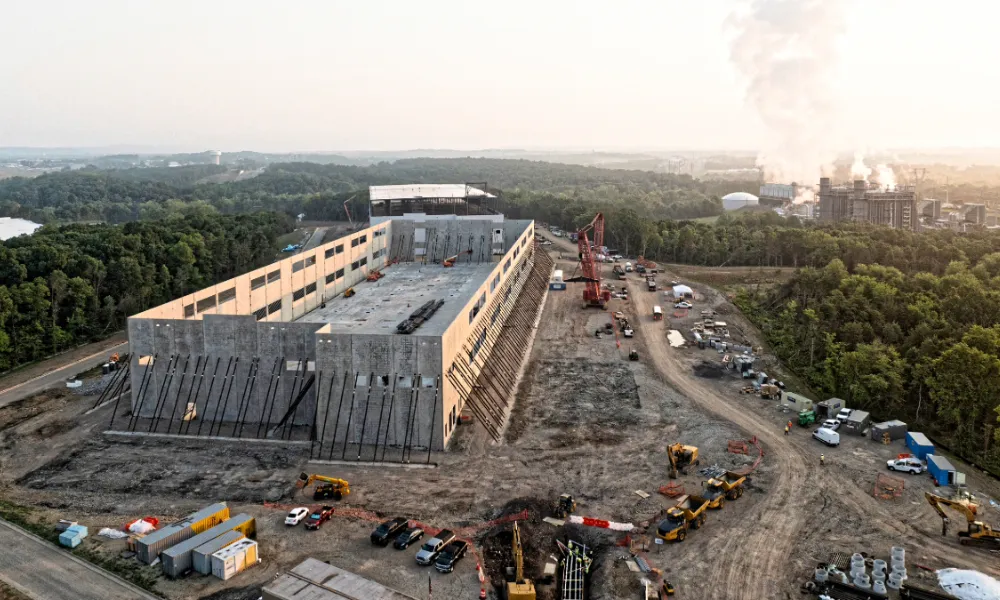

The rapid expansion of infrastructure supporting artificial intelligence is placing growing pressure on energy systems and natural resources, according to a new United Nations report.
Researchers say its environmental impact extends beyond carbon emissions, encompassing water consumption, land use, mineral extraction and electronic waste.
Community opposition grows in the US
Opposition is increasing in communities where data centres already operate or are being planned, particularly in the United States, which hosts many of the world’s facilities.
A Reuters poll conducted in June found that only one-third of Americans approved of the pace at which data centres were being built. Just 14% supported the construction of a facility near their neighbourhood.
A recent “National Day of Protest Against Data Centres” resulted in 142 demonstrations across 42 states.
More than 300 US cities, towns and counties have imposed bans or moratoriums on new data-centre developments.
During the first three months of 2026, 75 major projects worth more than $130 billion were delayed or cancelled, partly because of organised opposition from residents.
In July, the governor of New York signed an executive order establishing what was described as the country’s first moratorium on new hyperscale data centres. Pennsylvania, Michigan and South Carolina are among the states considering similar measures.
Carbon, water and land footprints
The UN report estimates that the world’s data centres supporting artificial intelligence could consume 945 terawatt-hours of electricity annually by 2030.
That is almost three times the combined annual electricity consumption of Pakistan, Bangladesh and Nigeria, which together have a population of more than 650 million.
Their water footprint could equal the basic annual domestic water needs of all 1.3 billion people in sub-Saharan Africa. Their land footprint could exceed 14,500 square kilometres, approximately twice the size of metropolitan Jakarta, which is home to more than 32 million people.
The findings are detailed in a report titled The Environmental Cost of AI’s Energy Use: Carbon, Water and Land Footprints, published by the United Nations University Institute for Water, Environment and Health.
Researchers have previously warned about the greenhouse gas emissions generated by data centres. The new report argues, however, that the environmental cost of artificial intelligence cannot be understood through carbon emissions alone.
It examines the carbon, water and land footprints associated with electricity used by AI systems and identifies substantial differences among the world’s 20 largest data-centre hubs.
“This report is not an argument against artificial intelligence, a technological transformation that is improving the lives of billions of people around the world,” said Professor Kaveh Madani, director of the institute and leader of the research team.
“It is a call for responsible use and for its impacts to be addressed proactively, so that it can become sustainable and equitable. We have a narrow window to ensure that the backbone of the technological revolution of our time develops within planetary boundaries, and that the communities supplying the critical minerals that drive AI, as well as those hosting its infrastructure and electronic waste, are among those who benefit.”
Environmental costs extend beyond emissions
Every unit of electricity consumed by a data centre also carries a water footprint through cooling and power generation, as well as a land footprint connected to energy production and supply chains, the report notes.
It identifies a significant gap in the way AI’s environmental impact is currently measured. Greenhouse gas emissions, particularly those associated with training large models, tend to receive the greatest attention, leaving other environmental pressures largely overlooked.
Solutions considered environmentally friendly in one area may increase pressure elsewhere, especially in regions already facing resource shortages. Some renewable energy sources, for example, may reduce carbon emissions while significantly increasing water consumption or land use.
Everyday use drives most energy demand
Public discussion has largely focused on the energy required to train advanced AI models. The study, however, estimates that everyday use accounts for between 80% and 90% of total energy demand.
One widely used AI service is estimated to process approximately 2.5 billion messages a day, consuming hundreds of gigawatt-hours of electricity each year.
Energy consumption also varies considerably according to the task performed. Generating a single AI image can require more than 1,000 times the energy needed for basic text classification, while video generation demands even greater resources.
The researchers warn that efficiency improvements alone are unlikely to offset rising demand. They point to the “rebound effect”, in which lower costs and improved performance encourage greater use, ultimately increasing overall resource consumption.
Environmental pressures vary by location
The environmental effects of AI infrastructure are not distributed evenly. While the benefits of the technology are global, the report says its costs are often concentrated in specific communities.
In some countries, data centres already account for a significant share of national electricity consumption, placing pressure on energy systems. Elsewhere, expanding facilities are drawing heavily on water supplies, sometimes in areas experiencing drought.
The report also warns of a growing electronic-waste problem. AI infrastructure could generate as much as 2.5 million tonnes of electronic waste annually by 2030, with much of the burden likely to fall on lower-income countries that have limited capacity for its safe disposal.
The production of critical minerals required for AI hardware also raises concerns about environmental degradation and social inequality in mining regions.
AI capacity is concentrated in two countries
More than 90% of specialised AI computing capacity is concentrated in the United States and China, while over 150 countries have no significant domestic AI infrastructure.
According to the report, this imbalance limits economic opportunities and raises questions of environmental justice, as some countries bear the environmental costs without sharing in the benefits of AI-driven development.
Recommendations for responsible AI
The researchers stress that their findings do not constitute an argument against artificial intelligence. Instead, they call for urgent measures to ensure that the technology develops within the planet’s environmental limits.
The study proposes a “responsible AI ecosystem” based on transparency, efficiency by design, equality, life-cycle responsibility, global cooperation and sustainable use.
Governments are urged to incorporate AI infrastructure into energy, water and land-use planning. Companies are encouraged to design systems that minimise resource consumption, while users can contribute by choosing lower-impact applications where possible.
The report concludes that the future of artificial intelligence will depend not only on technological innovation, but also on the governance decisions being made today.
Source: CNA