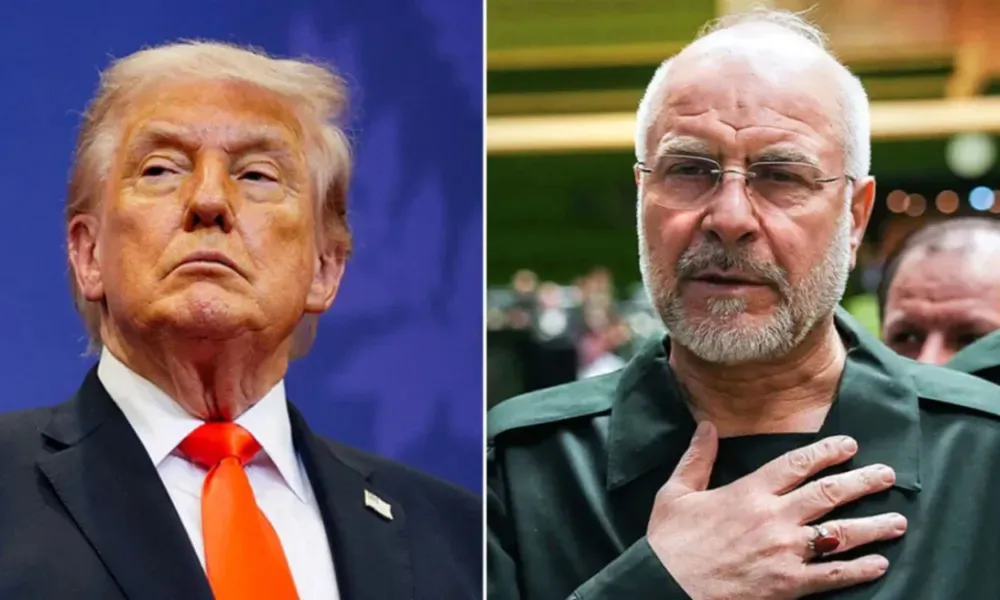

US President Donald Trump said on Monday that negotiations with Iran were taking place "right now", despite an earlier categorical denial from Iranian diplomats.
Mr Trump added that the alleged talks represented what he described as Iran's "last chance" to secure a favourable agreement.
Speaking to reporters at the White House, the Republican president insisted that discussions were being held "at Iran's request" and with the support of Saudi Arabia, the United Arab Emirates and Qatar.
"This is the last chance the Iranians have to sign a good document," he said.
According to Mr Trump, the talks concern the reopening of the Strait of Hormuz, potentially as early as "tomorrow".
Earlier in the day, writing on his Truth Social platform, Mr Trump criticised what he called the "unbelievable duplicity" of Iran's leaders, without specifying whom he meant.
"They ask for a meeting, some would say they are begging, talks begin, others are planned for the near future, and then they publicly and proudly say they are having no discussions," he wrote.
Last week, Mr Trump threatened to order a major strike against the Islamic Republic before reversing course and announcing that planned large-scale bombing operations, prepared in coordination with Israel, had been postponed.
The shift is consistent with a pattern in which the US president frequently moves between threats and announcements of negotiations.
Tehran rejects Trump's claims
Iran's response came during the Foreign Ministry's weekly briefing for accredited journalists.
"We are not negotiating with the United States at this time. We are negotiating with Oman in order to guarantee safe passage through the Strait of Hormuz," Foreign Ministry spokesman Esmaeil Baghaei said.
The spokesman had already indicated the previous day that a deal with Oman could soon be reached to reopen the strategically important maritime corridor for global hydrocarbon trade.
The strait was effectively closed again by Tehran after a preliminary agreement with Washington, referred to as the Islamabad Memorandum of Understanding, collapsed following the resumption of hostilities in early July.
Iran, which has said it does not want a return to the pre-war status quo, currently requires vessels transiting the Strait of Hormuz to follow a route running close to its coastline, thereby maintaining control over the waterway.
Oman, which angered Tehran by establishing a new shipping route in June, has not publicly confirmed or denied the negotiations.
Speaking to Iranian state television on Sunday, Mr Baghaei said:
"We are at a point where we can reach an agreement on a route acceptable to both sides, neither the northern route nor the southern route, while respecting the sovereign rights of each country and safeguarding our national interests and security."
Oil markets and security concerns
At around 3.30am Cyprus time, US crude WTI was up 0.49% at $80.73 per barrel, while Brent crude rose 0.60% to $82.47 per barrel.
The modest gains followed a sharper fall the previous day amid hopes that negotiations between Washington and Tehran might take place.
Brent crude had climbed above $100 per barrel in late July.
Meanwhile, tensions in the Strait of Hormuz remain high.
The UK's Maritime Trade Operations (UKMTO) service, which operates under the Ministry of Defence, reported overnight that a merchant vessel had been struck by an "unknown" projectile while transiting the strait.
No injuries or damage were reported.
US pressure on Iran
Mr Trump has made a rapid agreement with Iran, particularly concerning the strait, a condition for suspending US bombing operations.
On Monday he stated that the waterway was under the "full control" of the US Navy and added that the American blockade of Iranian ports in the Gulf would not be lifted except in the event of an agreement or Iran's "complete surrender".
The conflict in the Middle East, which began on 28 February with a US-Israeli attack on Iran, paused in April before hostilities resumed in early July.
According to US media reports, Washington had prepared plans for large-scale strikes against Iran over the weekend, including attacks on energy infrastructure such as refineries and power stations.
Announcing his decision not to proceed, Mr Trump said he had acted following requests from "countries in the region" and because a framework for an agreement existed.
He referred to requests from Saudi Arabia, the UAE, Qatar and Iran itself.
Tehran denied making any such request, describing the claim as "another lie" by the US president.
Conflict expands to the Red Sea
In recent days the conflict has expanded into a new theatre in the Red Sea.
The Iran-aligned Ansar Allah movement, better known in the West as the Houthis, first announced a blockade of Saudi Arabian ports and subsequently claimed attacks against oil tankers and ports belonging to the world's largest crude oil exporter.
Source: CNA