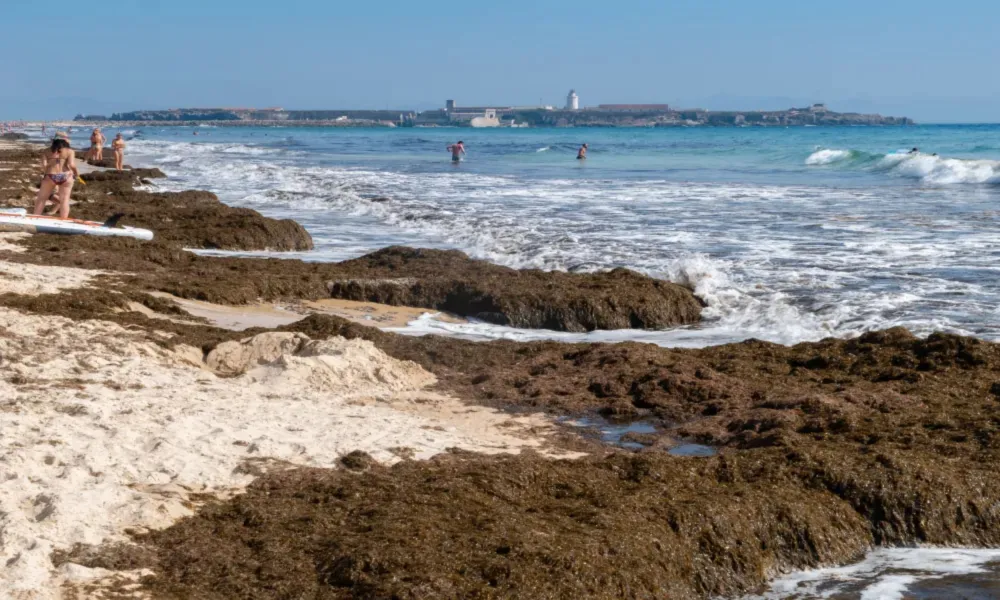

The invasive seaweed Rugulopteryx okamurae, commonly known as Asian seaweed, has spread across virtually the entire Spanish coastline in just over a decade, with the Balearic Islands the only region where its presence has not yet been officially recorded, according to a report by Spanish news agency EFE.
The species has nevertheless been detected among remains of Posidonia seagrass, according to Spain's Ministry for Ecological Transition, which is calling for cooperation among Spain's autonomous regions to contain a species that, for the time being, is considered impossible to eradicate.
Native to the Asian coasts of the North Pacific, the seaweed was added to Spain's Catalogue of Invasive Alien Species in 2022.
It was first identified in Spanish waters in the Strait of Gibraltar in 2015 and has since spread to every coastal autonomous community and autonomous city except the Balearic Islands.
The species has been present in the Cantabrian Sea since at least 2023, when it was detected near major ports such as Bilbao and Santander.
Experts believe the seaweed, first identified in Europe in 2002, reached European shores through ships' ballast water.
Eradication considered impossible
From May and June onwards, the life cycle of Rugulopteryx okamurae results in a massive increase in reproductive organisms and fragments that accumulate on beaches, in ports and along coastal areas.
According to experts, this coincides with the peak fishing and tourism season and creates significant problems for local economies and coastal communities.
Spanish authorities say current scientific knowledge does not offer a viable method for the widespread eradication of the species.
As a result, efforts are now focused on cooperation between different levels of government to limit its spread and minimise its environmental, social and economic consequences.
Among the measures being promoted by the central government are a national strategy for managing the invasion and the development of guidance to help regional authorities prepare Biomass Management Plans.
Biomass management plan approvals remain limited
The management strategy stipulates that the use or commercial exploitation of Rugulopteryx okamurae biomass may only be authorised after it has been removed from beaches or coastlines under an approved Biomass Management Plan.
The Ministry for Ecological Transition notes that responsibility for preparing and approving such plans lies exclusively with Spain's autonomous communities.
Consequently, where a region does not have an approved plan in place, the ministry cannot authorise projects involving the use or exploitation of biomass from the invasive seaweed, although it may approve research projects.
So far, only Andalusia, Galicia and Melilla have approved such plans.
The regional government of Cantabria recently announced its intention to examine legal avenues to recover the cost of removing Asian seaweed from its beaches.
According to regional authorities, 7,000 tonnes of the invasive seaweed were removed from Cantabrian beaches last year alone.
Source: CNA