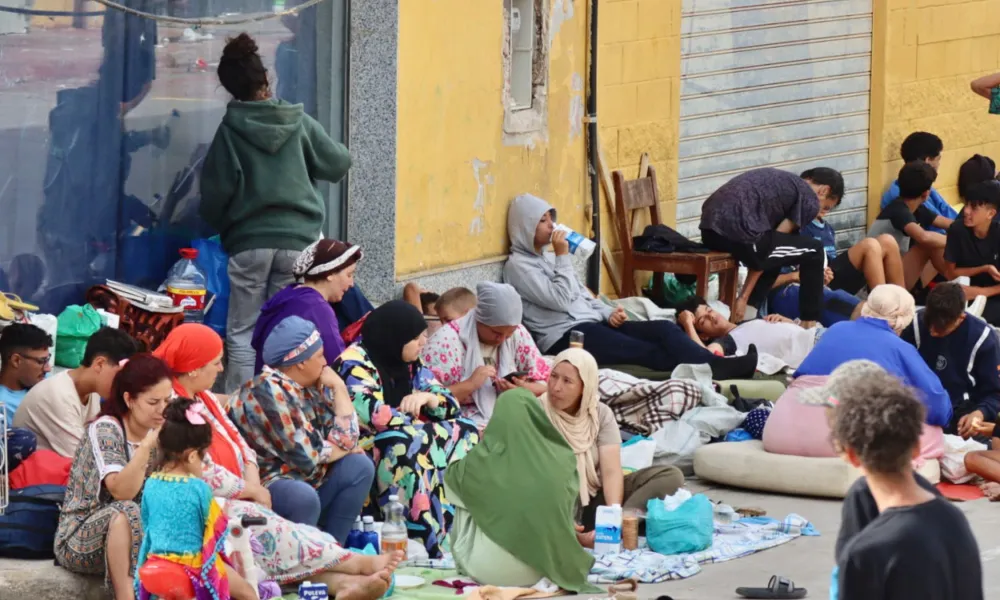

European Commission President Ursula von der Leyen has called for stronger protection of the EU's external borders and coordinated action to address migration pressures following the arrival of tens of thousands of migrants from Morocco into the Spanish enclave of Ceuta.
According to a BBC report, Spain estimates that around 69,500 migrants have returned to Morocco, a figure significantly higher than initial estimates of approximately 50,000 people.
The official death toll stands at 72 fatalities on the Spanish side of the border and 11 on the Moroccan side.
EU interior ministers are due to hold an emergency videoconference on Tuesday to assess the situation and its wider implications.
Images from Ceuta have reignited tensions among some of the EU's 27 member states, bringing questions over external border protection, the functioning of the Schengen Area and the distribution of responsibilities in migration policy back into focus.
In a letter to Spanish Prime Minister Pedro Sanchez, Ms von der Leyen reportedly praised the speed with which the Spanish government responded to the crisis.
At the same time, she said the episode demonstrated the need for stronger border protection at critical points.
The Commission president stressed that safeguarding the EU's external borders is a shared European responsibility and called for closer monitoring of developments and the use of physical barriers where deemed necessary.
Schengen dispute
Following the mass crossings into Ceuta, Italy moved to temporarily suspend the application of Schengen arrangements with Spain.
The decision was supported by Finland and Denmark, while Czech Prime Minister Andrej Babis called for the temporary suspension of Spain's participation in the Schengen Area.
The Schengen Agreement abolishes systematic checks at internal borders and currently covers more than 450 million people across 29 European countries.
Mr Sanchez responded by saying he viewed the stance adopted by some European governments with serious concern, stressing that Ceuta is not part of the Schengen Area.
According to the BBC, the Spanish prime minister said that while the majority of European governments had demonstrated solidarity and support, others had chosen to attack Spain, driven, in his view, by prejudice, misinformation, ignorance or political expediency.
Commission's five priorities
The emergency meeting of EU interior ministers is expected to provide an opportunity to draw lessons from events in Ceuta.
Ms von der Leyen warned that challenges related to irregular migration require a common European response, unity and solidarity.
According to the BBC, she outlined five key priorities:
- Preventing irregular migration through closer cooperation with third countries.
- Strengthening the EU's external borders.
- Implementing early warning systems.
- Dismantling human-trafficking networks.
- Improving the return of individuals who do not qualify for international protection.
Mr Sanchez accused smuggling networks of exploiting a recent ruling by Spain's Supreme Court, which limited the government's ability to immediately deport people arriving in the country by sea.
Spanish Interior Minister Fernando Grande-Marlaska said on Saturday that the situation had largely stabilised.
He added that Spanish authorities are examining the possibility of installing a floating inflatable barrier to prevent irregular sea crossings along the maritime border.