
The EU's High Representative for Foreign Affairs and Commission Vice-President, Kaja Kallas, has signalled tougher sanctions on entities supporting Russia's military-industrial complex, following a fierce new wave of Russian strikes on Ukraine.
Russia's defence ministry said it had struck "key military plants" overnight in Kyiv as part of what it described as a "massive strike using long-range precision air, land, and sea-based weapons and attack drones."
Kyiv Mayor Vitali Klitschko said the death toll had reached 17, with more than 100 injured, describing it as the largest attack Russia has ever carried out on the city. The toll rose steadily throughout the day: earlier tallies from Kyiv's military administration put the number of dead at three, then eight, then 10, before climbing further as rescue teams continued working through damaged buildings. AFP journalists in the central and eastern districts of Kyiv reported hearing more than a dozen explosions overnight, while Zelensky had warned hours earlier of an impending "massive" Russian attack.
Russia's strikes involved 496 drones and 74 missiles, while Russia said it had shot down 327 Ukrainian drones and that a refinery had been hit. Russia's defence ministry said the strikes hit military and energy facilities, as well as airports in Kyiv and other locations, and described the attack as retaliation for Ukrainian strikes on Russian civilian infrastructure.
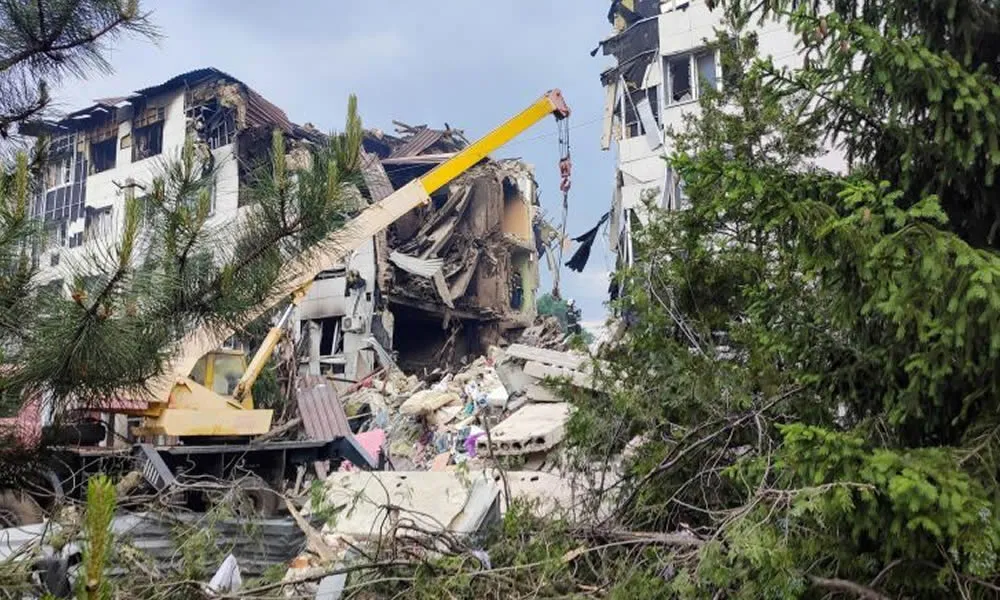
Damage was recorded at 30 locations across the city, mainly residential buildings and civilian infrastructure, said Tymur Tkachenko, head of the Kyiv City Military Administration. Tkachenko said the attack partially destroyed a residential building in the Desnianskyi district, sparked fires near residential buildings in the Pecherskyi district, and ignited a fire near an administrative building in the Solomianskyi district, with further damage recorded in the Obolonskyi and Podilskyi districts. In the Desnianskyi district, a nine-storey residential building partially collapsed, leaving people trapped inside, while in the Holosiivskyi district the roof of a multi-storey residential building caught fire. Interior Minister Ihor Klymenko said 20 residential buildings across the city had been damaged. The State Emergency Service said it had deployed almost 500 personnel and 100 specialist vehicles, including a helicopter, to deal with the aftermath of the attack.
The attack prompted a regional response beyond Ukraine's borders. Poland scrambled fighter jets in response to the attack, saying its ground-based air defence systems and radar reconnaissance had reached a state of readiness, while Finland temporarily imposed an aviation restriction zone in the eastern Gulf of Finland before lifting it shortly afterward. Zelensky had earlier warned of a possible overnight attack and cut short a visit to Dublin marking the start of Ireland's six-month term holding the rotating presidency of the EU Council. He called on the United States for approval to build Patriot air defence missiles. "Air defence supplies for Ukraine are an absolute priority. We are also relying heavily on a decision by the United States regarding licences for the Patriots," Zelensky said in a post on Facebook.
Ukrainian Foreign Minister Andrii Sybiha called on Ukraine's allies to strengthen the country's air defences after what he described as a "night of terror" in Kyiv, urging partners not to delay decisions on supplying air defence systems and missiles.
Sources: ERT, AP, Reuters, Al Jazeera, CNBC