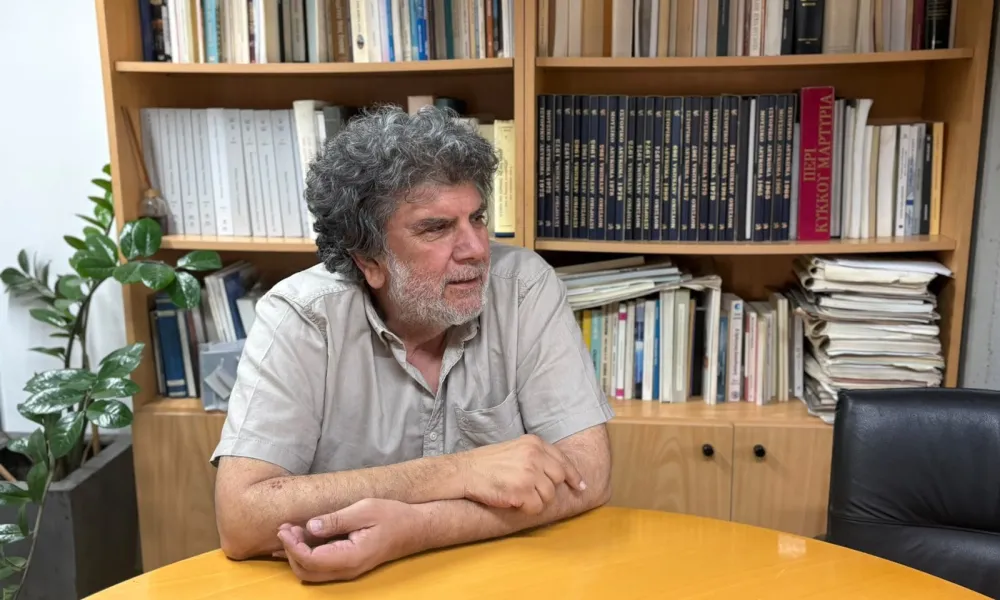

Politis newspaper director Dionysis Dionysiou has given his account of the widely discussed lunch attended by, among others, former DISY president Averof Neofytou and party leader Annita Demetriou, rejecting suggestions of behind-the-scenes intervention or political dealings.
Speaking on Politis radio 107.6 and 97.6 on the programme Second Look with Andrie Daniel, Dionysiou described the lunch as a friendly meeting involving an open discussion between people who have known and spoken with one another for years.
“It was a friendly meeting and I am surprised that my friend Averof decided to make a lunch meeting public and give it these metaphysical dimensions,” he said.
‘I will not give up my right to talk’
Dionysiou said meetings between journalists, publishers and politicians were part of journalistic work and insisted he would not give up his right to speak with political figures.
“I do not accept that I, after 40 years in journalism, as a reporter, editor-in-chief and newspaper director, do not have the right, just as publisher Chris Panayiotou does in this case, and Yiannis Papadopoulos did before him, to meet political leaders, discuss, exchange views and, why not, go and eat some fish or kleftiko,” he said.
Referring humorously to images circulated on social media, he added that “there was no lobster on the menu”.
Dionysiou maintained that speaking with politicians does not mean imposing views or attempting to determine political decisions.
“I will not give up my right to talk. I have every right to talk. I do not talk in order to impose something,” he said.
He added that it was entirely normal for politicians to seek the opinions of journalists with many years of experience.
Politicians, technocrats and state officials, he said, are not only people journalists speak with but also sources of information, meaning “you also have a duty to talk to these people”.
Dionysiou stressed that the lunch took place publicly, at a fish restaurant, and was not a secret meeting.
“Various views were expressed as part of a free discussion, and I did not avoid expressing my own position,” he said.
‘What was the transaction?’
Dionysiou also addressed claims surrounding whether Neofytou had been asked to help Demetriou.
According to Dionysiou, the fact that such a discussion took place did not in itself constitute political collusion or a transaction.
“Averof says he was asked to help Annita. But that is true. He admitted it himself. Of course he was asked whether there was a possibility that he would help and he replied that it was his obligation. It was not the subject of any collusion or any transaction,” he said.
Dionysiou questioned why the particular meeting had assumed such significance, adding that similar meetings between journalists, publishers and politicians take place frequently without becoming public.
Dionysiou rejects ‘extra-institutional’ label
Addressing references to “extra-institutional” actors, Dionysiou cited previous discussions with political figures.
“When we were talking with Harris Georgiades when he was finance minister, were we extra-institutional actors? Did we determine his policy on the Co-op or the other political decisions he made because a free discussion took place?” he asked.
He also criticised some of the discussion on social media.
“I will not enter into the logic of social media, where everyone came along and started saying whatever they wanted without basically knowing what the job of a journalist is and, above all, what the job of a newspaper director and publisher is,” he said.
Dionysiou refers to 2023 election
Dionysiou also addressed Neofytou’s recent statements, saying he understood the bitterness the former DISY leader may still feel following the 2023 presidential election.
“I understand the bitterness Averof Neofytou has felt since 2023. But allow me to remind my dear friend of something. In 2023, it was neither Annita, nor Hadjipantela, nor Pamboridis who undermined him. He named some other people,” Dionysiou said.
According to Dionysiou, the approach Neofytou has now chosen also affects people who had supported him.
He attributed some of the tension to Neofytou’s emotional state and expressed the view that the former DISY president would reconsider some of his statements.
“I hope these things do not leave bitterness in his relationships with journalists and his political friends, because it would be a shame after such a long political career. I believe that what he did, personally, was a mistake,” he said.
Warning over three-way DISY split
Turning to the internal balance within DISY, Dionysiou said the party could find itself in a difficult position if the current situation persists.
“Even the poll conducted by Averof himself appears to show a three-way split between Nicos Christodoulides, himself and Annita. Therefore, the balance is delicate,” he said.
In Dionysiou’s assessment, two candidacies emerging from the broader DISY political space could lead some voters to shift towards President Nicos Christodoulides.
‘We have moved away from political discussion’
Dionysiou also questioned the extent of coverage the lunch had received in news bulletins, arguing that public debate had moved away from substantive political issues.
“As a journalist, I could start from the era of Glafcos Clerides and George Vassiliou. We could discuss the conversations that took place with Glafcos Clerides, Tassos Papadopoulos and Demetris Christofias. These things happen. It does not mean that you impose an opinion,” he said.
‘Let’s leave the fish restaurants behind’
In the final part of his intervention, Dionysiou turned to the Cyprus issue, arguing that it is frequently used as a tool for political positioning.
He said the President of the Republic promotes an image of movement on the Cyprus issue, which helps him project a message of moderation and differentiation from ELAM.
According to Dionysiou, Neofytou has adopted a similar approach recently by presenting himself as a politician capable of managing the Cyprus issue.
Dionysiou concluded that, in his own assessment, there has been no substantive development on the Cyprus issue and that public discussion should return to genuine political questions.