


Citizens appear broadly satisfied with the election result, yet do not believe the new parliament will be able to bring about substantial change. Beyond the ballot box, the winners are the president of DISY, in terms of communication, and AKEL general secretary Stefanos Stefanou, in terms of trust.
Expectations
Society appears to accept the verdict of the ballot box, while at the same time maintaining low expectations for the effectiveness of the political system. This is an attitude that points more towards cool headed waiting than political enthusiasm.
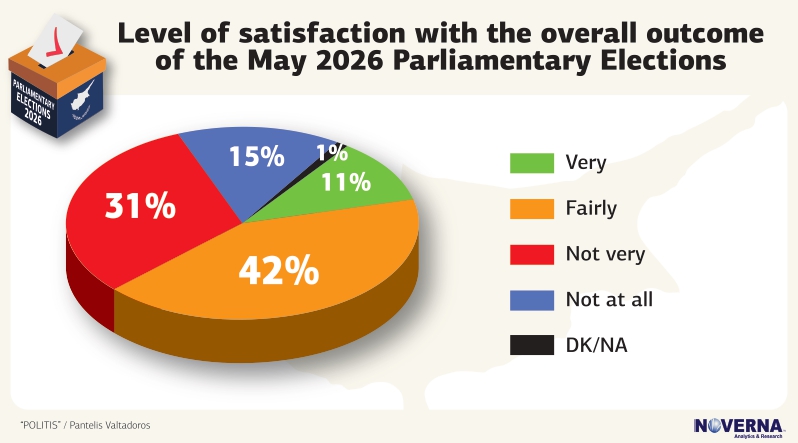
The first key finding is that the new parliament starts out with marginally positive political capital. Of those surveyed, 53% say they are "very" or "fairly" satisfied with the overall election result, against 46% who say they are "not particularly" or "not at all" satisfied.
These figures do not amount to triumphant acceptance, nor do they represent a rejection of the result. Instead, they reflect a society that views the ballot box as having produced a broadly acceptable balance of power.
The breakdown of satisfaction by party is particularly interesting. DISY voters appear the most satisfied with the result, with high satisfaction also recorded among ELAM and DIKO voters. By contrast, ALMA voters appear notably more reserved, a finding that may reflect the gap between pre-election expectations and the final result.
Voter loyalty
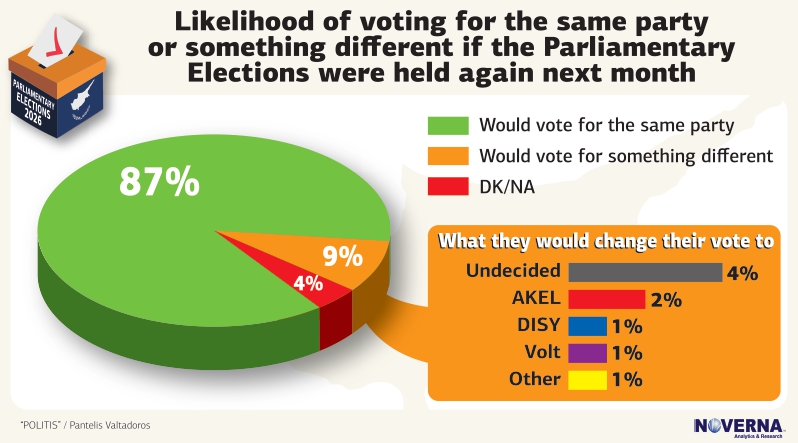
An even more striking finding concerns the stability of the vote. Of those surveyed, 87% say that if the election were held again next month, they would vote for the same party. Just 9% say they would choose differently, with the remainder not responding. This suggests the election did not leave behind strong feelings of regret or disappointment. On the contrary, most voters appear to feel that their choice was vindicated, or at least not contradicted, by the final result, a finding that points to a new party landscape with more stability than many analysts had predicted before the vote.
A more conservative parliament
The clearest political message from the poll concerns how citizens read the ideological direction of the result. More than one in two citizens, 56%, believe the composition of the new parliament is more conservative, while just 30% describe it as more progressive. In Cyprus, these terms tend to map more closely onto a left right divide than onto any more complex political or ideological classification.
This perception cuts across the electorate almost evenly and is not confined to voters of the left. Even among voters of centrist parties, there is a sense that the new parliament has shifted towards more conservative political and social positions.
This finding is clearly linked to the strengthening of right wing and nationalist right wing parties, as well as to the broader picture that emerged following the entry of new political forces into parliament.
New faces in parliament
If there is one point on which citizens appear optimistic, it concerns the renewal of political personnel. Of those surveyed, 63% believe the new parliament will have adequate representation of younger people, the only finding among all the questions asked that is purely positive.
Beyond that, the picture changes considerably. Just 43% believe the new parliament can change things for the better, while 46% disagree. The picture is similar on the question of social sensitivity, where positive and negative responses are essentially balanced.
The assessment is even more negative when it comes to the effectiveness of the new parliament. Only 34% believe it will be effective, against 46% who hold the opposite view. The message is clear: citizens recognise that a different composition has emerged, but are not convinced that this difference will translate into better governance.
Stefanou gains in trust
At the level of party leaders, one notable finding concerns AKEL's general secretary. Stefanos Stefanou is the only party leader to record a clearly positive trust balance following the election period. Of those surveyed, 20% say they consider him more trustworthy than before the election, against 12% who consider him less trustworthy.
Annita Demetriou, despite dominating the communication battle during the pre-election period, shows a slightly negative shift in trust. Nicolas Papadopoulos, Christos Christou and Odysseas Michaelides also recorded negative figures.
The biggest loser
The heaviest political blow appears to have been dealt to Fidias Panayiotou. According to the poll, 50% of citizens say the pre-election period made them trust him less, while just 11% say the opposite. This is the worst result among all party leaders, suggesting the election campaign worked to undermine rather than strengthen his public image.
Annita wins the communication battle
Despite the differences in trust, the picture changes when citizens are asked who communicated their message most effectively. Annita Demetriou comes first with 39%, followed by Stefanos Stefanou with 33%. The remaining party leaders trail considerably further behind, with Christos Christou, Fidias Panayiotou, Nicolas Papadopoulos and Odysseas Michaelides recording markedly lower scores.
This finding suggests the pre-election contest had two main protagonists. The DISY president appears to have won the communication battle, while AKEL's general secretary emerges as the politician who gained the most personal political capital.
The political message
The Noverna poll for Politis records a society that accepts the election result, considers the new parliament to have a clearly more conservative orientation, and recognises that new faces have entered the political scene.
At the same time, however, citizens remain cautious about the new parliament's ability to bring about substantial change or to function more effectively than its predecessor.
In essence, this is a message of patience directed at the political system: society has accepted the verdict of the ballot box, but has not yet been convinced that the new composition of parliament can meet its expectations. Citizens are giving the new parliament time, but not a blank cheque.
Survey details
Conducted by: Noverna Analytics & Research, a member of SEDEAK and ESOMAR, on behalf of Politis newspaper
Sample and methodology: 805 interviews with a representative sample of the population in the areas under government control, using random sampling
Interview method: structured questionnaire via CATI (Computer Assisted Telephone Interviewing)
Weighting: the sample was weighted according to the demographic profile of the electorate
Maximum margin of error: +/- 2.9% at a 95% confidence level
Fieldwork dates: 30 May to 10 June 2026