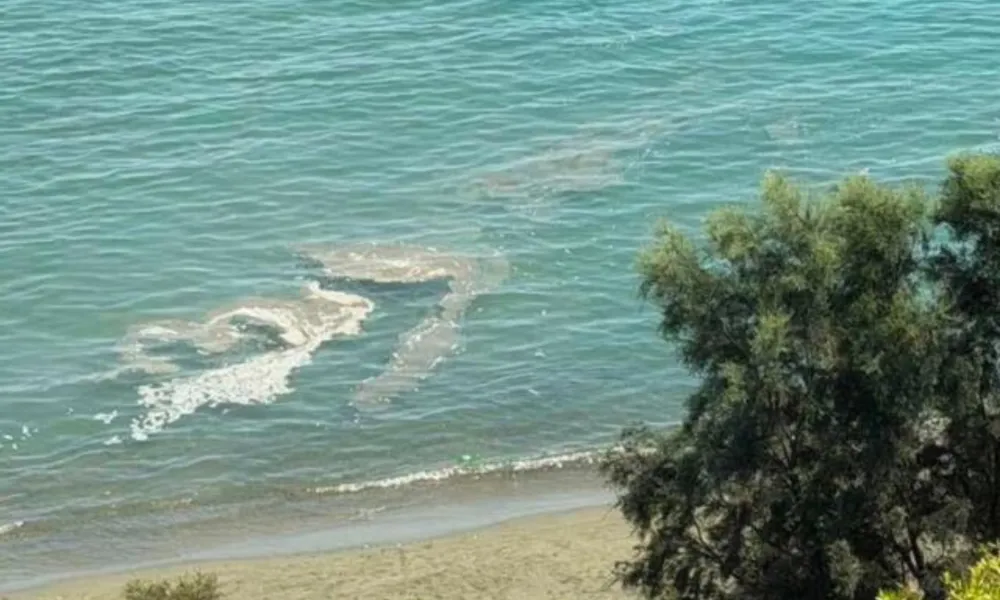

Questions over the effectiveness of Cyprus's response to marine pollution in Limassol came under renewed scrutiny in Parliament, where officials acknowledged shortcomings in the monitoring of drainage systems and discussed ongoing efforts to identify pollution sources affecting the coastal area.
The discussion before the House Environment Committee focused on multiple potential sources of pollution, including drainage pipelines linked to construction projects, wastewater management infrastructure and maritime activities. Concerns were also raised about the level of inspections being carried out and the coordination between responsible authorities.
Concerns over drainage pipeline monitoring
During the meeting, Environment Department Acting Director Elena Stylianopoulou said authorities had identified breaches relating to a drainage pipeline near Dasoudi and imposed penalties.
According to the department, water and sediment were discharged into the sea from an incomplete pipeline rather than at the approved offshore depth of 40 metres specified under its permit conditions.
Stylianopoulou also acknowledged that companies operating such systems largely conduct their own monitoring and are expected to inform the Environment Department if pollution incidents occur.
Lawmakers noted that similar concerns had been raised when the issue was discussed by the committee in November 2025.
Eight construction drainage systems licensed
An Environment Department official said eight high-rise developments in Limassol had received authorisation to operate drainage systems during construction.
The official stated that most projects have been completed, with only a small number of pipelines still in operation, including the Dasoudi case.
The department said it plans to proceed with the mapping of drainage pipelines across the district as part of broader monitoring efforts.
Fine imposed after wastewater incident
Stylianopoulou said a fine was issued after an operational failure at the Limassol District Local Government Organisation's wastewater treatment facility in Moni on 5 August.
EOA Limassol President Yiannis Tsioulouftas said the incident was caused by an electrical fault and resulted in discharges for approximately two hours.
He said measures have since been introduced, including diverting part of the wastewater stream to another facility and storing treated water in a dedicated tank if operational problems arise.
Academic highlights multiple pollution sources
Frederick University professor Angelos Menelaou, who advises the Shipping Deputy Ministry on marine pollution issues, said Limassol faces pressures from a range of activities concentrated along its coastline.
He identified four broad categories of potential pollution sources:
- Land-based discharges, including drainage pipelines.
- Marine infrastructure, such as desalination plants and fish farms.
- Commercial vessels.
- Leisure and coastal vessels operating from marinas.
Menelaou stressed the need for comprehensive mapping and monitoring of drainage infrastructure and environmental impacts before new developments are approved.
Five emergency vessel inspections conducted
A representative of the Shipping Deputy Ministry said Cyprus has approximately 230 coastal vessels, all of which undergo annual inspections for safety certification.
According to information presented to the committee, authorities conducted five emergency inspections this year across ten different locations during May and June, alongside routine inspections covering the wider fleet.
The representative said no violations were identified during this year's emergency checks, although one violation had been detected during inspections carried out in the previous year.
Mayor cites concerns over enforcement
Limassol Mayor Yiannis Armeftis criticised what he described as overlapping responsibilities among authorities dealing with marine pollution.
He called for the creation of a specialised response unit to investigate illegal marine discharges and claimed that unlawful dumping from coastal vessels is widely suspected within the district.
New coordination body expected in October
The Shipping Deputy Ministry said a new Marine Pollution Supervision and Coordination Group is expected to become operational in October with executive responsibilities for coordinating pollution response efforts nationwide.
Authorities also outlined a broader action plan for 2026-2027 that includes:
- Mapping discharge points and coastal outflows.
- Expanded inspections of ports, marinas and vessels.
- Increased use of data-sharing systems.
- Targeted compliance checks for coastal industries.
- Improved inter-agency coordination.
Technology-based monitoring proposed
Among the measures under consideration are the deployment of drones, cameras and environmental sensors to detect pollution incidents more quickly and help identify potential sources.
The proposals also include enhanced data collection, monitoring systems and cooperation between public authorities, local government and private-sector stakeholders.