
In May 1993, Takis Agathokleous, a nurse who worked at the hospital at the time of the bombing, returned to the area with colleagues and planted eleven cypress trees, believed to correspond to the number of victims buried in a crater at the site.
"Some of them were found with shards of glass embedded in their bodies. One was holding in his folded arm an ampoule of medication marked Serenace. We found up to 30 such ampoules. We found them exactly as witnesses had described them, the bodies wrapped in blankets and sheets. One female patient's dress, which was red, had not deteriorated at all because it was made of nylon."
The striking description comes from archaeologist Michalis Iacovides, one of those who carried out the exhumations at Athalassa Hospital, which began in November 2017 and lasted several weeks, in a search for the remains of patients killed when the Turkish air force bombed two wards of the hospital on 20 July 1974, causing the deaths of 33 people aged between 22 and 80.
Thirty-one of the victims were patients, three of them Turkish Cypriots. Two nurses were also killed in the bombing. The remains of two victims were handed over to their relatives at the time and buried in their hometowns.
A military camp used as a storage facility was located near Athalassa Hospital and is believed to have been the intended target of the Turkish military. This is why the casualties occurred in Wards 1 and 2, which were closest to the army depots.
Mr Iacovides spoke to CNA about the exhumations, which took place after years of efforts by the late Xenophon Kallis, who pressed more than anyone for excavations to locate the remains of missing persons in both the government-controlled and occupied areas, with the support of then Presidential Commissioner Photis Photiou.
"He had placed the exhumations at Athalassa Hospital very high on his list of priorities," the archaeologist said.
Hours of bombing, a crater and improvised burials
The bombing continued from 9am until 1.30pm on 20 July 1974.
When it stopped, the nurses on duty realised that Ward 1 had been completely destroyed and that Ward 2 contained wounded patients.
"The bomb that fell on Ward 1 weighed 500 pounds. It left behind a crater the size of half the ward, and we excavated it later," the archaeologist recalled while leafing through the excavation diary.
The bomb left behind 31 dead patients and two dead nurses. Approximately ten or eleven people were killed instantly and buried in a makeshift grave inside a crater behind what is now the mortuary at Nicosia General Hospital.
"The crater was created by the bomb. When we carried out the exhumations, we found evidence of burning. It smelled of sulphur."
Nurses kept records and eventually listed 33 victims.
"They wrapped the dead in blankets, those brown ones that withstand everything. They moved them to other wards, placed them in spare beds and then wrapped them in sheets. The bodies began to smell because of the high temperatures and they had to be buried. You understand that in periods of crisis there were no protocols. It was summer and they had to be buried. They were burned. The smell was unbelievable."
The victims were buried in the crater and later findings suggested that some had been dismembered, with remains scattered throughout the site.
Witness testimonies and a circle of cypress trees
How did the process that eventually led to the 2017 exhumations begin?
In May 1993, Takis Agathokleous returned with colleagues and planted eleven cypress trees around the area, corresponding to what was believed to be the number of people buried in the crater.
"A marker to encircle the area. When we excavated it, we found ten individuals, perhaps eleven if the skulls are included. The minimum number of individuals identified in the crater was ten, but the final number is only determined after anthropological examinations, which are still pending."
Agathokleous had provided testimony to Xenophon Kallis as early as 1981.
"When Kallis became an adviser to the Presidential Commissioner, he prioritised the Noratlas case and the Psychiatric Hospital together with other cases," Iacovides said.
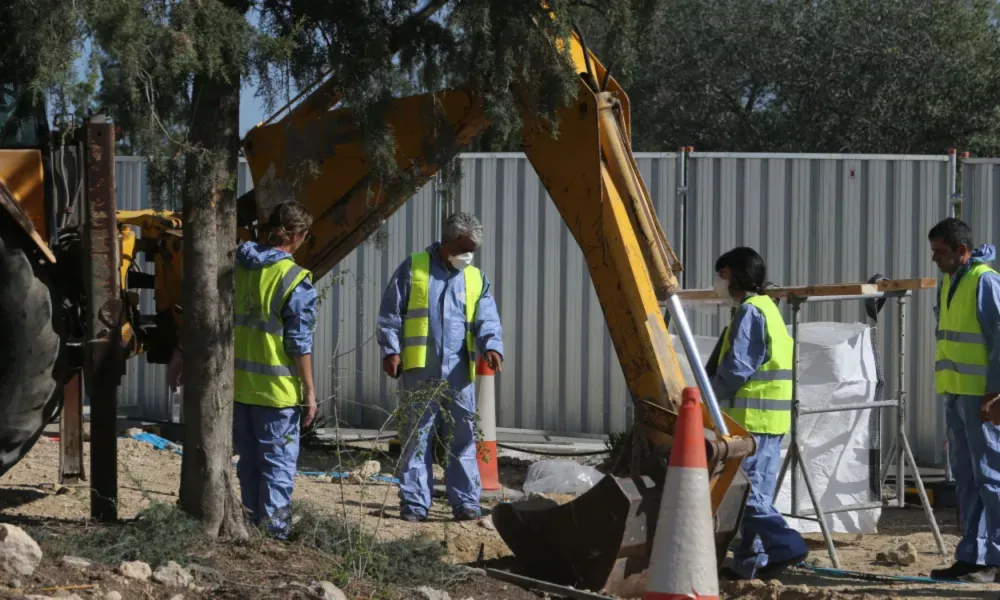
A preliminary test trench was opened on 3 August 2017.
"Three archaeologists carried out the test excavation to determine whether the witness accounts were accurate. They found the blankets and bones."
After the test trench, approval and funding were granted and the full excavation began on 1 November 2017.
"The cypress trees had to be cut down. We called the Forestry Department and nine of the eleven were removed. A private company was also brought in for guidance and logistical support because of the presence of asbestos."
He said the team continuously sprayed the area with water to avoid inhaling asbestos fibres.
"We removed a total of 100 cubic metres of asbestos and building materials, which were sent for controlled disposal."
The recovery of skeletal remains was completed on 16 November.
"We found the remains of ten individuals."
As he had already explained, the final number will only be established once the anthropological examinations are completed.
What happened to the other victims
Xenophon Kallis remained concerned after the excavation because one witness had provided a list containing the names of 31 dead patients.
The archaeologists conducted research in the archives of the Press and Information Office, CyBC and the Archbishopric.
"I was sent to the Greek Cemetery. I spoke to Andreas Karayiannis, who was responsible for the cemetery at the time. He was very cooperative, opened the records and we found that 20 people appeared to have been buried there with the designation 'asylum'."
A gravedigger, Pambos Alkiviades, who had worked there between 1965 and 2000, showed him an area opposite the monument dedicated to those killed in the coup.
"He told me that burned individuals from the asylum had been buried there."
The gravestones bore the inscription "Victims of the invasion".
Based on the cemetery records, funeral contractor Andreas Kekkouris identified locations where additional patients may have been buried.
"Six of them died between 23 and 25 July 1974 and the others up to October. They were probably injured and died later. Therefore, for ten or eleven people, death was instantaneous. The casualty list was for many more individuals."
The 2017 exhumations
For any archaeologist, the day human remains are discovered is a moment of profound emotion.
The case of Athalassa Hospital is perhaps one of the forgotten human stories connected with Cyprus's missing persons. These people were killed during the bombing and no one searched for them because the stigma associated with psychiatric illness was so great.
Asked whether anything remained particularly vivid in his memory, Iacovides replied emotionally:
"At a depth of two and a half metres in the crater, we found the victims exactly as described by the witnesses. Wrapped in blankets and sheets. We found glass fragments embedded in them, construction materials and glass ampoules containing medication marked Serenace. We found perhaps 30 ampoules and one victim was still holding one in his folded arm."
"One woman was wearing a red dress. It was preserved in excellent condition and had not melted because it was nylon."
"We excavated to a depth of four metres and found fragments of the bomb. Even though the exhumation took place 43 years later, the soil still smelled of sulphur and there was a black layer of burning inside the crater."
Based on testimony relating to the Greek Cemetery, four or five people are believed to be buried in Plot 102, behind and south of the Commandos Memorial, where six graves bear the inscription "Victims of the invasion".
Others appear to be buried elsewhere in the cemetery.
"The Greek Cemetery is divided into numbered sections, each containing around 100 to 120 graves. Therefore, locating unmarked graves is extremely difficult."
Nurses insisted and the excavation was expanded
When the excavation at the hospital was completed, witnesses Takis Agathokleous, George Tsolakis and Kypros Demosthenous returned and insisted there might be another burial site behind Ward 1.
"The excavation was expanded and we found another crater in the area where the nurses' offices once stood."
Demosthenous had told archaeologists that a septic tank used to exist behind the bathrooms.
"We excavated it but found no grave. We also excavated elsewhere around Ward 2. We covered a large area but unfortunately found nothing."
Iacovides noted that when the mortuary of the new Nicosia General Hospital was being planned, Xenophon Kallis informed the authorities about the cypress trees and the mass grave, prompting changes to the construction plans.
He also intervened when work began on the PASYDY kindergarten site, insisting that an excavation be carried out before construction proceeded.
"Kallis did everything that needed to be done. It was his idea to check the archives of the Press and Information Office, CyBC and the Archbishopric and to carry out investigations at the Greek Cemetery."
Ultimately, the remains of ten individuals were recovered and seven were identified, six Greek Cypriots and one Turkish Cypriot.
Testimony of another nurse
CNA also obtained testimony from another nurse who was on duty that day, Tassos Christodoulou.
"It was six in the morning. Saturday, 20 July. As I left the ward and headed towards my car, I looked in the direction of Mia Milia after hearing the engines of Turkish military transport aircraft dropping paratroopers there."
"Before we realised what was happening, at around eight in the morning, the bombers began hitting the Psychiatric Hospital while targeting the nearby National Guard camp. We had been told there were explosive storage tanks there and that these were their target."
He and a colleague tried to move between wards.
"I remember hiding under a small bridge. We stayed there until around eleven in the morning."
He recalled that once the bombardment ended, staff began searching for survivors and the dead.
"The outcome was tragic."
"One ward full of patients exploded, leaving a large crater. We started collecting the bodies of the patients, around twenty of them. They were transported by truck to the mortuary of the old Nicosia Hospital."
"We gathered the remaining injured patients into a ward and, together with doctors from Nicosia Hospital, began treating them and stitching their wounds where possible. This process continued until five in the afternoon."
"It was total destruction. Many patients ran outside when the wards were bombed in an effort to save themselves. Those images never leave your mind."
The case of little Giannakis
The heartbreaking story of Giannakis Charalambous from Katydata is also linked to the bombing of Athalassa Hospital.
Giannakis fell ill at the age of three. Incorrect medication caused him to lose the ability to speak and affected his intellectual development.
He never attended school and remained at home with his grandparents while his mother worked to support her three orphaned children.
The funeral of his identified remains took place in July 2023.
According to information presented by Commissioner for Humanitarian Issues Anna Aristotelous, Giannakis was primarily cared for by his grandmother Evrydiki and grandfather Giannis, who effectively served as a father to the three orphaned children.
In the late 1960s, his mother and sisters emigrated to Australia. Giannakis remained behind because the country did not permit the immigration of people with his condition.
When his grandparents developed health problems, and in the absence of state social care and because of social prejudice, Giannakis was admitted to Athalassa Hospital in 1972.
On 20 July 1974, his life came to a tragic end.
He was killed during the Turkish air force bombing of the hospital.
At the site where the patient wards and hospital buildings once stood, near the mortuary of Nicosia General Hospital, a memorial bearing the names of all those killed was erected in February 2023.
It is worth noting that former Presidential Commissioner Photis Photiou, during whose tenure the exhumations began, apologised "for the way in which the cases of the Athalassa Hospital patients and the burial sites in the wider area were handled".
He said their families "could and should have received answers many years ago, something that unfortunately did not happen".
Source: CNA