
Every new adaptation of the Odyssey almost automatically raises the question: how faithful is it to Homer? It is, however, a question that tends to limit rather than illuminate the discussion. No great work survives for three thousand years because it is reproduced mechanically, nor is it preserved through museum-like reverence. It survives because each era rereads it through its own anxieties, its own wars and its own fears.
Christopher Nolan does not attempt to illustrate Homer, nor to deliver a cinematic educational aid. He offers his own interpretation of the Homeric epic. His film should therefore be judged not on whether it follows every episode, every deity and every line of the Odyssey, but on whether it engages creatively with Homer's world. Despite certain simplifications and departures from the original myth, I believe it achieves this to a considerable degree.
An epic that changed from the moment it was born
There is something deeply Homeric in the freedom Nolan allows himself. The Iliad and the Odyssey, if we judge by the thousands of pages written on the Homeric Question, a term largely associated with Friedrich August Wolf, did not reach us as two unchanging texts, written on a specific day by a clearly identifiable author.
We do not know with certainty who the historical Homer was, whether the name belonged to a specific individual, or whether the two epics were even composed by the same poet. What is certain is that the Homeric poems were shaped through a long tradition of oral composition and performance. For centuries, the stories of the Trojan War and the return of its heroes were sung by bards and rhapsodes, who selected, emphasised, omitted and recomposed elements of the myth.
Even the tradition linking the definitive standardisation of the epics to the Athens of Pisistratus is not an undisputed historical fact. The Odyssey, in other words, was a living and evolving work from its very birth. Tradition preserved it not despite its changes, but through them.
This is exactly what great creators continued to do over the centuries. In Helen, Euripides overturned one of the Trojan myth's fundamental assumptions. In his version, the real Helen never reached Troy at all but was transported to Egypt, while Greeks and Trojans fought over a phantom image of her.
Virgil reconstructed the Homeric world according to the political, moral and imperial needs of Augustan Rome. James Joyce transferred Odysseus's wandering to the streets of Dublin. Seferis returned to Euripides' version of Helen to speak of illusions, wars fought "for an empty shirt", and the lost homelands of modern Hellenism.
Nolan therefore had every artistic right to recreate Homer for the 21st century. The real question is not whether he changed the Odyssey, but whether those changes generate new and meaningful insights.
The victors as the "Sea Peoples"
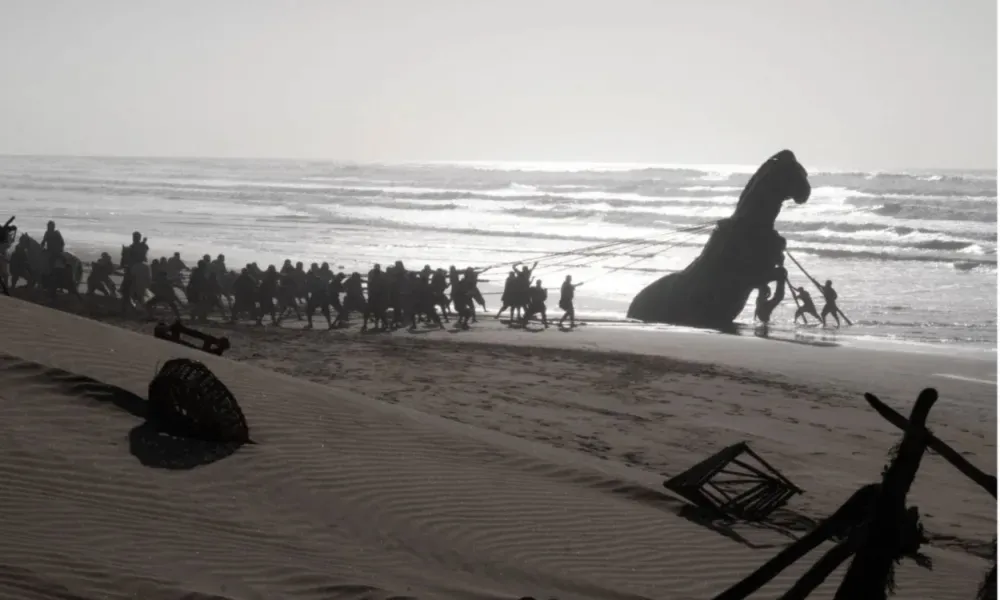
The film's boldest idea is its identification of the Greeks returning from Troy with the mysterious Sea Peoples, who are associated with the great upheavals that shook the Eastern Mediterranean at the end of the Bronze Age.
The exact identity and origins of these groups, whether referred to as Ahhiyawa (Achaeans), Danuna (Danaans) or by other names, remain the subject of historical and archaeological debate. Nolan, however, does not use the connection as historical certainty. He transforms it into an allegory.
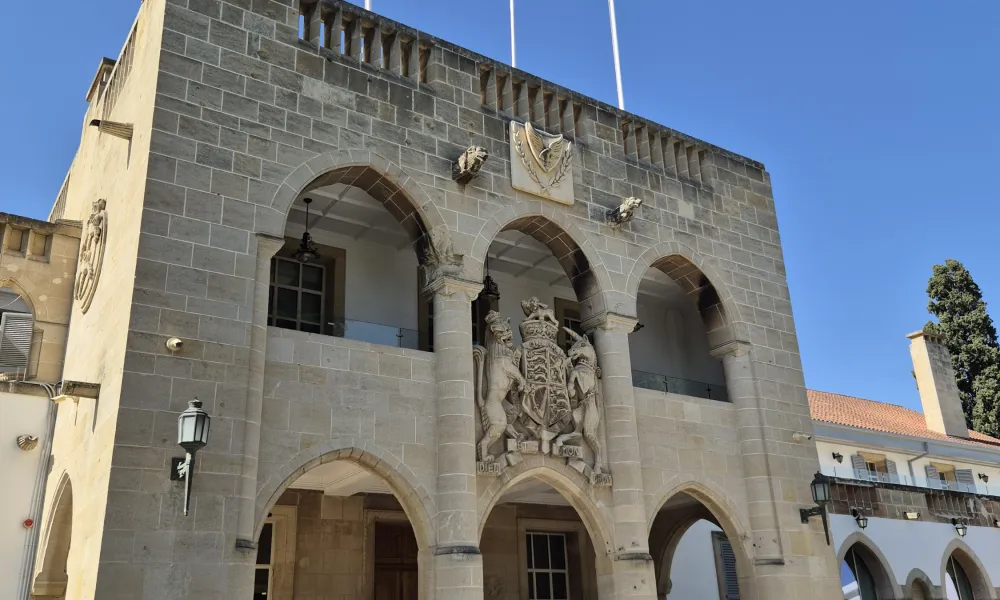
The Greeks begin their campaign as kings, warriors and defenders of a supposed code of honour. After the fall of Troy, however, they return as armed bands without a fixed destination. They plunder coastal settlements such as Ugarit, Hattusa, Kition and Enkomi in Cyprus, attack foreign populations and carry war wherever they land, while Ramses III is portrayed as heroically defending the Nile Delta.
The external enemy everyone expects to appear on the horizon is not some unknown or exotic people. It is themselves. The victors of Troy become the raiders who terrorise the world to which they are trying to return.
This idea radically transforms the concept of nostos, the homecoming. In Homer, the return is difficult because the gods are angered, the sea resists, and the hero succumbs to curiosity, desire and hubris. In Nolan, the return becomes difficult because war has changed the man who is returning.
Particularly striking is the scene in which Odysseus's companions are unable to understand the modern Greek spoken by one of the victims of their raids. The two sides are geographically close, yet separated linguistically and temporally by centuries. Odysseus's men suddenly resemble not the ancestors of the modern world but the ghosts of a civilisation that has already vanished.
Their inability to communicate shows that the warriors have become detached from time itself. They are trapped within their own space-time continuum, much like the characters in Interstellar, endlessly moving towards home while every step carries them further away from the world they knew. Ithaca still exists on the map, but not necessarily within their own time.
The war inside the human being
Nolan's Odyssey is not primarily a story about the monsters Odysseus encounters.
It is a story about the monster that returns with him.
The Cyclops, the Sirens, Circe and the other figures of the epic acquire meaning as expressions of memory, guilt, fear and psychological disintegration. The supernatural is gradually transferred into the hero's interior world. The gods do not disappear, but they cease to function solely as external forces. They become voices of conscience and memory.
Homer's Odysseus is resourceful, intelligent, deceitful, inventive and often ruthless. Nolan's Odysseus more closely resembles the modern war veteran. He is haunted not only by the desire to return home but by the suspicion that he no longer deserves to return.
This choice speaks directly to our own era, which no longer views the warrior as an unquestionable hero.
Twenty-first century societies understand that a person may return from war physically alive yet psychologically imprisoned within it. They also understand that military victory is not the same thing as moral justification.
Odysseus resembles someone returning from Vietnam, Afghanistan or Iraq suffering from post-traumatic stress disorder. In the film, this manifests itself through nightmares and flashbacks, while Calypso provides psychological support. He carries not only memories and trauma. He carries violence itself as a way of perceiving the world.
The West confronting its own reflection
Viewed from this perspective, the Trojan War becomes an allegory for the contemporary decline of the West.
A world that defines itself as civilised, rational and superior has unleashed such violence that, in the end, it can no longer distinguish itself from the barbarians it fears.
The enemy arriving by sea is a reflection.
Societies wait for an attack from some external force while the real threat has already been born within them. It reveals itself through arrogance, greed and the normalisation of violence, rooted in the belief that one's own actions are exempt from the moral standards imposed on others.
Agamemnon and Menelaus then, just as Trump, Netanyahu and Putin today, return from Troy believing they have restored honour and order.
In reality, they have opened the door to chaos.
They transformed revenge into a political principle and plunder into the right of the victor. When the world begins to collapse, they are unable to understand that they are not merely victims of that collapse, but its agents as well.
The illusion of Ithaca
Ithaca thus ceases to be a simple place.
It becomes the promise that a person can return to innocence, family and a former life.
That promise, however, proves deceptive.
No one truly returns to where he began because neither he nor his homeland remains unchanged.
The Odysseus who departed for Troy, the warrior who fought, the castaway who wandered and the stranger who finally arrives in Ithaca are no longer the same person.
Penelope is not merely called upon to recognise her husband.
She is called upon to accept the person he has become.
Nolan did not create the definitive Odyssey, and such a thing probably cannot exist.
What he did create, however, is an Odyssey for our age.
Dark, burdened by guilt, suspicious of heroic triumphs and deeply troubled by the legacy of Western violence.
The film engages meaningfully with the epic because it dares to ask it a modern and painful question:
What happens when a person wins the war, but the war has already won the person?
Nolan's answer is bleak.
The enemy we are waiting to arrive from the sea is already travelling aboard our own ships.