
By Kritonas Kapsalis
How should we regard the criminal investigation against journalist Makarios Drousiotis over the revelations in the Sandy Case, as well as the new criminal investigation launched following a private complaint about the violation of personal data in connection with the book Mafia State? An investigation into Drousiotis has also been opened by the Ministry of Interior in relation to the fundraising campaign he is running to cover his legal defence. On the other hand, no small number of people are speaking of the muzzling of the journalist, while there is no shortage of those who consider that journalists are not above criticism, or even criminal prosecution. The case, according to several lawyers we consulted, is particularly complex.
In the Sandy Case, the majority of legal experts consider that there was sufficient cause for a serious criminal investigation. By contrast, in the second case, that concerning personal data, most lean towards the view that the criminal process carries a significant risk of creating disproportionate pressure on investigative journalism. As for the criminal prosecution of Drousiotis for allegedly conducting unlawful fundraising, there is a widespread impression that those who pursue it may become politically exposed. No one disputes that the law on fundraising requires the permission of the Ministry of Interior. On the other hand, the interpretative provision of the law clarifies precisely what constitutes a fundraising campaign. Legal circles point out that what Drousiotis is doing does not fall within the interpretation of fundraising.
The Sandy Case
In this case there appears to be a genuine issue for the journalist. This particular case is not a simple instance of a journalist obtaining an authentic confidential document from a source and publishing it. That would have been a different case, with much stronger protection under Article 10 of the ECHR. Under that article, it is of particular importance that freedom of expression does not protect only information or opinions that are favourably received. The case law of the ECtHR also covers ideas or information that may offend, shock or disturb the state or a section of society, because pluralism and tolerance are considered fundamental elements of a democratic society.
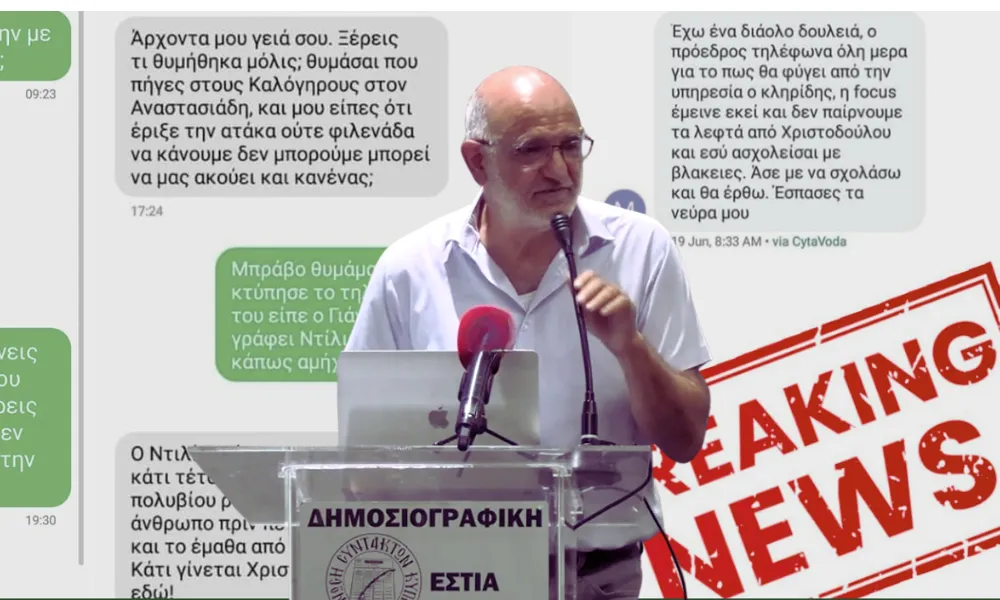
On the other hand, Drousiotis published extremely serious allegations: sexual abuse of a minor, rape, corruption of judges and politicians, surveillance, bribery, and the existence of an organised network within the institutions. In his original text he states that he had in his possession a large number of messages, that he had met Sandy Case, that she confirmed their authenticity to him, and that she promised to hand over to him the laptop on which the entire archive was stored. As far as we know, the laptop was ultimately never handed over to him.
Later, in his statement, which he himself made public, he claimed that his investigation had lasted almost three years, that he had cross-checked the content of the messages against other sources and records, and that he had found no indications of tampering.
He also states that most of the evidence consisted of screenshots, and describes a series of elements which, in his assessment, served as confirmation. This matters for journalistic ethics. The more serious an accusation, the greater the obligation of verification. A journalist cannot simply say "my source told me" when accusing someone of raping a minor or participating in a criminal organisation. At the very least, he is obliged to approach the person accused. On the other hand, verification does not mean that a journalist must possess the evidentiary capacity of the Police, or be able to prove the case beyond all reasonable doubt.
The critical point
Here lies the critical legal point. Drousiotis is charged, among other things, with circulating a forged document. Article 339 of the Criminal Code does not simply say "whoever circulates a forged document." It says: "Whoever knowingly and fraudulently puts into circulation a forged document." There is therefore a vast distance between the following two statements:
A. "The messages were proven to be forged," and
B. "Drousiotis knew they were forged and published them fraudulently."
The first does not, on its own, prove the second. This is the heart of the case. If the Prosecuting Authority holds messages, statements or other material showing that, prior to publication, Drousiotis had been reliably informed that the screenshots were fabricated, that he knew how they had been manufactured, or that he participated in some way in presenting them as authentic, then the prosecution changes character entirely. At that point we would no longer be speaking of a journalistic error, but of the possible knowing use of forged material.
If, however, the evidence amounts merely to the fact that Sandy Case fabricated the messages and that Drousiotis believed them, even if it is shown that he carried out inadequate journalistic verification, then it becomes harder to justify turning a journalistic mistake into a felony. It is somewhere here that the case will be decided in court.
The Police, for their part, maintain that they hold serious evidence. They announced that their investigation concluded that the messages in question were not authentic, and that their findings were confirmed with the assistance of Europol. On this basis, and the remaining body of evidence, the Attorney General filed a case on 24 July with a total of 101 charges for the fabrication and circulation of a forged document, false news and harassment, which is destined for the Assize Court.
There is, however, a substantial reservation: according to subsequent reporting, the electronic devices themselves were not sent to Europol's laboratories. It is reported that files and findings extracted from the Cypriot examinations were sent instead, and that these were what Europol confirmed. If this is true, then an issue may arise.
And the "false news" charge
Article 50 of the Criminal Code is a particularly heavy tool when applied to investigative journalism. It criminalises the publication of false information that may, among other things, undermine public trust in the state or its institutions. It does, however, expressly provide for a defence where the accused proves that he published in good faith and relied on facts that justified the publication. This means that, in the Drousiotis case, the court will essentially also have to examine the journalistic process itself: What did he have in his hands? What did he cross-check? Whom did he ask? What indications did he have of authenticity? Were there warning signs he ignored? What did he know at the moment he pressed "publish"?
The second case
In the second case under investigation, concerning personal data, greater reservations seem to arise regarding the state's response. The complaint, according to information available so far, comes from a state official working at the Cyprus Intelligence Service (KYP), who claims that Mafia State made it possible to identify him and reveal the true nature of his work at a sensitive service, and that he subsequently had to be relocated. These claims, if proven, are not insignificant, yet there is a substantial legal "but".
Cypriot personal data law expressly provides, under Article 29, that even the processing of personal data, special categories of data, or data relating to criminal offences is lawful for journalistic purposes when it is proportionate to the aim pursued and respects fundamental rights. Therefore, when a journalist publishes personal data, this does not automatically mean he is simultaneously committing a criminal offence.
It must be examined why he published it and whether it was necessary for exposing a matter of public interest. And here there is a very significant factual element: Mafia State was not, overall, shown to be a baseless construction. Following a multi-year independent investigation, the Independent Authority Against Corruption (IAAC)announced on 16 June 2026 that some of the allegations it investigated produced indications of possible criminal offences against a number of natural and legal persons, and referred the material for criminal investigation. The Authority itself clarified that other allegations were not substantiated to the required standard.
Therefore, when, four years after the book's publication, a criminal investigation is triggered over material contained in a work that formed the basis of such an institutional inquiry, the principle of proportionality must be applied with particular rigour. This does not mean that the private individual or the state official loses his right to privacy. It means that, before criminal law is used against the journalist, the following must be answered: was the publication of the material genuinely necessary to substantiate the case, and why is a criminal process required, rather than the milder means provided by personal data law or civil law being sufficient?
The question
In conclusion, is "excessive pressure" being exerted on Drousiotis? Cumulatively, yes, since there are now enough elements for the question to be raised seriously. Could the word "persecution" be used, in the sense of a proven political or institutional pursuit? That is difficult. Particularly in the Mafia State case, the roughly fifteen people currently under investigation probably feel greater pressure at this moment than the author himself does.
If there is one issue here, it is that of the appearance of impartiality. Giorgos Savvidis and Savvas Angelidis recused themselves from handling the Mafia State case for reasons of objective impartiality. At the same time, references to both men were included in the material Drousiotis published concerning Sandy Case. The fact that the Attorney General subsequently approved the prosecution in the Sandy Case does not automatically render it invalid, but institutionally it would have been far cleaner had the decision to prosecute been taken by someone with no personal connection whatsoever to the content of the publications in question.
A final assessment
In the personal data case, the state carries a far heavier burden of justification. Given that this concerns material published in the context of an investigative book on possible state corruption, Cypriot law itself provides special protection to journalistic data processing, so the choice of the criminal route raises a serious issue of proportionality and press freedom.
The investigation in the Sandy Case was justified, and it would be wrong to argue that journalistic status excluded criminal investigation. The allegations were extremely serious, and the authenticity of the core evidence was of central importance. The real test for the Sandy Case, of course, is not whether the screenshots were forged. It is whether the Prosecuting Authority can prove that the journalist knew this. If it cannot, then the case shifts dangerously from punishing possible fraud towards the criminalisation of a journalistic error. It is somewhere there that Article 10 of the ECHRtakes on decisive weight.