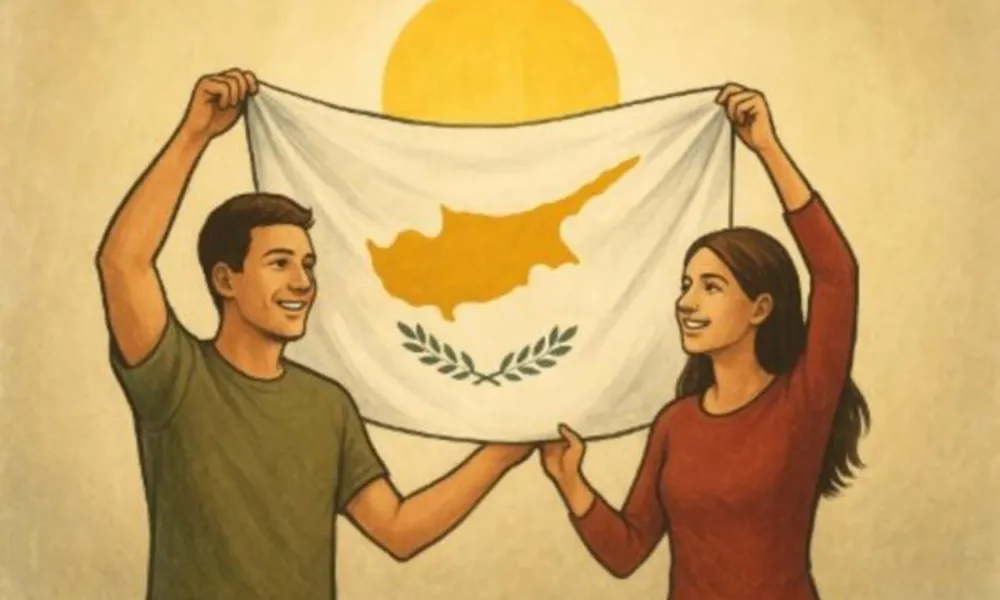

The personal envoy of the UN Secretary-General, María Ángela Holguín, has spent months building contacts with the technical committees and civil society on both sides of the Green Line. Among them, many young people. In the wake of António Guterres' recent visit to Cyprus and his meetings with the two leaders, one question remains that is rarely answered with ease: how does Cyprus's new generation today approach the prospect of a solution, and what would they vote if they were ever to find themselves faced with a specific proposal? This is a generation that has never lived on a united island, unlike their parents and grandparents, and which is being asked to imagine something that has never existed within its own experience.
The committee for youth
This question was answered by Christos Parmakkis, member of the Bicommunal Technical Committee on Youth, in an interview on Politis radio and the programme "Second Look," the day after Guterres' visit. He spoke in the language of institutional optimism. He said that young people support and welcome the Secretary-General's effort, that there is full trust in Holguín, and that "the stars are aligning" for something substantial to move forward. He called for young people to have a voice in the next phases too, even at the level of a 5+1 format, invoking Security Council Resolution 2250 on the role of youth in peacebuilding. He noted that the Secretary-General's choice to come to the island in person was not made by chance, but presupposed the tacit consent of the guarantor powers for further steps, and that the Committee meets regularly with the Turkish Cypriot side at Ledra Palace, demonstrating, through the reports that reach the Security Council, that this kind of confidence-building measure can work when given time.
Academic research
The same question, how the new generation really thinks, has systematically occupied the academic community for almost two decades now. The PRIO Cyprus Centre, a bicommunal research centre based in Nicosia since 2005, has published much of this body of literature. As early as 2015, a study by Hatay and Charalambous for the Centre examined the attitudes of students from the "post-Annan Plan generation," those who did not vote in the 2004 referendum but grew up in its shadow. In 2020, research by Cihan Dizdaroğlu, in cooperation with the Friedrich Ebert Foundation, systematically recorded, through telephone surveys in both communities, young people's perceptions of politics, peace and bicommunal contact, explicitly linked to Resolution 2250. The same researcher continued in 2023, comparing the views of local and diaspora youth, and in 2024 examining daily lived experience beyond the official negotiations. This year, a new comparative study by the same researcher together with İlhan Can Önsen and Özgehan Şenyuva specifically examined how a generation that has grown up entirely within the division perceives bicommunal contact and the prospect of a reunification referendum. Similar interest has been recorded on the other side of the Green Line too, with a 2017 study by Özgür, Köprülü and Reuchamps on how the next generation in the north envisions shared power and its own identity. The fact that this research continues uninterrupted, with new publications almost every year, shows how alive the question remains, even when the official process appears frozen.
The education system
In an interview with "P" last year, Professor of Social Anthropology at the University of Cyprus, Yiannis Papadakis, had placed the emphasis elsewhere. On how little young people actually know about the history of their own place, not out of their own indifference but because that is how the education system taught it to them, and on how difficult it remains for the word "Cypriot" to also accommodate the Turkish Cypriot. He had pointed out that both communities raise their children on parallel, mutually exclusive narratives of victimhood, and that this does not change through declarations but through years of work in schools and history books.
What they would vote today
A few days before the Secretary-General's visit, three young people, aged 27 and 28, were asked in an informal setting what they would vote if they were ever to find themselves faced with a specific solution proposal. Before even answering that, they stated that they expected nothing substantial from the upcoming Guterres visit. They saw no real momentum on the Cyprus problem, and the prospect of being offered something specific within one to two years seemed distant to them.
Their reasoning referred directly to the 2004 referendum, an event they themselves did not experience as adults, but which they regard as a legacy passed on to their generation. They believe that, at the time, the proposal was not adequately explained to public opinion, and that many voted out of fear or impulse, without fully understanding what they had in front of them. All three were emphatic that, should the moment ever come, they would want to study the solution thoroughly, fully aware of what they would be signing and whom they would be binding.
The conversation then moved on to practical matters: guarantees, possible NATO accession, property issues. Their main concern, however, was not the legal framework, but the manner of implementation: how the transition would actually work in practice, on what timetable, gradually or abruptly. None of the three questioned the need for a solution. What they questioned was the idea that they might be asked to decide hastily, as they believe their parents were asked to do in 2004.
The most troubling element, however, was not any particular objection, but the complete absence of optimism from three people who follow current affairs closely and take part in public debate. For their entire lives, and for most of their parents' lives, Cyprus has existed in a state of "fragile peace." A state they do not consider fair and does not satisfy them, but simply the only "status" they have ever known, and one they have learned to live with. They do not reject the idea of a solution, but they are a generation that was never given enough hope to be able to truly imagine what a peaceful future would look like. Somewhere between institutional uncertainty and the restrained scepticism of a generation that never learned to hope, lies today the real scale of the Cyprus problem.