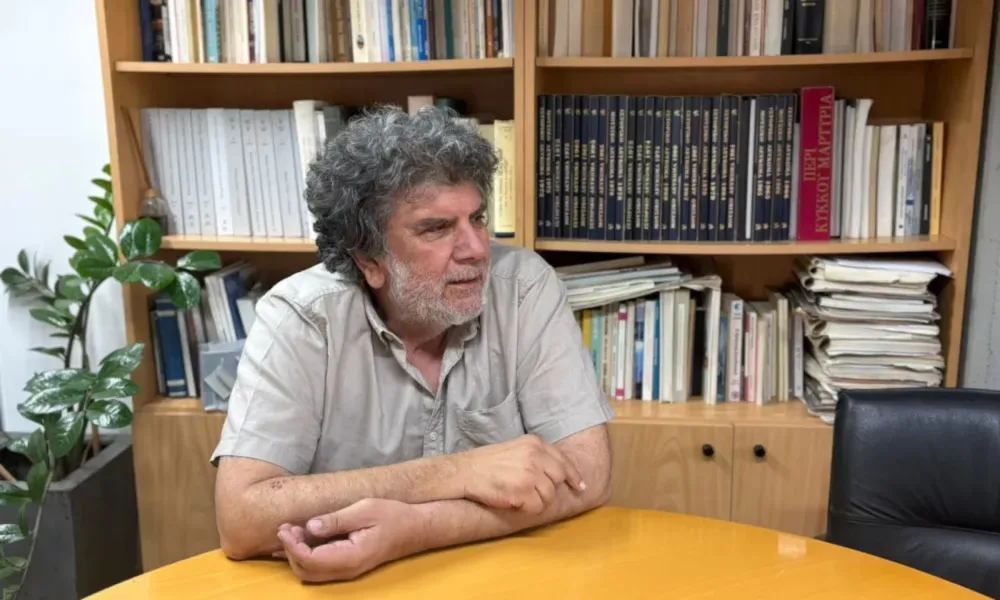

Journalist and Politis Media Group Director-General Dionysios Dionysiou has described UN Secretary-General António Guterres' visit to Cyprus as a potentially pivotal moment, warning that it could either become a final effort to revive the Cyprus peace process or a symbolic farewell before the end of the UN chief's term.
Speaking on Politis Radio's Proini Epitheorisi programme with Katerina Eliadi, Dionysiou urged caution over expectations, noting that numerous similar initiatives in the past failed to restart substantive negotiations.
"We must all keep expectations low, because we have seen this story repeated dozens of times," he said.
According to Dionysiou, Guterres' visit could represent either a last opportunity to relaunch the process or even a "final goodbye" to both communities.
Responsibility lies with the two leaders
Commenting on Guterres' message upon arriving in Cyprus that the United Nations cannot impose peace and that it can only be built by Cypriots and their leaders, Dionysiou said the statement clearly places responsibility on the two sides.
He argued that this has been the UN's consistent approach, particularly since the collapse of the Crans-Montana talks in 2017.
According to Dionysiou, the UN continues to call on both Greek Cypriot and Turkish Cypriot leaders to demonstrate greater initiative and political will.
He believes Guterres will attempt to persuade the two leaders to agree to a new expanded conference, potentially taking place in late August or early September.
"That would be an effort to create new momentum. Looking at the positions of all sides, however, it is difficult to be particularly optimistic unless new developments emerge."
‘The groundwork does not appear to have been prepared’
Dionysiou expressed doubts about whether the necessary diplomatic groundwork had been completed ahead of Guterres' visit and any potential expanded conference.
He noted that President Nikos Christodoulides had previously suggested that such a conference might take place in late July or early August and that there had even been speculation about convening the National Council.
"It appears that neither the visit nor the expanded conference was ultimately prepared properly," he said.
He also referred to the efforts of the UN Secretary-General's personal envoy, María Ángela Holguín, who has been holding contacts with all parties in an attempt to assemble what he described as a complex diplomatic puzzle.
So far, however, he does not believe the conditions exist for an immediate return to substantive negotiations.
Turkish Cypriot conditions
Dionysiou stressed that the Turkish Cypriot side's conditions for returning to negotiations should not be underestimated or ignored.
Beyond confidence-building measures, he said Turkish Cypriots continue to raise questions about the "day after" should another negotiation process fail.
According to him, the Turkish Cypriot side wants clarity regarding its future status and position if another round of talks collapses.
"We often ignore this or assume it is being said merely for the sake of saying it. But it is not a new demand and it does not appear that the Turkish Cypriot side is prepared to retreat from it easily."
Turkey links Cyprus issue to EU relations
Dionysiou said Ankara views the Cyprus issue within the broader framework of its geopolitical objectives and particularly through the lens of its relationship with the European Union.
He pointed to issues including:
- Deepening of the EU-Turkey Customs Union;
- Turkey's participation in the SAFE European defence programme;
- Visa liberalisation for Turkish citizens.
According to Dionysiou, Turkey remains dissatisfied with progress on these matters, while additional obstacles have arisen from Greece's position on Turkish participation in European defence planning.
Greece, he noted, opposes providing EU defence funding and strategic integration to a country that continues to maintain a casus belli over the potential extension of Greek territorial waters.
"None of this creates the positive atmosphere we would like to see for the process to move forward."
The Guterres framework and the federation divide
Dionysiou also reflected on Guterres' previous involvement in Cyprus negotiations, noting that the UN chief played an active role in past conferences and sought to bridge differences through his well-known six-point framework.
In his view, the Guterres framework represented a serious and innovative attempt to address the Cyprus issue comprehensively.
Since 2017, however, conditions have become significantly more difficult, particularly as Turkey moved away from support for a federal solution and increasingly promoted a two-state model.
He noted that the United Nations remains bound by Security Council resolutions supporting a bizonal, bicommunal federation.
At the same time, Holguín appears willing to explore ideas "outside the box" in an effort to overcome the prolonged stalemate.
Scepticism over ‘outside the box’ ideas
According to Dionysiou, such proposals are being approached cautiously by both the president and political parties.
He suggested, however, that concepts such as a looser form of federation, phased implementation of an agreement or referendums at a later stage are not necessarily viewed negatively by society.
"People are waiting to see. There does not appear to be the same intensity of reaction that existed in previous periods."
He added that both Greek Cypriots and Turkish Cypriots are increasingly concerned about what might follow if another effort to resolve the Cyprus problem ends in failure.