
By Kyriakos Pierides
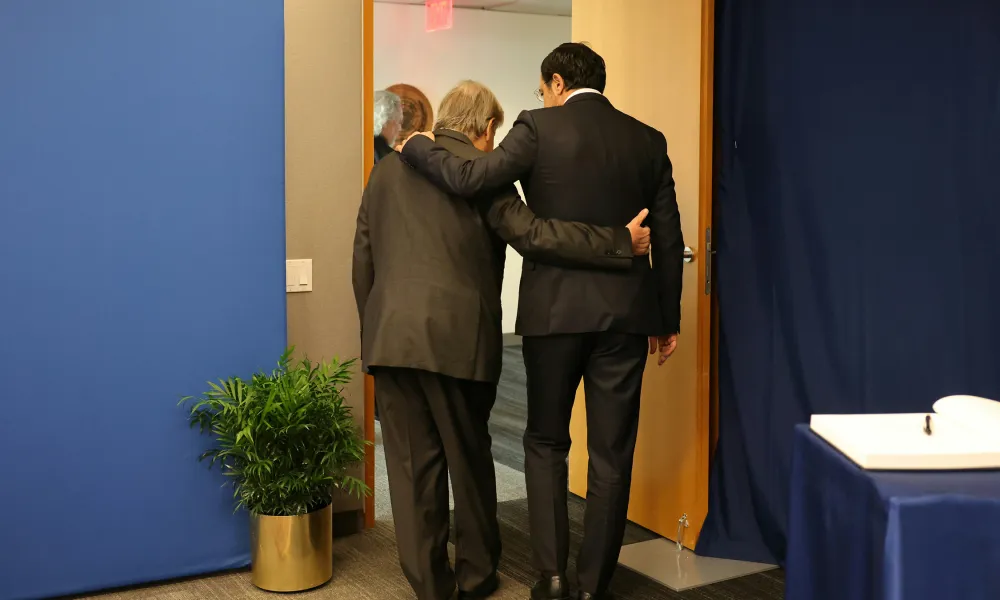
President Nikos Christodoulides returns from the UN General Assembly in New York having passed yet another of the many “milestones” he himself set for substantive developments on the Cyprus issue, without any of them materialising during his presidency.
Against this backdrop of a prolonged stalemate, the second term of UN Secretary-General António Guterres is also approaching its end.
When leaving Nicosia on 29 July, Guterres openly warned Cypriots that the longer the division continues, the greater their exposure to unwanted geopolitical risks.
“We see a number of conflicts continuing and we have seen that conflicts can spread. I therefore believe that solving the Cyprus problem is absolutely critical, not only to safeguard the interests and peace of the people of Cyprus, but also as a factor of stability in a region that is becoming dangerously unstable,” he said.
That warning is difficult to separate from the Cypriot government’s geopolitical choices and its increasingly close alignment with the Israel of Benjamin Netanyahu.
The regional rivalry between Israel and Turkey is intensifying, leaving a divided Cyprus at risk of finding itself caught in the middle.
Yet Christodoulides returns to Cyprus appearing publicly as though he has fulfilled his responsibility, allowing him to gradually shift towards campaigning for re-election in 2028.
As late as Friday evening, the President was saying he had presented “new ideas”, this time referring to 19 proposals without explaining their content, in an effort to persuade the Secretary-General to make at least some move forward.
The Cyprus issue as an alibi
The Cyprus issue has repeatedly served as an alibi for Cypriot political leaderships, allowing their own responsibilities to be obscured behind references to Turkish intransigence.
Christodoulides maintained expectations for months that ultimately proved unfounded.
His handling of the issue did not meet the conditions set by the UN for returning to negotiations from the point where they broke down at Crans-Montana nearly a decade ago.
The “appropriate groundwork” sought by Guterres did not emerge, nor did the progress on substance, methodology and confidence-building measures that he identified as prerequisites for another expanded meeting.
Meetings between the two leaders produced neither new confidence-building measures nor a common understanding.
Guterres had made clear that he would not convene a conference simply for appearances, without preparation, commitments and a realistic prospect of an outcome.
His comprehensive report to the UN Security Council at the end of the year, before he leaves office, will therefore be important reading.
The Secretary-General’s public statements already provide a substantial framework against which progress can be evaluated: “there is still a lot of work to do”, the parties are not “sufficiently prepared” and “the mistakes of the past” must not be repeated.
Comparing those assessments with Christodoulides’ repeated announcements should have triggered a serious debate about the results of his policy and his own share of responsibility.
That debate, however, is not taking place.
And the longer the absence of accountability keeps the Cyprus issue outside meaningful political confrontation, the easier it becomes for Christodoulides to close this political “pending issue” and move, largely unchallenged, into the 2028 presidential campaign.
Who, then, will meaningfully assess his handling of the Cyprus issue?
So far, nobody.
The election campaign begins
As the incumbent President, Christodoulides understands how to turn the indecision and procrastination of his opponents into a significant political advantage, much as he did in 2023.
At the time, with the behind-the-scenes support of former President Nicos Anastasiades, he succeeded early on in creating an image of himself as the undisputed favourite.
Opinion polls gave him an overwhelming perception of victory. That proved exaggerated as election day approached, but it was enough to create momentum behind his candidacy.
He is now attempting to recreate an image of political dominance, aided by the absence of a distinct and forceful opposition.
Private polls are circulating in the media and are even being cited by potential rivals, although their sponsors, samples, questionnaires and the conditions under which they were conducted are not always disclosed.
At the same time, there is a lack of polling on questions that would provide a clearer picture of the political situation: whether citizens believe the country is moving in the right or wrong direction, and how they evaluate the President and the government’s performance.
Earlier surveys showed weak approval of Christodoulides’ record, with only 20% to 25% approving of his performance.
Now, however, he is being presented as politically strong, including claims that he enjoys 30% support within DISY, the political space he is particularly interested in penetrating.
The debate is therefore being shifted prematurely away from the substantive issues, such as Cyprus, responsibility for the stalemate, the government’s record and the cost of living, towards the electability of Christodoulides and his potential opponents.
Opposition leaves Christodoulides largely unchallenged
One of Christodoulides’ greatest advantages is an opposition that continues to move slowly, sporadically and without clearly defined positions on the problems affecting society.
A comparison between Christodoulides’ statements and Guterres’ more pointed assessments, for example, could provide the foundation for a serious political challenge to the President's handling of Cyprus.
But how can a meaningful public debate develop when his record in this area remains largely untouched?
The opposition vacuum
Opposition parties have so far preferred restrained criticism of Christodoulides on the Cyprus issue.
On 17 September, DISY President Annita Demetriou called for attention to be focused “on the substance” and on what needed to be done to achieve “real developments”.
On 23 September, AKEL General Secretary Stefanos Stefanou observed that “the expectations arising from Guterres’ initiative did not translate into a resumption of negotiations”.
But neither position amounts to sustained, forceful scrutiny of Christodoulides’ policy.
The Cyprus issue has been placed on the shelf, while the consequences fall primarily on Greek Cypriots.
Or have we stopped believing that this is the case?
The leaderships of the two parties may believe that the time for an all-out political confrontation has not yet arrived.
Within DISY, a contest is expected between Annita Demetriou and former party president Averof Neofytou, who has been increasingly vocal in his criticism of the government.
Within AKEL, a lengthy candidate-selection process is taking shape, while the party’s 2023 presidential candidate Andreas Mavroyiannis has also reappeared publicly.
But this hesitancy has accumulated a political cost.
A sluggish opposition does not merely leave the President without meaningful scrutiny. It also damages the parties themselves by denying voters the opportunity to understand what is genuinely at stake.
Some political calculations appear to suggest that the Cyprus issue “does not sell” and no longer concerns public opinion.
Yet decisions taken by the Cypriot leadership in recent years have pushed the prospect of reunification further away, while developments on the ground risk becoming irreversible.
Silence over responsibility would therefore be the worst possible contribution to the debate as Cyprus moves towards another presidential election.