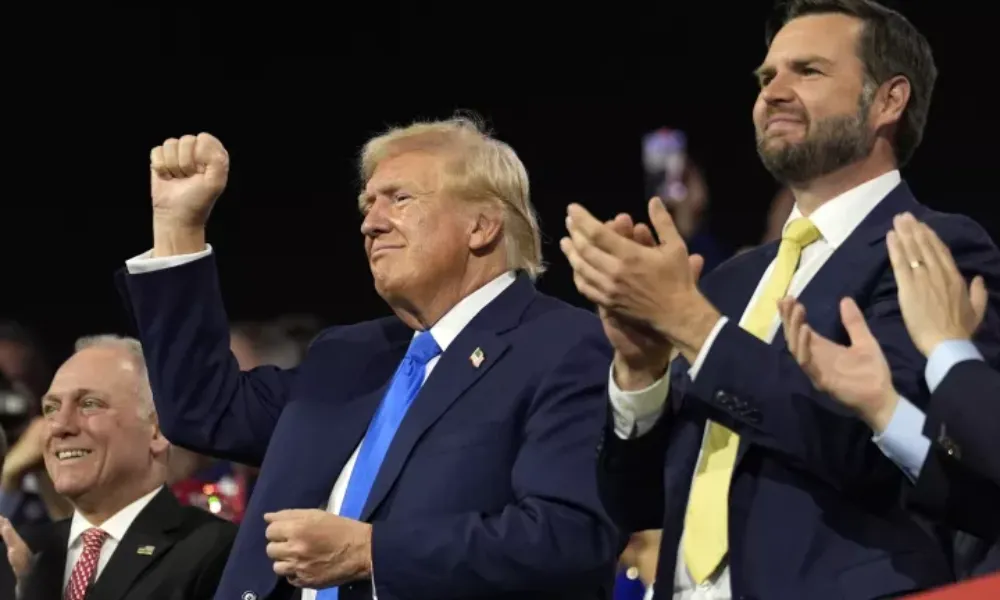

US Vice-President JD Vance sought to downplay the latest escalation with Iran on Thursday, arguing that the confrontation does not amount to a war and insisting that maritime traffic through the Strait of Hormuz has almost returned to normal.
His remarks came as the Wall Street Journal reported that President Donald Trump is considering declaring victory and formally announcing an end to the conflict.
"I wouldn't call it a war"
Speaking during a White House press conference, Vance attempted to minimise the significance of the recent flare-up in hostilities.
"I wouldn't call it a war. Right now, there is no exchange of fire," he said.
The comments came despite the United States carrying out two waves of air strikes against Iran in recent days.
One of those attacks, which Tehran has vowed to avenge, reportedly killed four people and injured dozens during a wedding celebration.
Asked about the strike, Vance said Iranian state media could not be considered a reliable source of information.
"Iranian state media are not truly giving a reliable account of what has happened in the conflict so far, so I treat that issue with great scepticism."
He added, however, that the United States was conducting a "thorough investigation".
Vance declined to say when hostilities might end. When the conflict began six months ago, Trump had suggested it would last only a matter of weeks.
Shipping "almost back to normal"
The Trump administration has repeatedly argued that shipping activity through the Strait of Hormuz is recovering, and Vance reiterated that position.
"If you go back three months, how much oil and gas was coming through the Strait of Hormuz amid Iranian threats? Almost none."
"Now, we've almost returned to the situation before the conflict."
Trump made a similar claim in an interview broadcast by Britain's GB News.
"We have great control over the Strait of Hormuz. We're making sure 30, 40 ships pass every night."
US Energy Secretary Chris Wright said around 17 million barrels of oil were moving through the waterway, while Trump shared a chart on Truth Social showing daily flows of 18 million barrels, compared with around 20 million barrels a day before the conflict.
Shipping data points to partial recovery
According to an analysis by Agence France-Presse, based on data from maritime tracking platform Kpler, traffic through the Strait fell sharply after Iran closed the waterway on 1 March.
Average daily crossings by vessels transporting commodities such as hydrocarbons, fertilisers and minerals dropped to about 10 per day, compared with 95 per day in February.
A preliminary agreement between Washington and Tehran in mid-June temporarily lifted traffic to around 36 crossings a day, before renewed hostilities between 8 July and 22 August pushed the figure back down to approximately 15 daily crossings.
Kpler data also indicate that since 8 July, around two-thirds of all crossings have been carried out by so-called "ghost ships", vessels whose routes cannot be independently verified because of disabled tracking systems, signal interference or a lack of satellite imagery. Before the conflict, such vessels accounted for less than 1% of traffic through the Strait.