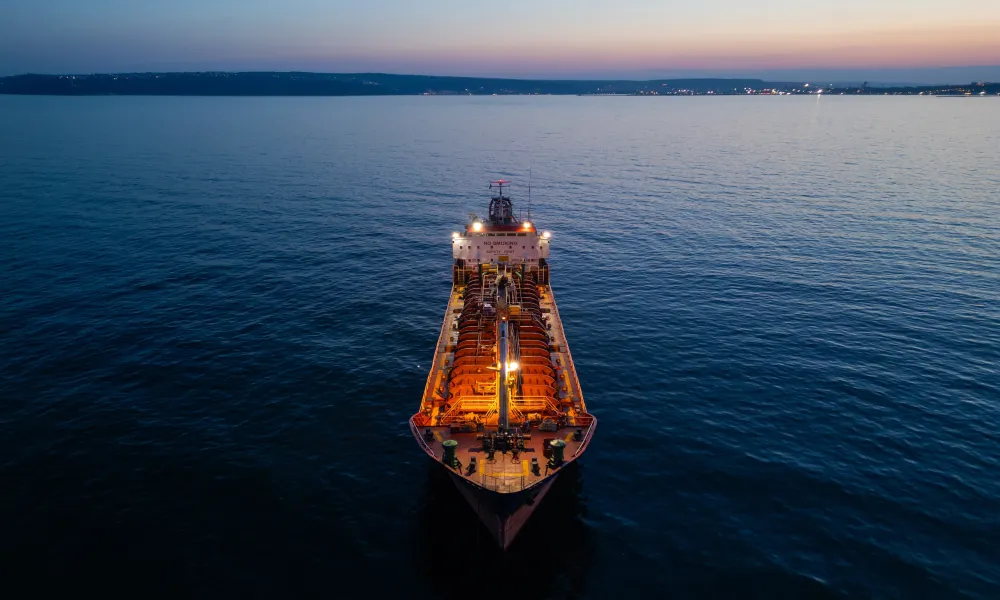

Oil producers in the Gulf have developed a new system to keep crude exports moving amid the war with Iran. According to CNN, tankers are sailing at night without transmitting their positions before transferring their cargoes to other vessels in the Gulf of Oman. Greek-owned ships are among those involved.
Tankers travel without tracking signals
One of the examples cited by CNN is the Greek-owned supertanker Kiku, which loaded crude oil at Qatar’s Mesaieed export terminal in late July.
Several days later, as it headed towards the Strait of Hormuz, the vessel disappeared from maritime traffic monitoring systems after switching off its Automatic Identification System, or AIS, transponder. The system broadcasts information about a ship’s position, speed and course.
The Kiku’s signal reappeared the following day on the other side of the strait.
CNN reports that the practice is being used increasingly by Gulf oil-producing countries to reduce the risk of attacks by Iranian drones. The tankers travel at night with their tracking systems switched off and under the protection of US military forces.
Oil shipments carried out in the dark
Companies from Saudi Arabia, Qatar, Kuwait and the United Arab Emirates are chartering tankers to make the crossing without transmitting their positions, according to CNN.
After reaching the Gulf of Oman, the vessels transfer the oil to other tankers operated by the eventual buyers before returning to the Persian Gulf.
CNN reports that the practice shifts much of the cost and risk away from commercial shipping companies and onto the oil-producing countries and the US government, which is helping protect maritime transport.
The US Department of Energy considers the strategy effective. An estimated 8 million to 9 million barrels of oil are now passing through the Strait of Hormuz each day, significantly more than is visible through conventional ship-tracking systems.
Greek-owned ships involved in transfers
CNN said it tracked more than a dozen ship-to-ship oil transfers in the Gulf of Oman over a two-day period.
After reappearing near the UAE port of Fujairah, the Kiku anchored alongside another Greek-owned supertanker, the Nave Electron. The two vessels remained together for around a week while crude oil was transferred between them.
The Nave Electron then departed carrying oil to the Chinese port of Ningbo. The Kiku remained in the area before returning to the Persian Gulf and Qatar.
CNN also identified another Greek-owned vessel, the Nissos Kythnos, as having taken part in a similar oil transfer operation through the Gulf of Oman.
Temporary response to a wider crisis
The new system has helped the global market absorb some of the disruption caused by the war, which has affected a significant share of global oil supplies for months.
Saudi Arabia has also redirected around 5 million barrels of oil per day through its East-West Pipeline to the Red Sea port of Yanbu, bypassing the Strait of Hormuz. Other Middle Eastern producers have diverted a further 2 million barrels per day, CNN reports.
Brazil, Guyana, Venezuela and the United States have increased production, while Washington has released hundreds of millions of barrels from the US Strategic Petroleum Reserve.
Risks to oil supplies remain
CNN cautions that the system cannot provide a permanent solution. Global oil inventories have fallen substantially during the conflict, while fuel markets are already under pressure because of problems at refineries in the Middle East and Russia.
Prices for petrol, diesel and aviation fuel have risen sharply, according to the network. The US government’s new strategy of increasing economic pressure on Iran has also helped push oil prices towards $100 a barrel.
The market’s ability to bypass some of the disruption in the Strait of Hormuz has so far prevented a more severe energy crisis. However, CNN reports that pressure on global energy markets is expected to continue without a political settlement and a lasting arrangement for navigation through the strait.
Source: CNN