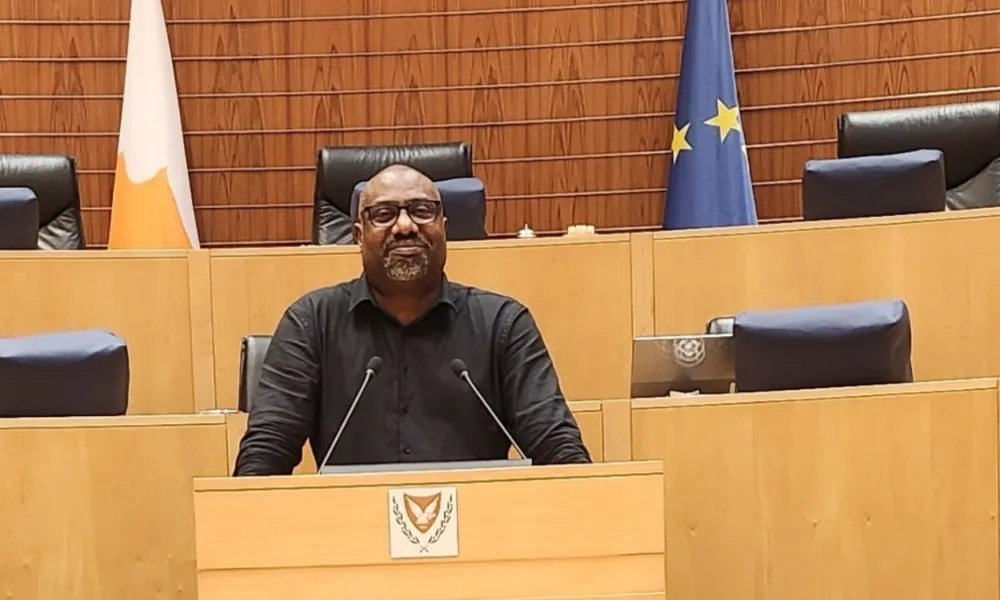
A 54-year-old learning technologist from London has turned the world’s parliaments into his personal school of politics. Nicholas Elliott has visited 33 parliaments in 19 months, paying for the trips himself.
Among them was Cyprus’s House of Representatives, an experience that he says made him reconsider not only Cyprus, but democracy itself.
When Elliott arrived in Nicosia on 8 December 2025, he may have expected the Cyprus familiar to many Britons: sunshine, holidays and a recognisable Mediterranean setting. Instead, he encountered rain, the aftermath of a major storm and, very quickly, a country far more complex than he had imagined.
“For us, Cyprus is somewhere we go on holiday,” he says.
He knew about the British bases, but little about the colonial period, independence in 1960 or the events that followed the Turkish invasion of 1974. He also admits that he did not know the island’s exact geographical location.
That, however, is part of his method. Elliott does not conduct exhaustive research before travelling. He prefers to arrive with as “clear a mind” as possible, listen to local people and speak with taxi drivers, employees, people in cafés and, of course, those working inside the parliaments themselves.
An idea born from a television quiz
The idea began almost by chance. Around two years ago, Elliott started appearing on television quiz shows and realised that he wanted to learn more about the world.
A family visit to the UK Parliament, together with his mother-in-law and his daughter, who studies political science, showed him that a parliament could offer a condensed lesson in history, culture and politics.
A visit to the Belgian Federal Parliament followed. Elliott then began emailing other parliaments to ask whether he could visit.
Nineteen months later, he had reached 33. Some now invite him directly.
He is neither an academic nor a politician. He works at a university as a learning technologist, designing and supporting digital learning environments.
It is precisely because he describes himself as “a normal person” that he believes parliamentary doors should also be open to ordinary citizens.
Discovering an unfamiliar Cyprus
Cyprus was among the visits that left the strongest impression on him.
The first surprise was the composition of the House of Representatives: 80 seats, 24 of which remain vacant, while 56 are allocated to Greek Cypriot MPs.
For a visitor unfamiliar with Cyprus’s political system, this was the first tangible reminder that the country’s political history does not simply belong to the past.
The divided city of Nicosia had an even greater impact. Elliott describes how Google Maps led him to roadblocks and streets he could not cross.
“You may have read a great deal of history, but when you experience it yourself, it is a different reality,” he says.
During two hours at the House of Representatives, he recalls learning more about Cyprus than he had throughout the rest of his life.
He was particularly struck by the presidential system, which differs from Britain’s parliamentary model, as well as by the election of a woman as president of the House.
Elliott also followed Cyprus’s parliamentary elections in May, focusing particularly on the growing strength of forces outside the traditional party system.
For him, these developments form part of a broader European realignment, with parties that were on the political margins only a few years ago now securing significant parliamentary representation.
A ‘normal person’ inside parliament
His journey has not made Elliott more certain about democracy. It has made him more demanding of it.
At first, he wanted to visit every parliament, including those in countries whose democratic systems he questions. He now says he prefers institutions that he considers democratic and open to their own citizens.
He is also concerned by the distance between voters and elected representatives, particularly in larger countries.
In smaller parliaments, he says, there is often a closer relationship with local issues and less of a sense of an impersonal “political machine”.
This is one reason why he is particularly fond of smaller countries. He has found that they often respond more warmly to his project.
In Slovenia, for example, a parliamentary official expressed delight that someone had taken an interest in an institution often overshadowed by the parliaments of Britain, France or Germany.
One of the most personal moments of his travels came in Jamaica. Elliott’s father is Jamaican, and he visited the country for his father’s 80th birthday.
The Jamaican Parliament not only welcomed him but formally recognised him during a sitting, with his mother present. It was the first time a parliamentary institution had publicly acknowledged his project.
Democracy in the TikTok era
Another challenge concerns Elliott deeply: the TikTok generation.
As the father of two daughters, aged 14 and 19, he sees first-hand how differently younger people consume information.
“If you cannot connect with young people, democracy may eventually come to an end,” he says.
He does not mean that politicians should dance in front of a camera. He believes, however, that they must learn to communicate serious messages within a few seconds, on the platforms where much of their audience now spends its time.
Politics, he argues, cannot simply expect younger generations to return to older ways of consuming news. It must also find the language needed to reach them.
‘It is your Parliament’
Elliott’s simplest message is ultimately directed at citizens themselves.
He uses an analogy: if we rented our home to someone for five years, we would want to know who they were and would occasionally check how they were looking after it.
With politicians, he says, people often do the opposite. They elect them for four or five years and only take an interest again when the next election approaches.
“Speak to your politicians. Find out what they are doing and where your money and taxes go. Watch the parliamentary sittings,” he urges.
For Cyprus, he has an even more important message. If someone is willing to travel from London to enter the House of Representatives and learn how it works, then Cypriots themselves have even more reason to understand the institution representing them.
He made this point to a Cypriot friend who had never visited the House and asked him to describe what he had seen.
“I’m not going to tell you. You are Cypriot. If you want to learn about your country, you must go there. It is your Parliament,” he told her.
That is the central purpose of Elliott’s journey. He is not simply collecting photographs of parliamentary benches, presidential chairs and plenary halls.
He is collecting small pieces of evidence showing how close, or how distant, democracy is from the people it is meant to serve.