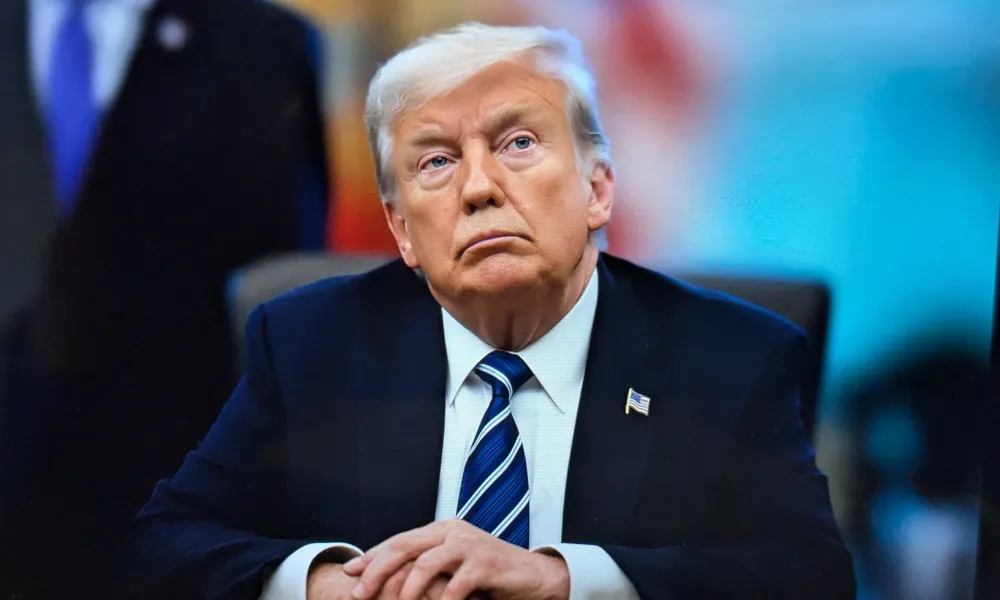



One hundred days into a war he began without congressional approval, President Donald Trump is rewriting his own campaign history. In an interview with NBC's "Meet the Press" host Kristen Welker, taped in Wisconsin on Friday and aired on Sunday, Trump denied ever having pledged to keep the United States out of new conflicts, a promise he made repeatedly and emphatically on the 2024 campaign trail.
Welker: "You insisted no new wars."
— The Bulwark (@BulwarkOnline) June 7, 2026
Trump: "First of all, I didn't guarantee no war."
Welker: "You said it over and over again." pic.twitter.com/CFNhFFuspn
"I didn't guarantee no war," Trump told Welker. "Why would I have built the strongest military in the world?" He added: "I don't like these endless wars. This is not an endless war. We've been doing this for three months."
The record says otherwise. As a candidate, Trump told a crowd in Pennsylvania: "I will not send you to fight and die in stupid foreign wars that never end." On election night in 2024, he said directly: "I'm not going to start a war. I'm going to stop wars." On Sunday, he said he had not promised anything.
The interview, which Trump abruptly ended after being pressed on unsubstantiated claims of election fraud in California, calling NBC "a one-sided crooked network" before walking out, offered a revealing portrait of a president under mounting pressure over a war that is costing the United States roughly $29 billion a month, has deployed some 50,000 troops to the Middle East, and shows no clear path to conclusion.
Vague on the endgame
Trump offered little clarity on when or how the conflict ends. He repeated his promise that fuel prices would fall once the war is over: "It's all coming down as soon as the war's over." He declined, however, to commit to withdrawing any of the troops currently stationed in the region. "It costs us very little to keep them there," he said. "I would say it would be foolhardy to do that because maybe we may use them. It's unlikely. But I think we'll keep them there until such time as we have a completion."
He also failed to explain how the United States intends to remove highly enriched uranium from Iran's heavily secured underground bunkers, which he has described as a core objective of the operation. He suggested that if no deal was reached, US forces would continue fighting and then "go in for the uranium." On the state of negotiations with Tehran, Trump described Iranian negotiators as "more rational" and "very smart," and insisted a deal was within reach. He had told the Financial Times separately: "We're very close to a deal, or I'm going to blow the hell out of them." Iran's demands include the lifting of US and international sanctions, the release of billions of dollars in frozen assets and recognition of its control over the Strait of Hormuz.
The nuclear justification
Trump defended the decision to strike Iran by arguing that Tehran had been on the verge of acquiring a nuclear weapon. "If I didn't go in there with the B-2 bombers, they would right now have a nuclear weapon, and it could be that half of the world would be eradicated already," he said. That assessment is not consistent with the intelligence picture presented to Congress earlier this year by then-Director of National Intelligence Tulsi Gabbard, whose testimony stopped short of confirming Iran was at the threshold of weaponisation. The Pentagon has said US forces have destroyed approximately 90% of Iran's conventional navy, more than 95% of its naval mines and more than 80% of its missile facilities. Trump framed the operation as a swift and decisive success, comparing the pace favourably to the Vietnam War and the US presence in Iraq. "We're there for a few months," he told Welker. "And the threat is largely over. Soon, it will be over."
Growing domestic pressure
The interview came as Trump faces growing domestic scrutiny on multiple fronts. Fuel costs have risen 40% since the war began, with US petrol averaging $4.17 a gallon nationally, and the total cost of the war reached approximately $29 billion in May. With midterm elections approaching, voters have become increasingly vocal about the economic burden of the conflict, and Republican lawmakers have grown restless over Trump's push to create a fund to compensate people he describes as victims of federal prosecution, many of them participants in the 6 January 2021 Capitol assault. Trump's attorneys said in court this week that the fund, estimated at nearly $1.8 billion, was not moving forward, but Trump continued to advocate for it in the NBC interview. "If they get it approved, that's great," he said. "If they don't get it approved, I'd be disappointed."
The war marked its 100th day on Sunday with Iran and Israel exchanging their worst strikes since the April ceasefire, oil prices above $96 a barrel and peace negotiations under serious strain. Trump, pressed on the widening gap between his promises and the present reality, reached for historical comparison. "Listen, Kristen," he said. "We're there for a few months. And the threat is largely over. Soon, it will be over."
Source: New York Times, NBC News