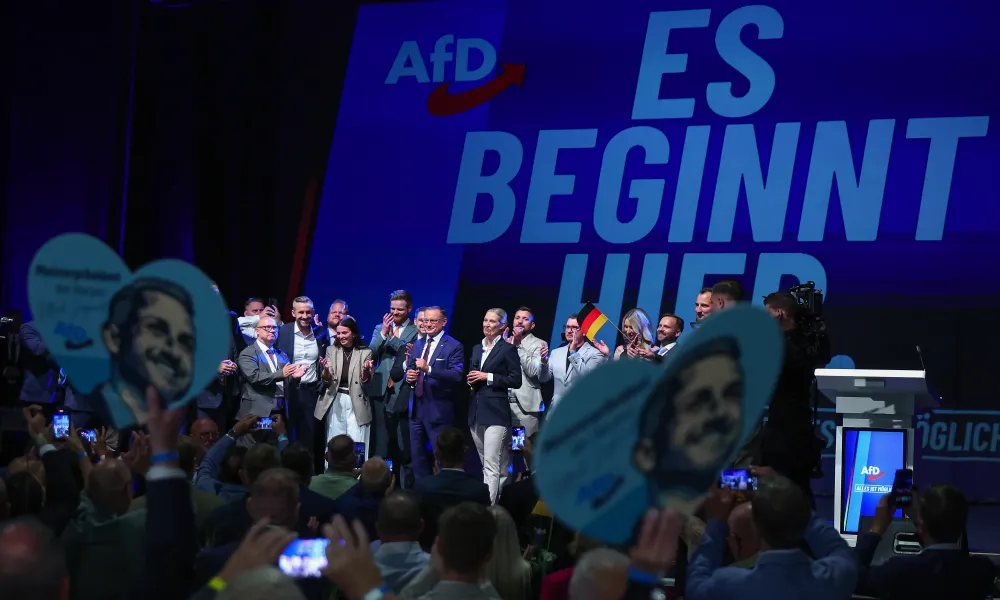



The Alternative for Germany, AfD, finished comfortably first in Sunday's state election in Saxony-Anhalt, according to official results, more than doubling its support from the last state election in 2021. The Christian Democrats, Chancellor Friedrich Merz's party, saw their vote share nearly halved to 17.2%, with Reuters reporting that around 83,000 former Christian Democrat voters switched to the AfD. Three other parties, the Social Democrats, the Greens and Die Linke, each cleared the 5% threshold needed to enter the state parliament, securing roughly 9% apiece. The populist Sahra Wagenknecht Alliance, known as BSW, also passed the threshold. The outgoing coalition partner, the Free Democrats, collapsed to 2.6% and lost all its seats.
Turnout was reported at 77%-78%, being described as the highest since German reunification in 1990.
Despite its scale, the AfD's win leaves the party short of the outright majority it would need to govern alone. Every other party in the state parliament has ruled out forming a coalition with it, a longstanding policy known in German political shorthand as the "firewall," or Brandmauer. The AfD calls the policy undemocratic. National AfD co-leader Tino Chrupalla appealed directly to Christian Democrat lawmakers on Monday to help form what he called a "centre-right conservative majority" in the state, telling German broadcaster ARD that "politics always means compromise," according to Reuters. Ulrich Siegmund, the AfD's 35-year-old lead candidate in Saxony-Anhalt, said he hoped to become the state's premier if a stable majority could be built, though he has previously rejected the idea of leading a minority government.
The BSW is the only party to have signalled any openness to working with the AfD, and could in theory allow Siegmund to govern by abstaining in a parliamentary vote rather than voting against him, Reuters reported. BSW's state leader, Klaudia Witting, said it would be "completely undemocratic" not to involve the AfD in government in some way. One alternative floated is a Christian Democrat minority government tolerated by Die Linke, similar to arrangements already in place in neighbouring Thuringia and in Saxony, though the Christian Democrats have a standing internal resolution against cooperating with either the AfD or Die Linke. Analysts say that whatever government eventually emerges is likely to be fragile.
Pressure mounts on Merz in Berlin
The result has landed heavily on Merz, whose personal approval has fallen to what analysts describe as historic lows. Marcel Fratzscher, president of the German Institute for Economic Research, called the result "above all, a vote of no confidence in the federal government," according to Reuters. Tim Brand, a board member of the Christian Democrats' youth wing in Brandenburg, said the chancellor should step down as both chancellor and party chairman and that new elections should be held. Others pushed back firmly: Torsten Frei, leader of the Christian Democrat-led parliamentary group, insisted "the chancellor is elected for four years" and ruled out any reshuffle.
Der Spiegel described party officials as shocked and spoke of a looming "chancellor problem." Handelsblatt called the night "historic" for the AfD and a "fiasco" for the Christian Democrats. The Süddeutsche Zeitung warned that "the centre failed" and that the AfD is "dangerously close to power," adding that the long-standing assumption that Nazis and their sympathisers were permanently excluded from power in Germany "is being replaced by the reminder that nothing is guaranteed forever."
Reaction beyond Germany's borders
French Finance Minister Roland Lescure told RTL radio it "sends out a very, very worrying signal," linking it to what he called a global populist wave. Polish Foreign Minister Radoslaw Sikorski called it. Elon Musk posted a message on X congratulating AfD co-leader Alice Weidel and dismissing the party's "far-right" label as "fake news," framing its platform instead as common sense.
Analysts see the result as part of a broader European pattern. Mujtaba Rahman of Eurasia Group told The New York Times that governments across the continent are struggling with a form of "sophisticated state failure," unable to address cost-of-living pressures that are pushing voters toward the political extremes. With elections due in France, Spain and Italy over the next two years, and with Marine Le Pen currently leading first-round polling in France, several analysts quoted by the Times argue that Saxony-Anhalt may serve as both a warning and a template for the wider European right.
A state defined by decline since reunification
Saxony-Anhalt is one of Germany's smaller states by population, roughly 2.23 million people across an area of 20,447.7 square kilometres, entirely within the former East Germany. It is, by several measures, also one of the country's most economically marginal states, and analysts say that history is central to understanding Sunday's result.
Marcus Böick, a historian at Cambridge University who grew up in the state, told the Christian Science Monitor that Saxony-Anhalt is now the oldest state in Germany by average resident age, and that the population of his own hometown has halved since reunification as younger residents leave for cities or for western Germany. He described the collapse of East German society after 1989, when factories and the Communist Party had structured daily life, as leaving a vacuum that, in his account, only the AfD has since filled by embedding itself in local clubs and associations. "Voting for right-wing populists is a very rational thing to do in the rural areas" of the east, he said, calling it "a cry for support."
Elisabeth Kaiser, the federal government's commissioner for eastern Germany, linked the region's politics to the economic shock that followed reunification, when many state-owned East German enterprises closed and unemployment and outmigration surged, particularly among young women. That experience, she said, has become part of "a collective East German memory" involving "this sense of devaluation" and the realisation that everything can change overnight, according to comments reported by the South China Morning Post. Markus Ziener of the German Marshall Fund told the Christian Science Monitor that western Germany had long assumed prosperity transfers alone would secure eastern loyalty to mainstream parties, and had "misjudged" what lay beneath that assumption. He said eastern Germans "feel the West Germans are in control of everything."
How the AfD got here
The AfD was founded in February 2013, in the aftermath of the Eurozone financial crisis, initially as a Eurosceptic party focused on fiscal sovereignty rather than immigration. The party now holds 151 of 630 Bundestag seats and reports around 75,000 members as of mid-2026. It is co-led by Alice Weidel, who was the party's candidate for chancellor in 2025, and Tino Chrupalla.
Germany's domestic intelligence service has designated the national AfD a "suspected extremist" organisation, while its Saxony-Anhalt branch specifically has been designated a confirmed right-wing extremist group, allowing for increased surveillance, according to the New York Times. The AfD rejects both designations as politically motivated. The party's Vision 2026 manifesto, on which its Saxony-Anhalt campaign was built, calls for a state-level deportation task force, the removal of war refugee status for Ukrainians from eastern Ukraine, segregated classrooms for refugee children, a ban on rainbow flags in schools, restrictions on Islamic religious expression including the call to prayer, and financial incentives for German citizens to have more children rather than pursuing immigration to offset an ageing population, according to Reuters' review of the manifesto.
A wider European pattern
Analysts caution against reading Saxony-Anhalt in isolation. Jana Puglierin of the European Council on Foreign Relations told the New York Times that the result reflects less the appeal of the AfD's own programme than "the political establishment's failure to articulate a convincing vision" for the region's future. That reading echoes a broader argument now circulating among analysts of the German result: that a party's rise from marginal protest vote into a genuine social base, as Saxony-Anhalt appears to show, reflects real and unaddressed grievances over representation, migration and economic security, and that treating the firewall against the AfD as a complete political strategy risks ceding ownership of those grievances to the far right.
Sources: Reuters, The New York Times, CNA, AMNA