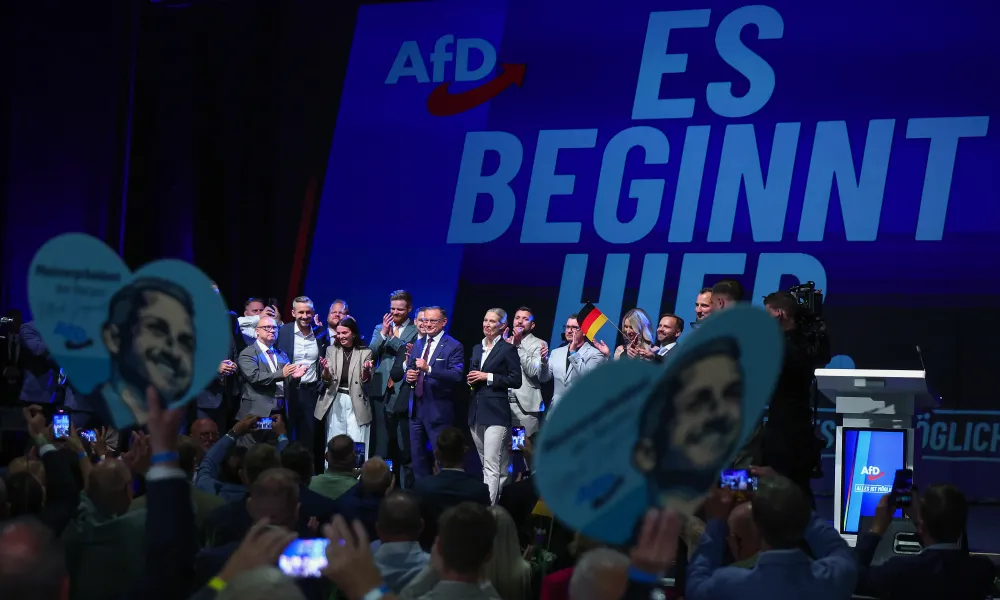

Germany's far-right Alternative for Germany (AfD) won Sunday's regional election in Saxony-Anhalt, but appears unlikely to secure outright control of the state parliament, leaving the formation of a new government uncertain.
According to preliminary results, the AfD won 43.8% of the vote, comfortably ahead of the Christian Democratic Union (CDU), which fell to 17.2%.
Three parties from the centre-left spectrum, the Social Democrats (SPD), the Greens and The Left (Die Linke), each secured around 9%, ensuring representation in the state parliament.
The Sahra Wagenknecht Alliance (BSW) also crossed the 5% threshold and won seats, while the pro-business Free Democratic Party (FDP) slumped to 2.6%, losing parliamentary representation.
Voter turnout reached 78%, the highest recorded in the state since German reunification in 1990.
Who will govern?
Despite its electoral victory, the AfD's route to government remains complicated.
The party had hoped to secure an outright majority of seats, allowing it to govern alone, but projections suggest it is unlikely to achieve that goal.
At the same time, almost all other parties continue to reject cooperation with the AfD under Germany's long-standing political "firewall" policy.
BSW has indicated a willingness to cooperate with the AfD only on individual issues rather than in a formal coalition.
For the moment, Saxony-Anhalt is governed by a coalition of the CDU, SPD and FDP, but that alliance can no longer continue following the FDP's collapse.
A CDU-SPD-Green coalition also appears mathematically unworkable.
One possible option would be a CDU-led minority government dependent on support from The Left, a scenario similar to arrangements seen in Thuringia and Saxony.
However, that prospect is controversial within the CDU, which has formally ruled out cooperation with both the AfD and The Left.
Pressure grows on Merz
The election is widely being viewed as a serious setback for Chancellor Friedrich Merz.
The CDU has suffered another regional defeat, this time in a state that was long considered one of its strongholds.
German media have suggested the result could reopen questions about Merz's leadership.
The public broadcaster ARD reported growing calls from within party ranks for a renewal of personnel and policy, while commentators questioned how long the Chancellor could withstand continued electoral setbacks.
Tim Brandt, a board member of the Young Union in Brandenburg, argued that the CDU requires "a new beginning" and called on Merz to resign as both Chancellor and party leader.
The Chancellor himself has so far avoided public comment on the result.
CDU rejects leadership speculation
Government officials and senior CDU figures have sought to downplay suggestions of a leadership crisis.
Chancellery chief Nina Warken described the outcome as "a very difficult result" but insisted it would not simply be accepted without reflection.
Meanwhile, CDU/CSU parliamentary leader Thorsten Frei rejected the possibility of Merz stepping down or reshuffling the federal cabinet.
"The Chancellor is elected for four years," Frei said.
"No. We are in a good position."
He argued that the government must do more to engage with voters and address concerns that many regard as legitimate.
AfD sees national significance
AfD leader in Saxony-Anhalt Ulrich Siegmund described the result as a breakthrough and suggested it carried significance well beyond the state.
He said the party would not abandon its positions simply to secure a coalition and argued that the election sent a message to the entire country.
"We have finally found ourselves and our place in Germany," he said.
Media reaction
German newspapers portrayed the result as a landmark political moment.
Handelsblatt described it as a "historic success" for the AfD and a "debacle" for the CDU.
Die Zeit spoke of "shock" and "disappointment" within CDU ranks following what it called an electoral fiasco, arguing that the scale of the AfD's victory reflected a profound shift in voter behaviour.
The Süddeutsche Zeitung warned that the result demonstrated that Germany was no longer immune to right-wing extremism and that established parties faced increasingly difficult choices in responding to the AfD's rise.
Support from the United States
US President Donald Trump, who has repeatedly expressed sympathy for Germany's far right, shared a graphic on Truth Social highlighting the AfD's victory in Saxony-Anhalt.
A former associate of Elon Musk also congratulated AfD leader Alice Weidel on social media, criticising media descriptions of the party as far-right and praising what he described as its defence of national interests.
Source: CNA