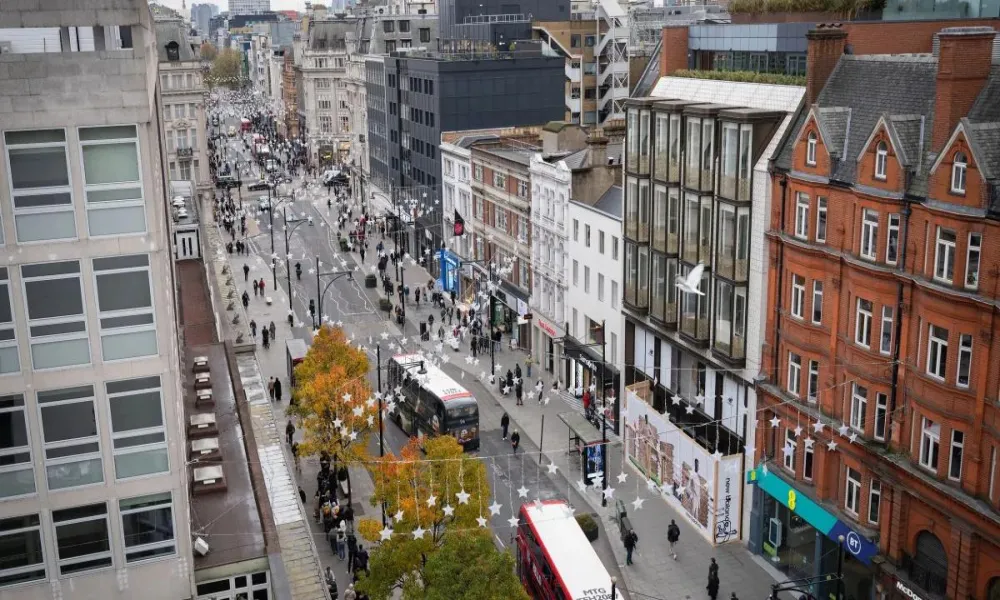

A new era began on Monday, 26 October, for Oxford Street, one of the world's busiest and most recognisable shopping destinations, as vehicles were removed from a central section of the famous London thoroughfare and public space was handed back to pedestrians.
The British capital is following a path already taken by several major European cities, most notably Paris, by investing in urban quality, accessibility and retail activity through reduced vehicle traffic.
The initial phase covers almost one kilometre, stretching from Orchard Street, near the iconic Selfridges department store, to Great Portland Street, just beyond Oxford Circus.
From today, private cars, buses, taxis, motorbikes and bicycles are no longer permitted in that section. Exceptions will apply for emergency vehicles and overnight deliveries to businesses.
The change marks a historic shift for a street that attracts around half a million visitors every day and serves as one of Europe's most important retail corridors.
The initiative, introduced by London Mayor Sadiq Khan, forms part of a wider regeneration programme that includes additional green spaces, seating areas, improved lighting and more room for shoppers and visitors.
The idea behind the project is that commercial success does not necessarily depend on allowing customers to drive directly to shop entrances, but rather on the overall experience offered by a commercial district. London is seeking to boost Oxford Street's competitiveness by transforming it from a traffic-heavy road into an attractive public space.
Following Paris' example
London is pursuing an approach already adopted by Paris, where extensive measures have been introduced in recent years to reduce vehicle traffic and encourage walking and cycling.
One notable example is Rue de Rivoli, where vehicle access has been significantly restricted in favour of pedestrians, cyclists and authorised vehicles.
Similar projects have transformed several parts of the French capital, with local authorities increasingly treating public space as a crucial component of both economic activity and everyday life.
The changes have not been without controversy. Concerns have been raised over accessibility, deliveries and the possibility of traffic being displaced to nearby streets.
Nevertheless, the direction of urban policy remains clear, with growing emphasis on reducing dependence on private cars.
Cyprus moving in the opposite direction
While many European cities continue to restrict vehicle access in major shopping districts, public debate in Cyprus has largely moved in the opposite direction.
In Nicosia, despite experts highlighting the need to reduce car dependency, Makarios Avenue remains at the centre of ongoing disputes. Organised groups of shop owners continue to lobby politicians, municipal authorities and government agencies to allow greater access for private vehicles.
They argue that existing restrictions have harmed commercial activity and that more cars would help attract additional customers.
A similar debate is taking place in Limassol, where discussions over the future of Anexartisias Street continue. Some business owners are pressing for vehicle access to remain, while proposals for one-way traffic and wider pavements have been suggested as an alternative to full pedestrianisation.
The contrast is striking.
While London views the removal of cars as an investment in commercial revitalisation, part of Cyprus' business community still sees vehicle access as essential to the survival of city-centre shops.
Cypriot cities do not enjoy the same level of public transport infrastructure as London or Paris. As a result, successful pedestrianisation would require complementary measures such as alternative transport options, park-and-ride facilities and comprehensive accessibility planning.
The broader question remains whether the solution to challenges facing city centres lies in bringing back more cars, or in creating urban environments that give people more reasons to visit, spend time and stay.