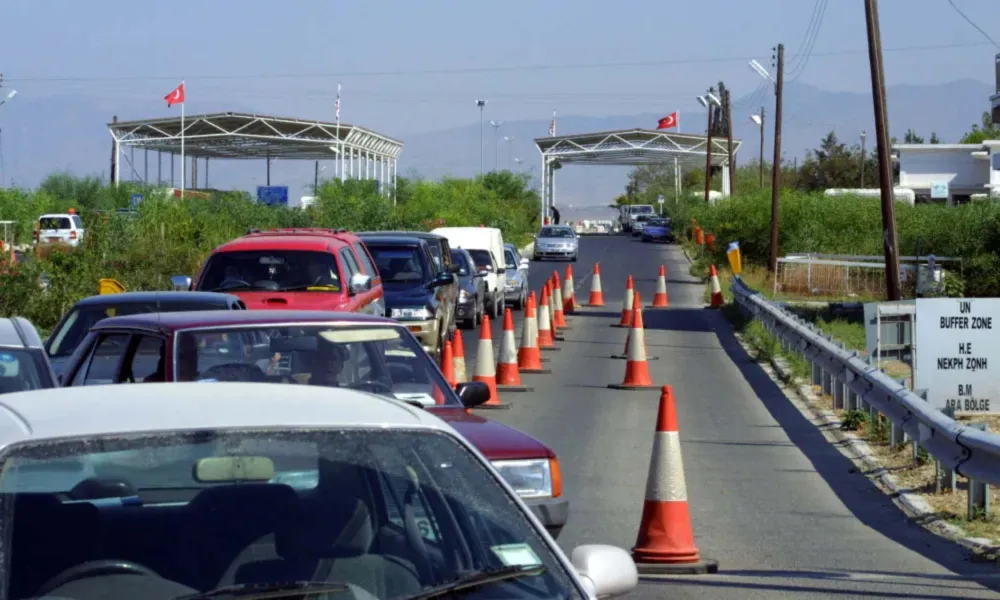

Police are continuing to serve outstanding traffic fines generated by Cyprus’ mobile and fixed speed cameras at all crossing points, with around 25,000 fines delivered to people passing through checkpoints so far.
According to information obtained by the Politis, the fines relate to cases where previous attempts to serve the notices through the prescribed procedure had been exhausted.
These attempts include two registered letters followed by an effort to deliver the notice through a private process server.
In some cases, more than one outstanding fine may relate to the same individual.
Police continue checkpoint service
The practice has nevertheless raised questions over its legal basis and was discussed by the House of Representatives’ Legal Affairs Committee last July.
MPs questioned whether the legislation governing the traffic camera system specifically allows fines to be served at crossing points.
The issue was raised following an initiative by AKEL MPs Aristos Damianou and Andreas Pasiourtidis, who referred to complaints that fines had been served at checkpoints and airports.
The MPs argued that such a practice was not covered by the existing legislation.
Legal Service says service is lawful
Representatives of the Traffic Police took the view that serving the fines at crossing points was not prohibited.
The Ministry of Justice and Police have also relied on an opinion from the Legal Service, which concluded that the practice is lawful.
The opinion, which was submitted to Parliament, states that there is no restriction on an officer serving written notices or summonses at crossing points.
It refers to Article 46 of Chapter 155, as cited by Article 6(2) of Law 55/2001, under which written notices or summonses may be served anywhere in the Republic by a police officer or a person authorised in writing by the responsible officer.
What the camera legislation provides
The relevant legislation is Article 6 of the Traffic Offences (Use of Photographic Devices and Other Related Matters) Law of 2001.
Under the law, where an offence is recorded using a photographic device, the owner of the vehicle shown in the photograph is served with the device’s finding, including an explanation of the location code, together with a notice under the legislation governing the out-of-court settlement of offences.
The law provides that these documents may be served personally in accordance with Article 46 of the Criminal Procedure Law or sent by registered personal post to the vehicle owner.
Personal service may also be carried out by a person authorised in writing by the responsible officer to perform the relevant duties on his or her behalf.
Based on this framework, the Legal Service has concluded that there is no legal restriction preventing a police officer from serving the fines at crossing points.
Questions remain over implementation
Although the Legal Service has provided its interpretation of the relevant legislation, questions were raised in Parliament over whether the specific practice adopted by Police at checkpoints is sufficiently covered by the legislation governing photographic enforcement.
A separate issue concerns airports and ports.
Police explained that the automated passport identification and control system used at such locations cannot identify whether a person has outstanding, undelivered camera fines.
The system can identify matters such as arrest warrants, but does not detect outstanding fines issued through the photographic enforcement system.
Around 228,000 fines remain outstanding
Meanwhile, the number of undelivered camera fines remains high.
According to information obtained by the Politis, around 228,000 fines are currently awaiting service.
The number previously reached approximately 330,000 following the introduction of the photographic enforcement system.
The exceptionally high figure prompted the Ministry of Justice and Police to look for alternative ways of serving notices on drivers who had committed traffic offences.
The continued use of crossing points is therefore intended to address part of the longstanding backlog, while the legal framework governing the service of camera fines remains under scrutiny.