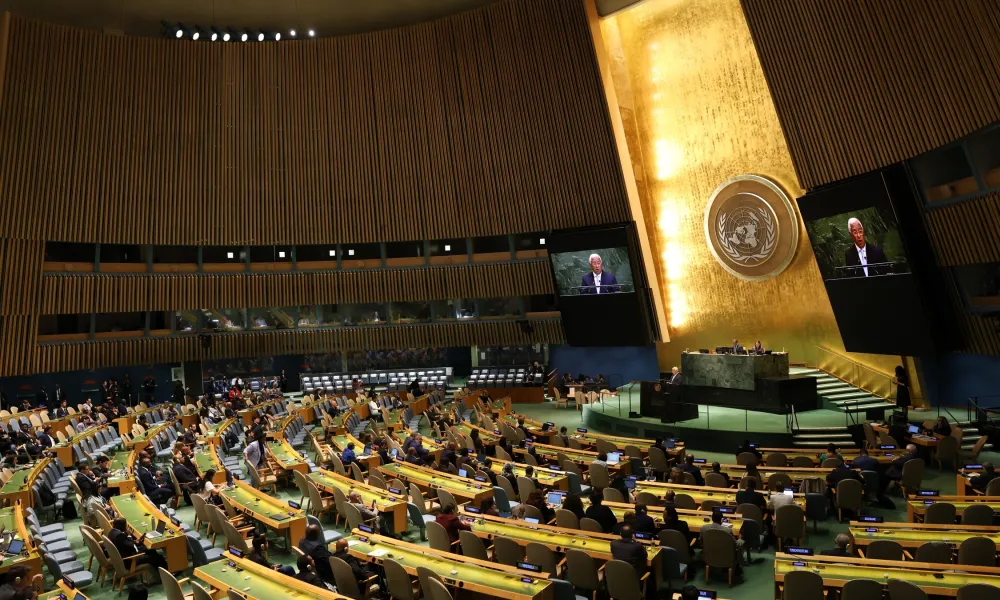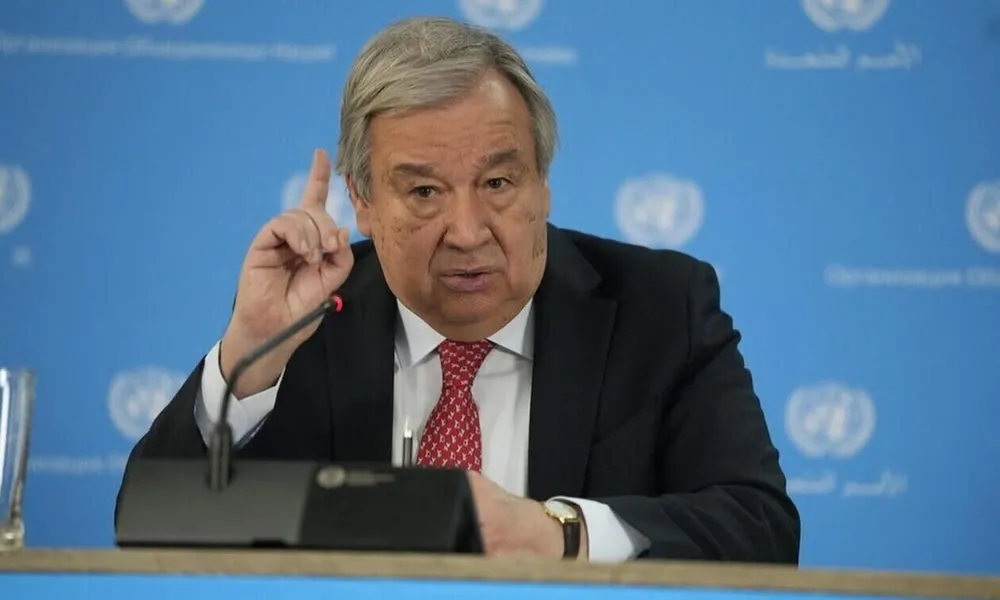

At a critical point in the United Nations’ effort to bring the Cyprus problem out of deep freeze, Secretary-General António Guterres is considering what can realistically be achieved to prevent the island’s dangerous stagnation from continuing.
Before his term ends, he is “trying to persuade the two sides to take concrete steps towards a final settlement”, his personal envoy, María Ángela Holguín, said after briefing him in New York.
The news is not encouraging. Judging by Holguín’s remarks, a settlement appears increasingly unlikely. She has denied reports that she is sounding out the parties on new ideas for a strategic agreement or a comprehensive settlement plan.
“I have not written a single word,” she said.
The reason is well known. Guterres is interested “not only in the resumption of negotiations, but in ensuring that a new process can reach a successful conclusion”, Holguín noted.
What punishment?
For nine years, Cyprus has been moving closer to the edge. As Guterres approaches the end of his term, he is reminding Cypriots that no one can help them unless their own leaders genuinely want a settlement.
“The sustained and sincere political will of both leaders, supported by their communities, remains essential for a successful outcome,” Holguín said.
“The UN does not have prisons in which to punish leaders who fail to honour their commitments,” a diplomatic source with full knowledge of the discussions told Politis.
Over the years, the UN has exhausted every available option, but none has produced a successful result. The source listed efforts to restart the process through a declaration of principles, confidence-building measures, packages of ideas and documents recording previous convergences. All ultimately failed.
There is no substitute for political will when it is absent among the leaders.
Lowering the bar
Guterres can see the deadlock and may decide to lower expectations, at least to keep hope alive.
The idea of a “joint declaration on the future” is already reflected in Holguín’s writing.
“Cyprus can become a place where bridges are built in every direction and coexistence is promoted in a complex region such as the eastern Mediterranean,” she wrote. “In this way, it can serve as an example for the region, Europe and the rest of the world.”
Such an option would suit President Nikos Christodoulides, allowing him to argue that he revived the UN-led effort, which could then continue under the next Secretary-General.
It would also benefit Turkish Cypriot leader Tufan Erhürman by helping him reassure a disillusioned constituency searching for a way forward.
Ultimately, a meaningful effort may only become possible if the leaderships change, something that could happen in 2028.
Despite the gloom prevailing in Nicosia, Holguín offered a positive assessment of the foreign ministers of Greece and Turkey.
“The discussions were frank, clear and focused on the areas in which work is needed to create the conditions for concrete actions that will allow progress on the Cyprus problem,” she said.
The EU’s role
Holguín also wrote that “other actors, such as the European Union, have an important role to play in creating an environment that will actively support, with determination and vision, the effort to resolve the Cyprus problem”.
The EU maintained an active presence until the Crans-Montana talks and made a significant contribution to the negotiations. More recently, the European Commission proposed including specific funding for reunification needs in the EU’s new budget for 2028 to 2034.
However, the conditions required for the EU to re-enter the process have remained undeveloped for years. Negotiations have been paralysed, and the EU is unwilling to become involved without the UN framework that guides the process.
Efforts to align the Turkish Cypriot community with the European Union were unfortunately suspended by a decision of the Cyprus government, leaving the north of the island a decade behind.
Nicosia’s longstanding approach in Brussels towards the strategic relationship between Turkey and the EU has also failed to help create the necessary connections.
EU-Turkey relations have nevertheless gained momentum, despite strong objections and technical obstacles raised primarily by Nicosia and, to a lesser extent, Athens.
The agenda of mutual interests has expanded, while the continuing difficulties are affecting the vital interests of other European partners. This is reflected at every meeting.
The most recent example was the joint statement issued in Ankara on June 30 following talks involving Turkish Foreign Minister Hakan Fidan, EU foreign policy chief Kaja Kallas and the commissioners responsible for enlargement and migration.
The Cyprus problem received only a passing reference, perhaps the most limited yet. The four officials “expressed their support for the efforts of the UN Secretary-General regarding the Cyprus issue”.
Guterres clearly recognises that the island remains trapped in its troubled past.
“There is fear, and within this climate of uncertainty, powerful forces are emerging that appear to favour preserving the status quo,” Holguín wrote.
But she also warned that “the status quo can no longer guarantee stability and security in today’s rapidly changing and turbulent world”, even as the island’s leaders continue to pretend otherwise.