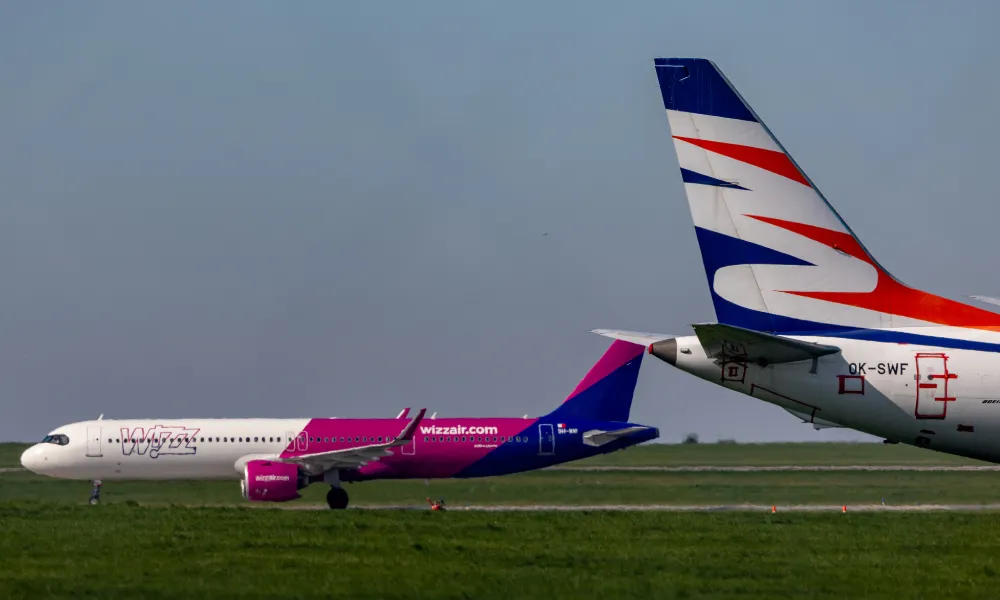

Cyprus ranks among the most dynamic aviation markets in the Eastern Mediterranean. At the same time, the cost of air travel is becoming an increasing concern for passengers.
Andras Szabo, Network Officer at Wizz Air, speaks to Politis about the outlook for the European aviation market, explains why the airline considers Cyprus a strategically important destination, outlines its expansion plans and addresses the issue of ticket prices.
The aviation industry continues to face geopolitical uncertainty, inflationary pressures and changing travel demand. How would you describe the current state of the European aviation market, and what are the main challenges facing low-cost airlines such as Wizz Air?
The European aviation market remains resilient, with demand for travel continuing to be strong across most markets. However, the industry is operating in an increasingly complex environment shaped by geopolitical developments, inflationary pressures, airspace restrictions and continuing supply-chain challenges affecting aircraft deliveries and maintenance across the sector.
For low-cost airlines, the main challenge is maintaining operational efficiency and cost competitiveness while remaining flexible enough to respond to rapidly changing market conditions. This is where Wizz Air’s business model and disciplined approach provide a significant advantage.
We continuously monitor geopolitical developments and assess their potential impact on our operations, working closely with the relevant authorities and aviation industry partners. Our teams have extensive experience in adapting quickly when circumstances require it, while ensuring that passengers are kept informed in a clear and transparent manner.
Fuel and fares
Fuel prices remain one of the most significant factors affecting airline profitability. How does Wizz Air manage volatility in fuel costs, and to what extent does hedging influence your pricing and operational strategy?
Fuel is one of the largest cost components for any airline, which is why managing volatility effectively is essential. At Wizz Air, we follow a disciplined and proactive approach through a combination of strategic hedging, operational efficiency and fleet modernisation.
Our fuel strategy provides greater cost predictability and reduces our exposure to short-term market fluctuations. This allows us to plan our operations more effectively and continue offering competitive fares, even during periods of significant volatility in global energy markets.
At the same time, we continue to invest in our modern fleet, which is among the youngest in Europe and records some of the lowest carbon dioxide emissions per passenger kilometre.
We operate almost 270 aircraft, with the Airbus A321neo accounting for three quarters of the fleet. It consumes around 20% less fuel per seat than previous-generation aircraft, reducing both operating costs and emissions.
Although fuel prices will continue to be an important factor for the industry, the combination of prudent hedging, operational discipline and an efficient fleet allows us to manage market fluctuations effectively.
Our priority remains maintaining reliable operations, affordable fares and strong value for our passengers, regardless of external conditions.
Airfares have increased in many European markets in recent years. Do you believe prices have now stabilised, or should consumers expect further increases because of fuel costs, airport charges and operating expenses?
Although the industry continues to face cost pressures from fuel, airport charges and inflation, our priority at Wizz Air remains keeping fares as low as possible.
Thanks to our efficient business model, disciplined cost management and modern fleet, we are in a strong position to offer highly competitive fares even in a challenging environment.
Ticket prices will continue to be influenced by external factors. However, we do not believe that rising costs should automatically translate into substantially higher fares.
Our strategy is based on stimulating demand through low prices and consistently offering customers the best possible value. Low fares mean more passengers, higher load factors and a greater number of commercially viable flights.
Wizz Air has built its business model around affordable travel. How do you balance competitive fares with profitability?
Keeping fares low and protecting profitability go hand in hand at Wizz Air. Our business model is built on efficiency, from operating one of Europe’s youngest fleets to maximising aircraft utilisation and maintaining a disciplined cost structure.
We continuously look for ways to improve efficiency across all areas of our operations while keeping costs under control. This allows us to offer competitive fares to customers while ensuring that the business remains sustainable and profitable.
Our objective is simple: to provide affordable travel without compromising operational excellence or long-term growth.
Cyprus
Cyprus has developed into a highly competitive aviation market, with passenger traffic reaching record levels. How strategically important is the Cypriot market to Wizz Air, and what role do you see it playing in the airline’s regional expansion plans?
Cyprus is a highly important and long-established market for Wizz Air. We are proud to operate an extensive and diverse network of routes to and from Cyprus, making us one of the largest airlines operating in the country.
Wizz Air is continuously expanding its network serving Cyprus, supporting tourism through a large number of year-round connections that make a significant contribution to the economy during the shoulder and low seasons as well.
At the same time, we are operating an increasing number of routes serving multiple purposes, facilitating business travel, short leisure trips and family visits for the benefit of Cypriot passengers.
We are particularly proud of the recent launch of the Larnaca to Barcelona and Larnaca to Madrid routes, as well as the return of the Larnaca to Athens service from August.
We have developed strong partnerships with the airport and tourism stakeholders, which have supported our growth and enabled the launch of new routes.
We continue to see considerable potential in the Cypriot market and remain committed to strengthening connectivity, responding to passenger needs and providing affordable travel options across the island.
Larnaca has developed into one of Wizz Air’s most important bases in the Eastern Mediterranean. Are there plans to expand your presence in Cyprus further?
Absolutely. Cyprus remains a key market for Wizz Air. We continuously assess opportunities to expand our network, increase frequencies on high-demand routes and further strengthen connectivity to and from Cyprus.
In recent years, we have steadily expanded our presence in the market and remain committed to investing wherever we identify strong customer demand.
Although we cannot comment on specific announcements before they are officially made, Cyprus will continue to play an important role in Wizz Air’s long-term growth strategy.
How does Wizz Air distinguish itself from traditional airlines and other low-cost competitors?
Wizz Air distinguishes itself through a combination of ultra-low fares, a modern and young fleet, and a strong focus on customer service and market demand.
Traditional airlines typically operate older aircraft and face considerably higher operating costs. Wizz Air operates Airbus A321neo aircraft, which consume around 20% less fuel per passenger than previous-generation aircraft, enabling us to offer lower fares and greater efficiency.
In 2025, we carried 68.6 million passengers and operated almost 335,000 scheduled flights. Our target for 2026 is to carry 80 million passengers, supported by a network capable of operating as many as 1,200 flights a day during peak periods.
Alongside the expansion of our network, we have introduced a series of innovations designed to improve the travel experience while maintaining our ultra-low-cost model.
Overall customer satisfaction now exceeds 77%, representing a year-on-year increase of 5%, supported by new services including Wizz Class, Wizz Link, in-seat ordering and Disruption Assistance.
When deciding on new routes, we carefully examine where passengers want to travel and where we can provide affordable and reliable connectivity.
We also maintain continuous cooperation and dialogue with airports and local stakeholders to create new connectivity opportunities.
Our objective is not simply to compete, but to stimulate demand for travel by making air transport accessible to more people and connecting markets with strong growth potential.