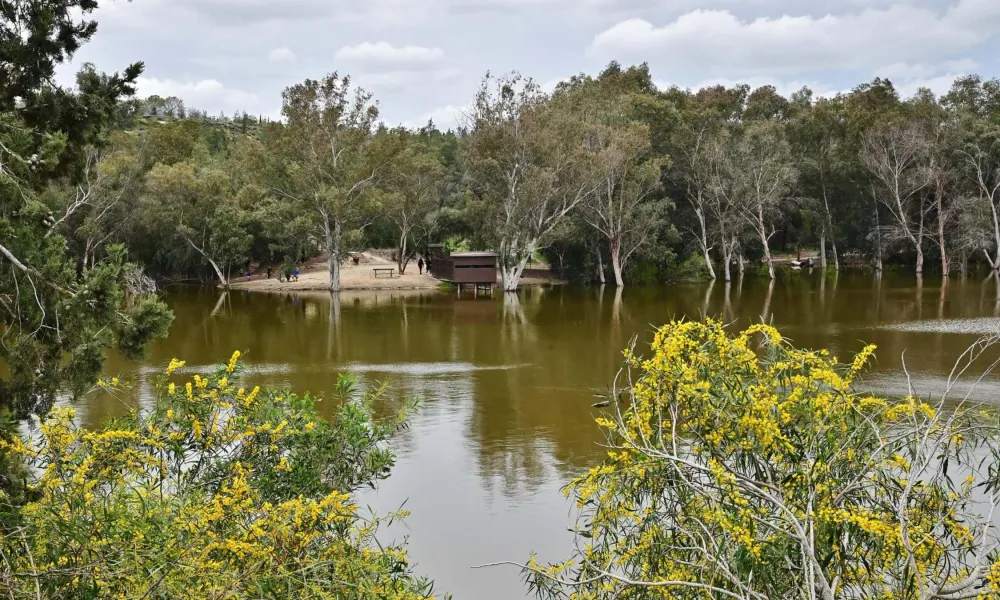

Veterinary Services are investigating a possible second case of H5N1 avian influenza after another dead bird was found at the lake in Athalassa National Forest Park.
Veterinary Services officer Dimitris Epaminondas said on Wednesday that the bird had been taken for testing, but it has not yet been established whether it was infected with the virus. People who came into contact with the first infected bird are also undergoing precautionary screening, with no positive cases detected so far.
First case confirmed as highly pathogenic H5N1
The first case emerged last Tuesday, when a visitor to Athalassa lake spotted a goose that “did not appear to be in good condition” and notified the Game Fund.
The bird was collected and taken to a wildlife care facility, where it died the following day. It was subsequently transferred to the Veterinary Services, where examinations and a post-mortem were conducted and samples taken.
“The first indication that we were dealing with influenza came out on Friday,” Epaminondas said.
Identification was completed on Monday afternoon, confirming a highly pathogenic H5N1 strain. Following confirmation, protocols were activated and all relevant services were notified.
Officials conducted on-site visits to the area on Monday and Tuesday. The second dead bird was discovered during the latest visit.
Precautionary tests for people exposed to bird
The Health Ministry was informed last Friday, and people who came into contact with the infected bird were subsequently placed under precautionary monitoring.
They include Game Fund officials and the person who initially found the goose.
“It has not been confirmed in humans. They are simply being tested,” Epaminondas said, adding that no one tested so far has been found positive for the virus.
Under the Medical Services protocol, those concerned are undergoing PCR tests at regular intervals.
Asked whether the virus can pass from birds to humans, Epaminondas said it could but stressed that humans are not the virus’s main host.
“The main host is birds,” he said, adding that humans could become hosts and that authorities were concerned about the possibility of the virus mutating within a person.
Public advised to avoid Athalassa temporarily
No other birds displaying symptoms were identified during the on-site inspection beyond the dead bird collected for testing.
Epaminondas recommended that members of the public avoid visiting the park for around one week.
He explained that one week had already passed since the first case was detected, while two weeks are considered sufficient for the virus’s transmission cycle to be completed.
“The two weeks recommended by the Medical Services mean that, for the coming period, people should not visit the park until Monday or Tuesday and should not come into contact with the birds, so that there is no possibility of transmission,” he said.
Migratory birds possible source
Epaminondas said the H5N1 strain had been detected in several European countries.
“This is not the first time we have found this particular strain. Generally, this year in Europe there has been a huge number of cases involving it. It has been identified in 15 European countries,” he said.
According to Epaminondas, its detection in Cyprus was understandable because the virus can arrive through migratory birds.
He said it may also have been present last year without being noticed and reported to the authorities, and that it could potentially occur every year.
Once the virus had been identified, however, authorities were required to implement the relevant protocols and inform the public.
Protecting poultry farms a priority
The Veterinary Services’ main priority is preventing the virus from entering commercial poultry farms.
A confirmed case in a commercial flock would trigger protocols requiring the birds to be killed.
Poultry farmers have therefore been instructed to implement the strictest biosecurity measures, including changing clothing and taking all necessary precautions to prevent the virus from entering farms.
Most facilities are enclosed, with the main exception being free-range egg production facilities, making direct entry by a wild bird more difficult.
“The easiest way is mechanical transmission by the owner himself or by poultry farm workers,” Epaminondas said. “That is our main concern at the moment.”
No concern over consumption of animal products
Epaminondas reiterated that people had been advised to stay away from the park for the specified period and avoid contact with birds.
“At this moment, however, there is no particular danger. Generally, there is no risk from consuming animal products,” he said.
Samples have so far been taken from two dead birds at Athalassa: the first, which tested positive for H5N1, and the second bird found on Tuesday.
“No other samples have been taken yet,” Epaminondas said.
An annual avian influenza surveillance programme is also in place, under which samples are collected from farmed birds.
Despite confirmation of H5N1 in a wild bird, authorities’ primary objective remains preventing transmission to commercial poultry farms.
Source: CNA