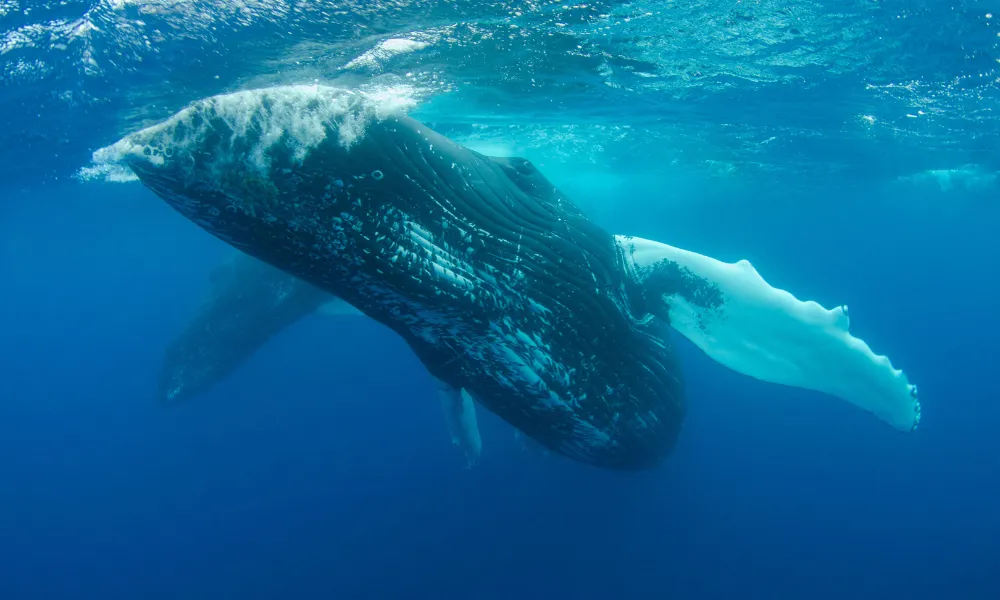

Scientists have identified a vast whale graveyard on the floor of the southeastern Indian Ocean, a discovery that is shedding new light on how life survives in some of the planet’s most extreme environments.
The site lies around seven kilometres below the ocean surface and is believed to be the deepest, oldest and largest whale graveyard ever recorded. Researchers found five separate whale carcass sites, along with numerous fossilised remains, during deep-sea submersible expeditions carried out in 2023.
Among the discoveries were skulls from beaked and baleen whales, with some bones estimated to be up to 5.3 million years old. The findings, published in the journal Nature, suggest that the remains have supported complex communities of marine organisms over exceptionally long periods of time.
The whale bones were surrounded by deep-sea life, including jellyfish, tubeworms, brittle stars, sea cucumbers, squat lobsters and saltwater clams. Scientists believe some of the species found at the site may be new to science.
A rare deep-sea food source
Whale falls occur when the body of a dead whale sinks to the seabed. In the deep ocean, where food is scarce and sunlight does not reach, such carcasses can become important biological hotspots, feeding and sheltering marine life for decades or longer.
According to Xikun Song, a biologist at the Chinese Academy of Sciences’ Institute of Deep-sea Science and Engineering, whales are especially suited to creating these ecosystems because of their size and the chemical composition of their bones.
The discovery has drawn attention not only because of the number of remains found, but also because of how well some of the fossils have been preserved. Researchers suggest that the density of the bones may have helped protect them from bone-eating worms, while the depth of the site reduced the risk of burial by sediment. Mineral deposits from seawater may also have slowed their breakdown.
Stephen Godfrey, a palaeontologist at the Calvert Marine Museum in the United States who was not involved in the study, described the possible number of specimens at the site as striking.
Why so many whales ended up there remains unclear. One explanation is that whales lived and died naturally in the area over millions of years. Another possibility is that some died after illness or exhaustion linked to deep diving. Researchers also believe the V-shaped structure of the seabed may have funnelled remains into the same location over time.
The study’s authors say the site offers important evidence of how ecosystems can develop in conditions of darkness, low oxygen and immense pressure. Giovanni Bianucci, a palaeontologist at the University of Pisa and co-author of the study, said such discoveries help scientists understand how life adapts to some of Earth’s harshest environments.
The whale graveyard also underlines how much remains unknown about the deep ocean, where entire ecosystems can exist far beyond the reach of sunlight and largely out of human view.
With information from Euronews, Nature