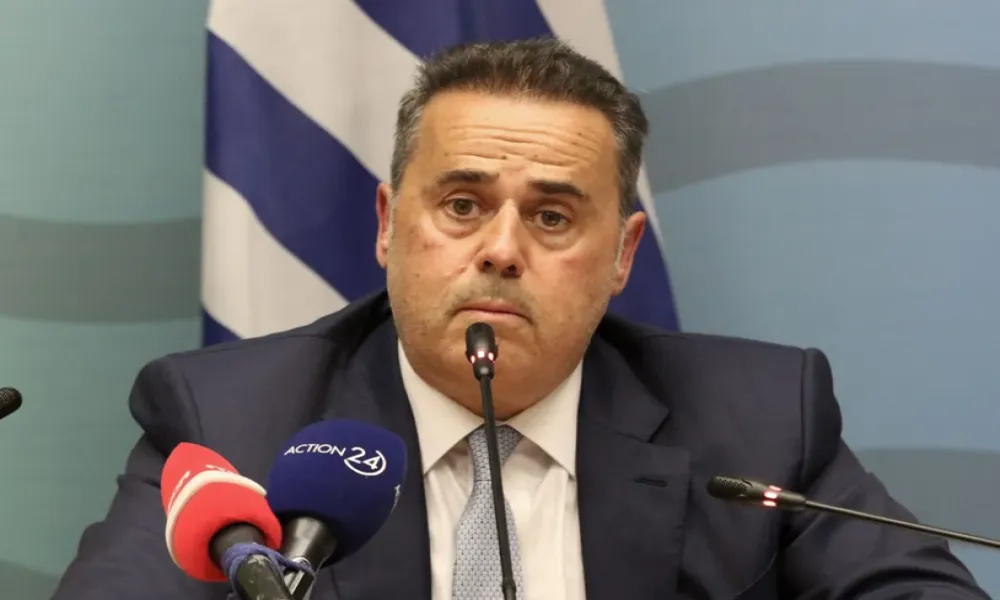

The agreement bringing French investment group Meridiam in as majority shareholder of the Great Sea Interconnector (GSI) creates strong new momentum for the project, which aims to end Cyprus' energy isolation, Greek Environment and Energy Minister Stavros Papastavrou said.
Speaking about the agreement, signed at the Maximos Mansion in the presence of Prime Minister Kyriakos Mitsotakis, Papastavrou said the Greece-Cyprus-Israel electricity interconnection is a project of strategic importance, since Cyprus remains the only European Union member state without an electricity link to the European grid.
Speaking on OPEN television, Papastavrou said Meridiam's involvement significantly strengthens the project's prospects, noting the group's proven experience with comparable subsea electricity interconnections of high technical difficulty, including the one between the United Kingdom and Germany. He described the project as complex, involving technical, geopolitical and economic challenges that would not be resolved overnight, but said the new partnership broadens the base of participants and makes clear the project is not just a matter for Greece and Cyprus but a European priority.
He said completing the Great Sea Interconnector would be a decisive step toward ending Cyprus' energy isolation, strengthening security of supply, increasing the use of renewable energy sources, and reinforcing overall energy security across the Eastern Mediterranean.
Cost-benefit study due within days
The minister said the cost-benefit study for the Cyprus-Israel section of the project would be completed in the coming days and submitted to the regulatory authorities of both countries. He added that electricity interconnections are essential for Europe's energy security, particularly in the Eastern Mediterranean, and that work was continuing decisively to complete the Greece-Cyprus-Israel link.
Addressing Turkey's stance, Papastavrou said Greece exercises its sovereign rights under international law and the Law of the Sea, while investing in strong international alliances. He described Greece's strategy for the Eastern Mediterranean as one of development, cooperation and progress for all countries in the region, without exclusions, while rejecting coercive practices or threats. "Threats have no place in the modern Eastern Mediterranean," he said.
Source: CNA