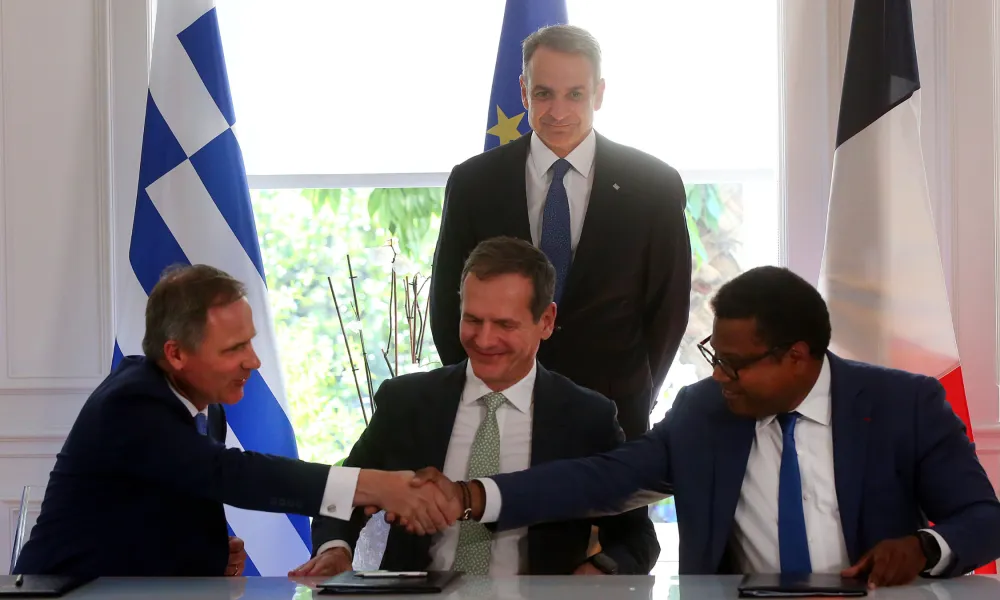



French investment group Meridiam's acquisition of a 66% stake in the Great Sea Interconnector (GSI) does not change the route, capacity or technology of the Greece-Cyprus electricity link. What it changes is something just as significant: who is putting up the capital, who carries most of the commercial risk, and which political weight now stands behind the project.
That shift is reinforced by another political fact. Greek Prime Minister Kyriakos Mitsotakis is personally behind the agreement, having effectively taken the project on himself. He described it as a particularly strong vote of confidence and as a strategic project of European significance that will end Cyprus' energy isolation.
Under the agreement, Greece's Independent Power Transmission Operator, IPTO (known in Greece as ADMIE), retains 34% of the company. It remains a strategic partner with minority rights under the company's statutes, keeps technical leadership of the project, and will operate the interconnector once it is complete. The new shareholding structure turns the GSI from a project that relied almost entirely on the Greek grid operator's own capacity into a stronger European investment platform with a decisive French presence.
The technical outline of the project remains unchanged for now. It will consist of an undersea direct-current connection roughly 898 kilometres long between Crete and Cyprus, with an initial transmission capacity of 1,000 MW and an estimated cost of around €1.9 billion. The project already carries a European grant of €657 million from the Connecting Europe Facility. The agreement signed on 5 August 2026 is therefore not a new construction contract, nor a revision of the technical specifications. It is a restructuring of ownership, financing and responsibility, one that may allow work that has been delayed until now to move forward.
The agreement went beyond a change of shareholders. Alongside it, IPTO, the GSI company and Nexans signed a trilateral agreement to speed up the marine surveys of the seabed, with the aim of finalising the cable's route and advancing the project's next technical stages. This is the first tangible link between the new corporate structure and construction itself, since the project has gained not only a new financier but also a concrete mechanism for restarting work.
A stronger financial base
Meridiam is not an opportunistic investor seeking a quick return. It is an international manager of long-term infrastructure investments, with around €24 billion under management, more than 130 projects, and roughly €100 billion invested since its founding. Its presence in major transport, energy and public infrastructure projects, along with its financing relationships with the European Investment Bank and the European Bank for Reconstruction and Development, gives the GSI an institutional weight it has lacked until now.
A group of this scale choosing to take a majority stake amounts to a clear vote of confidence in the interconnector's prospects. That does not mean, however, that every question about cost and viability disappears automatically.
Updating the budget, the European Investment Bank's assessment, the final financing structure and the regulatory decisions still pending in Greece and Cyprus all remain critical open issues. What changes is the weight of the argument, since it becomes far harder to present the project as an investment orphan or as a scheme no serious private investor wants to touch.
As recently as May, the Cypriot government was awaiting the European Investment Bank's assessment of whether costs had risen beyond the original estimate, with the energy minister acknowledging that any overrun would require additional sources of financing. Meridiam's entry partly answers that need, without replacing the necessary financial and regulatory scrutiny.
Meridiam takes on the majority of the commercial risk and broadens the capital base, while IPTO retains technical control and critical minority rights. This division of responsibility may make it easier to attract lending and further investors, while also easing the pressure that would otherwise fall solely on IPTO's balance sheet or on consumers in Greece and Cyprus.
The project remains expensive, technically complex and exposed to delay. Its financial and investment credibility, however, is now clearly stronger than before.
France enters the equation
The second major change is geopolitical. Meridiam is a French group, and so is Nexans, the company building the cable itself. The signing ceremony at the Maximos Mansion, in the presence of Kyriakos Mitsotakis, together with public remarks from Meridiam's chief executive on the backing of Emmanuel Macron, suggest the project is gaining stronger French, and by extension European, political cover.
This does not eliminate the geopolitical risk, nor does it mean Turkish objections to the project cease to exist. It does, however, change the balance.
Any attempt to obstruct the surveys or the laying of the cable will no longer concern only a Greek-Cypriot initiative. It will concern a project of common European interest, backed by hundreds of millions of euros in EU funding and the direct involvement of two major French companies.
Paris' involvement is not, on its own, a military or diplomatic guarantee against renewed tension. It does, however, significantly raise the political cost of any Turkish intervention, and it widens the circle of states and European institutions with a direct interest in seeing the project carried out unimpeded.
The real test will come in the field, when the marine surveys resume and the relevant NAVTEX notices are issued. That is when it will become clear whether this new French presence can actually translate political backing into operational progress.
A second channel for electricity
For Cyprus, the most substantial benefit is neither corporate nor symbolic. It is the creation of a second gateway for its electricity supply.
The Republic of Cyprus remains the only European Union member state not connected to the electricity market of another member state. Its power generation still relies heavily on imported liquid fuels, while the absence of an interconnection limits competition, makes it harder to safely integrate more renewable sources, and leaves consumers exposed to fluctuations in oil prices and the distortions of a small, closed market.
The GSI is not, on its own, a mechanism for guaranteeing cheap electricity. Final prices will depend on the cost of using the interconnector, how the market functions, the energy mix, and regulatory decisions still to be made.
What it does create is something that does not currently exist: the ability to import electricity from the European market when prices are lower, backup supply in periods of need, and the ability to export surplus energy from Cyprus' solar power plants and other renewable sources.
This would gradually reduce dependence on heavy fuel oil and weaken the position of those who benefit from today's isolated market. The interconnection could also allow for a greater expansion of solar power without the large-scale production cuts currently required, since surplus energy could, under certain conditions, be exported out of Cyprus.
Nicosia's awkward silence
The agreement appears to have caught Nicosia off guard, or at least that is the impression created by the Cypriot government's delay in issuing an official response. The silence was made more noticeable by the fact that the signing took place in the presence of the Greek prime minister and came with a clear message that the project is back on track.
By contrast, the first political reactions within Cyprus were positive. Disy president Annita Demetriou described the agreement as a decisive step for the country's energy roadmap, while Diko president Nicolas Papadopoulos called on the government to honour the commitments it has made to the project.
The Cypriot government now faces a new reality. Legitimate demands for transparency, an updated cost estimate and consumer protection remain valid. They cannot, however, serve as a pretext for indefinite delay.
With the European Commission describing the GSI as a project of strategic importance, EU funding secured, and a strong institutional investor now taking a majority stake, the question is no longer whether the project has international backing.
The question is whether Cyprus will make use of this new momentum to secure better terms, adequate safeguards and faster implementation, or whether it will remain a bystander in a project that concerns, above all, its own energy security.