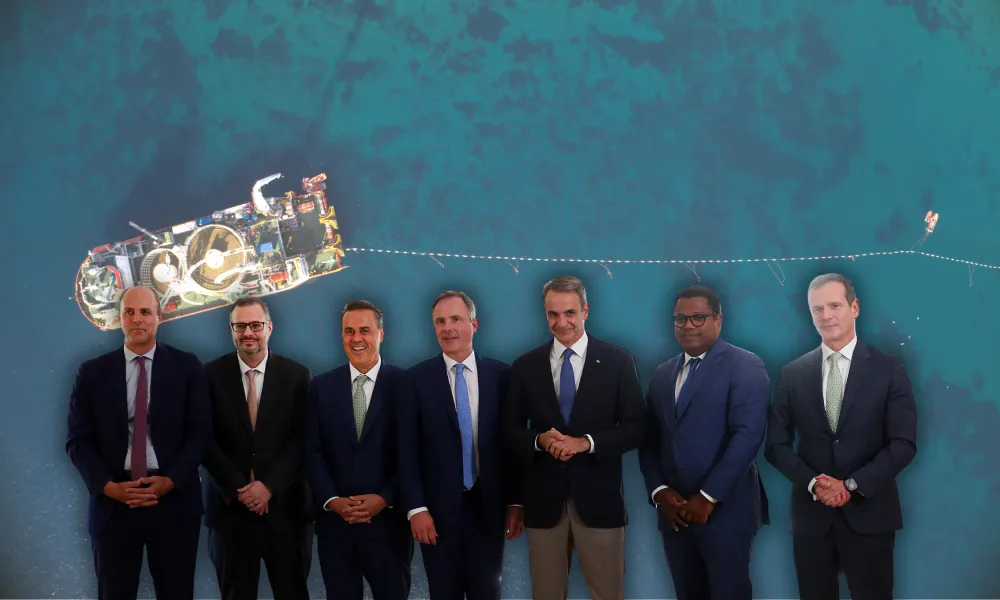

The announcement that French infrastructure investment fund Meridiam will become the majority shareholder in the Great Sea Interconnector (GSI) came as a surprise, with the agreement signed in Athens without any prior public indication that negotiations had reached their final stage.
The deal significantly alters the project's financial, ownership and geopolitical framework.
Talks had been under way for months
The surprise appears to have been greater in Nicosia than in Athens or Paris.
According to information published by protothema.gr, contacts with Meridiam had been ongoing for months, with Greek Environment and Energy Minister Stavros Papastavrou holding relevant meetings in Paris from mid-May.
The process reportedly gained additional momentum following Emmanuel Macron's visit to Athens in April, when Meridiam chief executive Thierry Déau was part of the French president's business delegation.
The move was therefore prepared at the Greek-French level, but emerged as a surprise in Cyprus' public sphere.
By Thursday morning, no comprehensive official position had been issued by the Cypriot government, reinforcing the impression that Nicosia is now examining an agreement in whose formation it did not appear to play a visible leading role.
According to government sources cited by Philenews, Cyprus continues to view several conditions as critical, including the issuance of a NAVTEX, the actual resumption of offshore seabed surveys, and the assessment of the project's economic viability by the European Investment Bank.
Pressure on Nicosia
The surprise announcement is not necessarily negative for Cyprus.
The arrival of a major international infrastructure investor has the potential to strengthen financing, distribute risk and add political weight to the project.
However, it also reduces Nicosia's ability to approach the GSI under previous assumptions, as the project now carries a clearer French and broader European dimension.
While the government remained largely silent, initial political reactions in Cyprus were positive.
DISY President Annita Demetriou described the agreement as a decisive step towards ending the country's energy isolation, while DIKO President Nikolas Papadopoulos called on the government to honour the commitments it has undertaken in relation to the project.
These interventions increase pressure on Nicosia to clarify whether Meridiam's entry addresses its concerns regarding financing, viability and the geopolitical security of the GSI.
The French stamp changes the GSI
Meridiam's acquisition of a 66% stake in the Great Sea Interconnector company does not alter the route, capacity or technology of the Greece-Cyprus electricity interconnection.
What it does change is who provides the capital, who assumes most of the commercial risk and what political weight now stands behind the project.
According to available information, ADMIE will remain in the new structure with a 34% stake, retaining minority protection rights, technical leadership and responsibility for the future operation of the interconnection.
The new ownership structure transforms the GSI from a project that depended largely on the capabilities of the Greek transmission operator into a broader European investment platform with a strong French presence.
The technical framework remains unchanged at this stage: a subsea direct-current connection of approximately 898 kilometres between Crete and Cyprus, with an initial transmission capacity of 1,000MW and an estimated cost of around €1.9 billion.
The project has already secured €657 million in European funding through the Connecting Europe Facility.
As a result, the 5 August agreement does not appear to constitute a new construction contract or a revision of technical specifications. Rather, it represents a restructuring of ownership, financing and responsibilities that could enable delayed aspects of the project to move forward.
Agreement includes acceleration of seabed surveys
The agreement was not limited to a change in shareholders.
A separate tripartite agreement was also signed between ADMIE, GSI and Nexans to accelerate offshore seabed surveys, with the aim of finalising the cable route and advancing subsequent technical phases.
This provides the first tangible link between the new corporate structure and the construction process itself, giving the project not only a new investor but also a mechanism for restarting works.