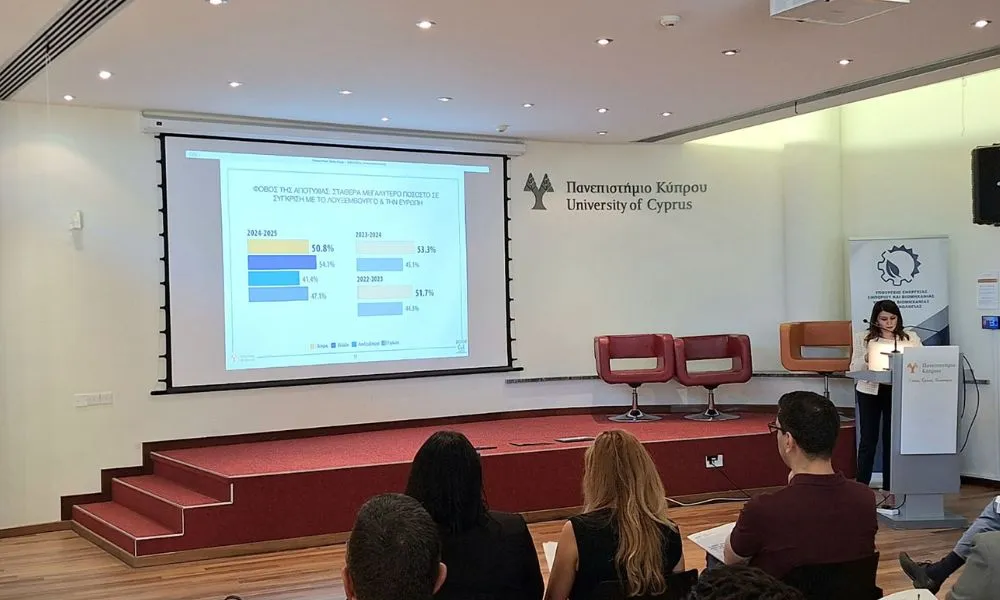

The report was presented on Tuesday by the Centre for Entrepreneurship (C4E) of the University of Cyprus.
In 2024/2025, 40.2% of adults perceive that there are good opportunities to start a business, maintaining the improvements observed in recent years. At the same time, 47.8% consider it easy to start a business, a percentage that aligns with the European average.
A total of 59.9% of individuals report that they possess the knowledge, skills and experience required to start a business. In addition, 68.3% personally know an entrepreneur, highlighting the strong presence of entrepreneurial networks within the country.
Some 24.1% of adults expect to start a business within the next three years. This percentage is higher than the European average and the highest level recorded in the past three years.
High fear of failure
Despite the positive perceptions, the survey shows that fear of failure remains relatively high, affecting 50.8% of individuals, resulting in the Total Early‑stage Entrepreneurial Activity (TEA) rate in Cyprus standing at 9.7%.
“While entrepreneurial activity in Cyprus is resilient, the transition from intention to actual business creation remains an area that requires further support,” it is noted.
Entrepreneurial activity is higher among younger individuals and those with higher levels of education. At the same time, a notable gender gap remains, with men’s participation in early‑stage entrepreneurship significantly higher than that of women.
A total of 38.3% of early‑stage entrepreneurs expect to create six or more jobs over the next five years, while 56.9% foresee increased use of digital technologies for selling products or services. Meanwhile, 36.5% consider artificial intelligence to be very important for their business over the next three years.
As stated in the report, new businesses in Cyprus are increasingly adopting growth‑oriented and technology‑driven approaches. However, it is indicated that sustainability in entrepreneurship remains an area requiring further development.
Strengths and weaknesses
The report also notes that Cyprus performs relatively well in areas such as Physical Infrastructure, Commercial and Professional Infrastructure, Government Policy and Cultural Support for Entrepreneurship. However, structural challenges remain in Entrepreneurship Financing, Research and Development, Government Entrepreneurship Programmes and Entrepreneurial Education. These conditions continue to limit the growth of new businesses.
Targeted actions
The report highlights the importance of targeted and coordinated policy actions. Key priorities include improving access to financing, strengthening entrepreneurship education at all levels, enhancing collaboration between academic institutions and industry, and reducing administrative barriers.