
Fifty-two years after the Turkish invasion of 1974, the Cyprus problem remains one of the longest-running unresolved international issues. Over this period, proposals, plans and "sets of ideas" have been tabled for its resolution, with a common denominator being the gradual shift of the negotiating basis from the unitary state of 1960 towards more decentralised, bi-state or confederal models.
1960-1977: From the unitary state to federation on a geographical basis
The 1960 Constitution, which established the Republic of Cyprus, provided for a form of administrative bicommunal cooperation without geographical separation of the two communities, based on what is known as consociational democracy.
Between 1972 and 1974, intercommunal talks were held on the basis of a unitary state solution, with enhanced communal self-administration in matters of low politics. On 13 July 1974, the two constitutional experts who had been called in to assist the talks, Michael Decleris from Greece and Orhan Aldikaçti from Turkey, had reached a draft agreement providing for a unitary state with elements of communal self-administration. The text was due to be initialled by Glafkos Clerides and Rauf Denktash on 16 July 1974, but the coup against Archbishop Makarios and the Turkish invasion that followed overturned the situation entirely.
After the invasion, the basis of the talks shifted dramatically: from July 1974 onwards, the discussion has concerned federation on a geographical basis, initially in the form of a bi-regional or multi-regional federation.
What "bicommunal federation" and "bizonal bicommunal federation" mean
The term bicommunal federation describes a federal state made up of two politically equal communities, the Greek Cypriot and the Turkish Cypriot, with a single sovereignty, a single international personality and a single citizenship. In the 1970s, bizonality was added to this content, meaning the geographical organisation of the state into two territorial zones, one under Greek Cypriot and one under Turkish Cypriot administration, with a clear majority of the corresponding community in each zone. This is how the term bizonal bicommunal federation (BBF) took shape, which since the late 1980s has been used at various levels, including by the UN, without its precise content ever having been agreed in detail as regards governance, territory, property, the economy and the security regime.
In practice, significant divergences have developed around this term. The Greek Cypriot side insists on a functional federation with a strong central government, while the Turkish Cypriot side and Turkey have consistently pursued a model with a weaker centre and strong "constituent states".
Former President Tassos Papadopoulos sought to differentiate the Republic of Cyprus's position by using the formulation "bizonal bicommunal federation with the correct content", precisely because the term on its own left room for interpretations that moved closer to a looser or more decentralised structure.

According to Alexandra Attalides, a former MP, "the critical question is not whether the federation will be more or less centralised. In any federal system, the distribution of competences can be discussed on the basis of subsidiarity: which powers should be exercised effectively by the federal government and which by the two constituent states. Such a discussion can reduce everyday friction and strengthen the functionality of the state. The very history of the debate over a 'loose' or 'decentralised' federation shows that, when the term is not accompanied by specific content, it causes confusion and fears that it amounts to a slide towards confederal or partitionist logics. This is precisely where the danger of today's ambiguity lies. Each side can hear the same term but understand something entirely different: one side a decentralised federation and the other two separate entities with distinct sovereignty. In this way, instead of the gap being bridged, it is postponed for later, and it may return even larger at the critical stage of negotiation. A 'loose federation' can become a bridge only when it is clear which bank it leads to. Otherwise, it risks turning into a verbal alibi for the permanent entrenchment of partition."
The five High-Level Agreements
The basis of the BBF was shaped through a series of framework agreements between the two leaders, known as the High-Level Agreements:
- 12 February 1977 – Makarios-Denktash Agreement: formally established for the first time the principle of federation on a bicommunal and bizonal basis as the goal of the talks.
- 19 May 1979 – Kyprianou-Denktash Agreement: confirmed and further specified the ten guiding principles of the 1977 agreement.
- 8 July 2006 – Papadopoulos-Talat Agreement (known as the 8 July Agreement): the first High-Level Agreement to explicitly include the term "bizonal bicommunal federation".
- 23 May 2008 – Christofias-Talat Agreement: relaunched substantive negotiations after the 2004 referendum, with a new reference to "constituent states".
- 11 February 2014 – Anastasiades-Eroğlu Agreement: a joint declaration reaffirming the basic parameters ahead of a new round of substantive talks.
The Ghali Set of Ideas (1992)
On 15 July 1992, during the presidency of George Vassiliou, the then UN Secretary-General Boutros Boutros-Ghali published a "set of ideas" for resolving the Cyprus problem, which was endorsed by the Security Council in Resolution 774 of 26 August 1992. The plan provided for a unitary state with a single sovereignty, a single international personality and a single citizenship, organised on a bicommunal and bizonal federal basis, with territorial arrangements, confidence-building measures and demilitarisation. It explicitly excluded union of the whole or part of the island with any other country, as well as any form of partition or secession. The Ghali Ideas were rejected both by Turkey and by almost the entire spectrum of Greek Cypriot parties, with the exception of AKEL and President Vassiliou himself, and ultimately were not implemented.
The Annan Plan (2002-2004)
The Annan Plan was presented in five successive versions between November 2002 and March 2004, as negotiations between Tassos Papadopoulos and Rauf Denktash failed to reach agreement. On 29 and 30 March 2004, Kofi Annan, acting as arbitrator, "bridged" the points of disagreement and delivered the fifth and final version of the plan, setting 24 April 2004 as the date for a simultaneous referendum in both communities, just days before the Republic of Cyprus's accession to the European Union on 1 May 2004.
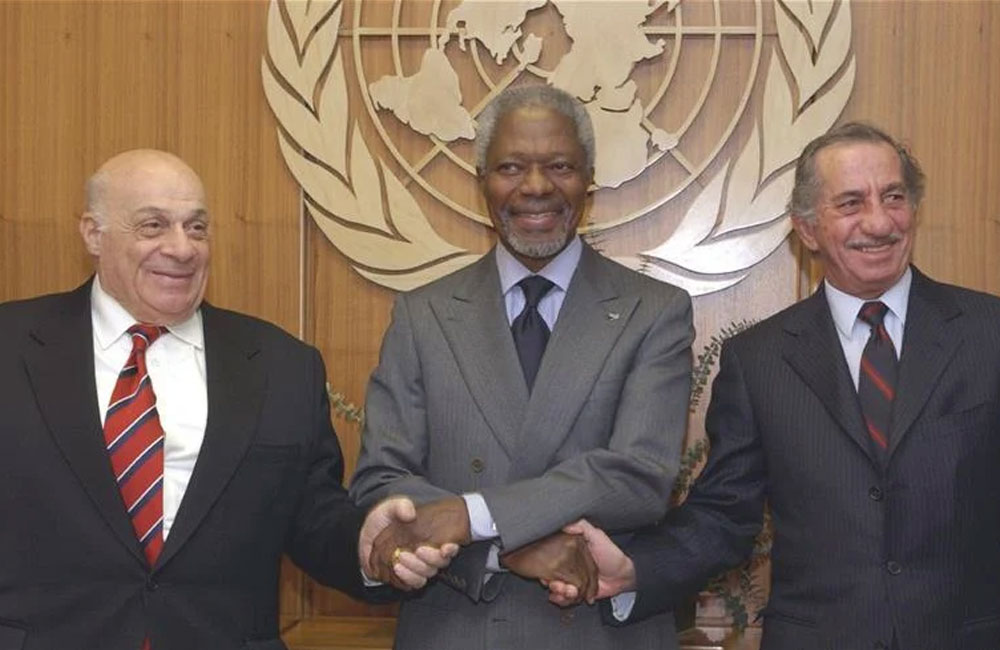
The plan promoted a bizonal bicommunal federation solution, with explicit reference to models such as Switzerland and Belgium, two strong constituent states and a weak federal government, as well as extensive provisions on property, territory and transitional security measures. According to its critics, it also provided for the retention of the British Sovereign Base Areas with additional privileges and a derogation from full application of the European acquis in the areas under Turkish Cypriot administration.
In the referendum of 24 April 2004, the Greek Cypriot side rejected the plan by 75.83% to 24.17% in favour, with then President Tassos Papadopoulos having publicly opposed its adoption. The Turkish Cypriot side, by contrast, approved it by around 65%. Since only joint approval by both communities would have made the plan applicable, the Annan Plan did not enter into force, and the Republic of Cyprus joined the European Union without a prior solution to the Cyprus problem.
Crans-Montana (June-July 2017)
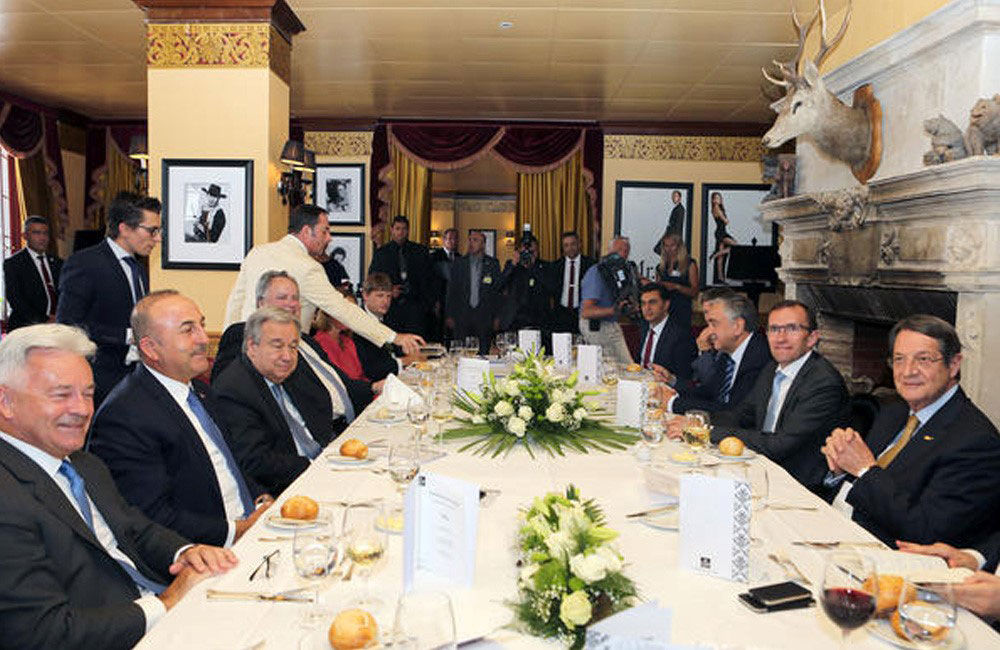
Following a series of negotiating rounds in Geneva between Nicos Anastasiades and Mustafa Akıncı, the Cyprus problem conference was moved in June and July 2017 to the Swiss resort of Crans-Montana, with the participation, besides the two leaders, of Greece, Turkey and the United Kingdom as guarantor powers, under the UN Secretary-General's Special Adviser Espen Barth Eide and in the presence of António Guterres himself. The conference collapsed in July 2017 without agreement. In September 2017, Guterres presented to the Security Council a "six-point framework" capturing the convergence that had been reached up to the point of collapse, which the UN has since periodically invoked as a reference point for resuming talks, though without substantive progress to date.
Former Foreign Minister Erato Kozakou-Marcoullis, asked about the opportunity whose loss had the most serious consequences for the course of the negotiations, said: "Although the Annan Plan was regarded by the majority of Turkish Cypriots, and a smaller proportion of Greek Cypriots, as an opportunity to escape the impasse and avoid the risks of non-solution, the negotiating acquis of the more recent process (2008-2010, 2015-17) has characteristics that make it more reliable for a solution that would be lasting and more widely accepted. First and foremost, in 2004 Cyprus joined the European Union, creating conditions for the solution to be consistent with the European acquis, which constitutes an important guarantee of its viability. In addition, in 2008 the leaders had agreed that the negotiations and the solution should be Cypriot-owned, a development that excluded any form of arbitration. Furthermore, in the negotiations almost all chapters had been discussed and significant convergences were adopted, while for the first time both sides had submitted maps on the territorial issue, with a divergence between them of just one percentage point, something that was considered very positive and allowed the convening of the international conference in Geneva and later in Crans-Montana in 2017, to discuss the chapter of security and guarantees as well, with the aim of concluding the negotiations. Finally, a significant development was the submission by the Secretary-General, after consultations with the parties, of a six-point framework concerning the most fundamental aspects of the Cyprus problem that remained outstanding, agreement on which would lock in a strategic agreement and allow the negotiations to be concluded within a short period of time."
"Loose federation" vs "loose confederation"
Loose federation and confederation are not conceptually identical, although they are often conflated in public debate. In a federation, even a loose one, there continues to exist a single state with one sovereignty and one international personality, which nonetheless devolves the greater part of its competences to the constituent units, retaining under central control only a very limited core of functions, such as foreign policy, defence, citizenship and federal finances. Confederation, by contrast, presupposes two separate sovereign states with independent international standing, which voluntarily delegate certain competences to joint bodies of cooperation, while each retains the right of withdrawal.
The term "loose federation" is not new. Already in 1993-1994, the United Kingdom is reported to have sounded out the Greek Cypriot leadership on reactions to ideas of a "loosely decentralised federation" or a "two-state confederation".
Asked by "P" whether the creative ambiguity in the debate over "loose federation" leaves room for the continuation of the negotiations, Anna Koukkides-Procopiou, former Minister of Justice and Public Order and a Fellow at Yale University, told us: "Although initial ambiguity in a discussion is not necessarily something negative, no serious country comes to the negotiating table if the end game has not previously been determined as a necessary requirement. Consequently, a five-party meeting of the two communities and the three guarantor powers, possibly with the EU present in observer status, should not take place in the near future unless the broad lines of where we stand on the security issue, which is a major matter that precedes all others, and what type of governance will form the centre of gravity of such a meeting, have first been outlined. In this particular case, what exactly does the term 'loose federation' encompass. Because that is what matters, the substance of what 'loose federation' actually is, not the name. On the one hand, because a more decentralised form of governance could be a positive development, since it would likely reduce the risk of systematic blocking of citizens' daily lives after a solution to the Cyprus problem, something we have experienced with traumatic effects in the past. On the other hand, because such a decentralised form of federation must at the same time contain the necessary safeguards preventing any incentive for a 'velvet divorce' of secession at the first disagreement between the contracting parties."
The elephant in the room of the negotiations
The official positions of the two sides remain, formally, divergent: the Republic of Cyprus and the European Union continue to favour a bizonal bicommunal federation solution, while Turkey continues to refer to a two-state solution. Between these two poles moves the effort of María Ángela Holguín.
Andreas Mavroyiannis, former Cyprus problem negotiator and current chair of the UN International Law Commission, responding to a question from "P" about the elephant in the room of the negotiations, commented: "From the outset, for Turkey the problem has been the gradual emancipation of Cyprus within a space it considers vital. To this day, in every manifestation of efforts to solve the Cyprus problem, this runs through and overrides the Turkish position. The perception that if Cyprus functions competitively it diminishes Turkey's geopolitical importance, whether because it constitutes an alternative access point, or a thorn in its side, or a constraint on its maritime zones.
Thus every attempt at a solution runs up against Turkey's persistent demand to retain control through guarantees and troops. Further arrangements ratifying them would retroactively legitimise both the invasion and the occupation.
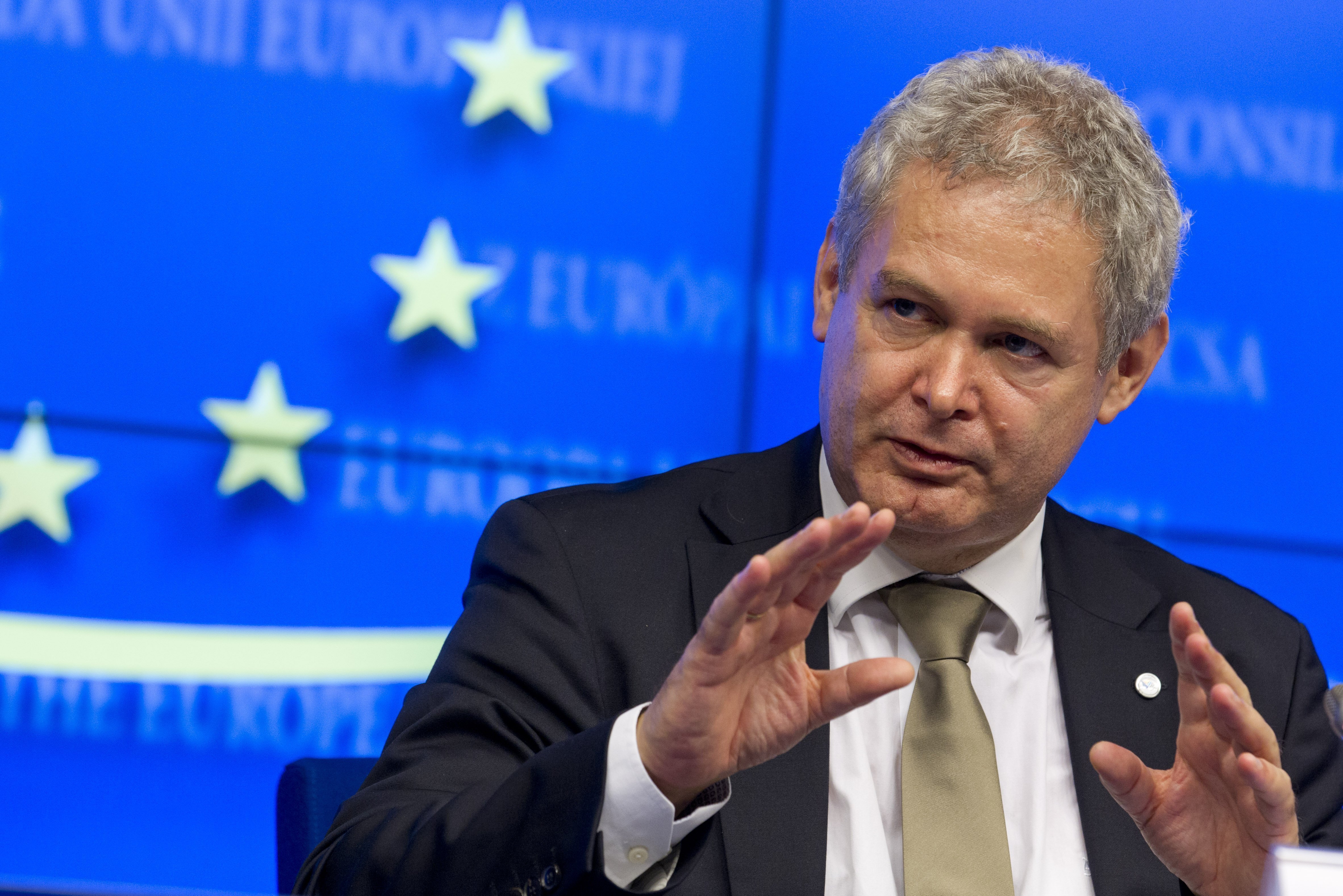
Thus, each time and in every attempt, the fundamental compromise that, through federalisation, the substantive participation of Turkish Cypriots in governance, political equality, the resolution of the territorial and property issues on the one hand, and the abolition of guarantees, intervention rights and the presence of troops on the other, is nullified by the continuous and systematic rejection by the Turkish side of this 'giving', that is, the very essence of the equation. An elephant that is not easily dispelled. Neither demilitarisation nor other newly coined proposals appear capable of overcoming the Turkish fixation. I look more to the catalytic role of the European security architecture, combined with the creation of organic conditions of peace, along the lines of the European integration process."
Is a Realistic Compromise Solution Achievable?
By Niyazi Kızılyürek
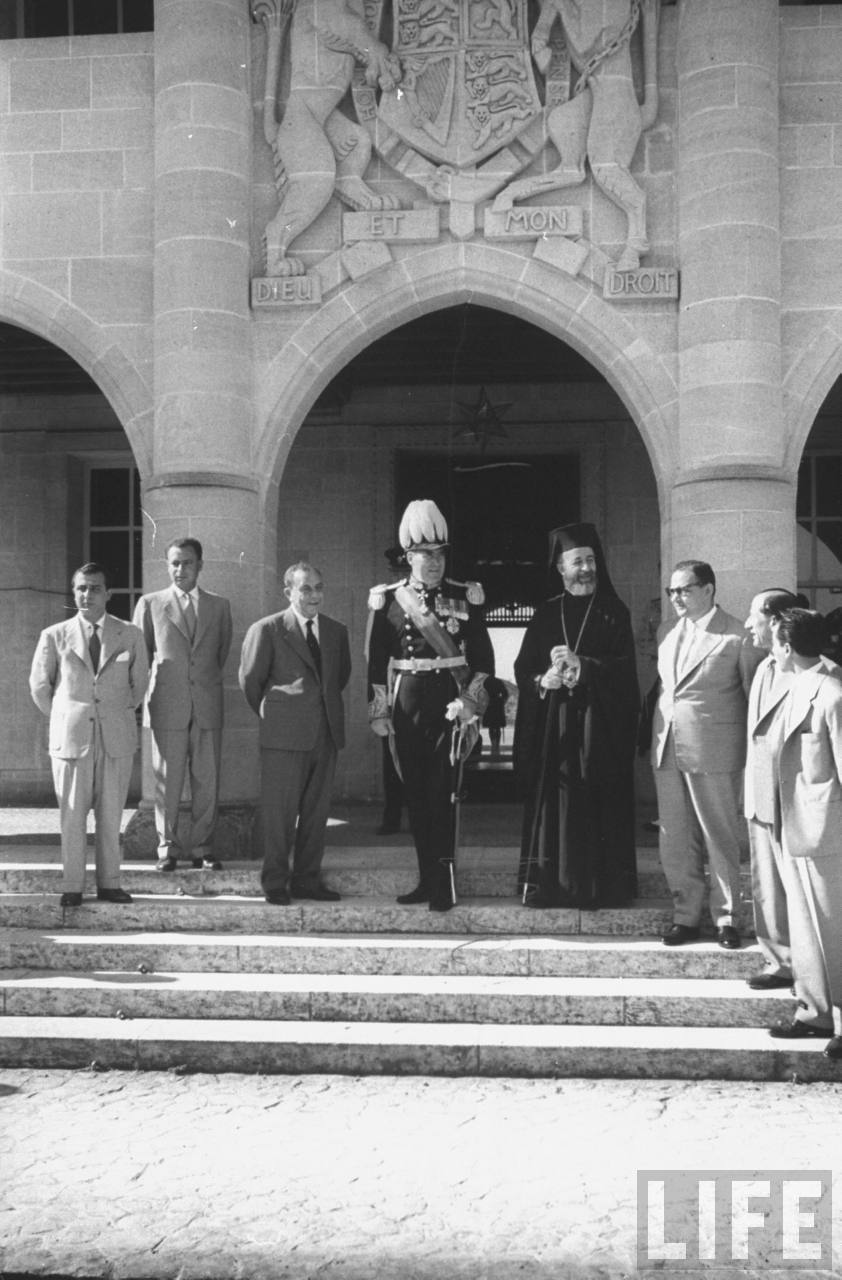
To begin, it is worth recalling what the Greek constitutional expert Michael Decleris, who took part in the talks on the Cyprus problem during 1972-1974, said about Makarios's stance: "For Makarios, the ideal and most likely solution was the preservation of a state consisting exclusively of Greek Cypriots, granting Turkish Cypriots only limited possibilities of participation. What impressed me most during our cooperation was his conviction that maintaining the de facto regime entailed no loss whatsoever for Hellenism." Indeed, Makarios sought to buy time, hoping to extract greater concessions from the Turkish side. Moreover, on 30 November 1974, at the first meeting of leaders in Athens after the Greek coup and the Turkish invasion, he himself admitted as much, saying: "We conducted the talks in a calm climate. We could have achieved more."
Rauf Denktash: Imitating Makarios
After 1974, the policy pursued by Rauf Denktash on the Cyprus problem largely resembled the policy Makarios had pursued before 1974. Once conditions changed in favour of the Turkish side, Denktash, just like Makarios, came to believe that "we can achieve more", prolonged the negotiations and did not display the necessary political will for a definitive solution.
Absence of a culture of realistic compromise
Unfortunately, neither Greek Cypriot nor Turkish Cypriot political culture has a tradition of realistic compromise. Instead of adopting a realistic approach guided by "what works best", both sides chose a different path.
When the de facto situation favours them, they tend to set aside international law and invoke "realities on the ground". But when circumstances turn against them, they revert to the principles of law. For example, before 1974 Turkish Cypriots invoked the Constitution of the Republic of Cyprus and international law, while the Greek Cypriot side, relying on the de facto situation, put forward maximalist demands. After 1974, exactly the opposite occurred: the Turkish side now invokes "realities on the ground", while the Greek Cypriot side tries to rely on international law.
The Turkey factor
For Turkey, the Cyprus problem has from the outset been a geopolitical issue. When it intervened in the Cyprus problem in the 1950s, it approached it mainly from the standpoint of security and defence.
After 1974, new dimensions were gradually added to these geopolitical concerns. The Cyprus problem developed into a bargaining chip for advancing broader Turkish interests. A characteristic example is the support Turkey gave to the Annan Plan in 2004, as it anticipated specific benefits in its relations with the European Union. Today, the scope of this negotiating bargain has widened even further. The Cyprus problem is exploited, on the one hand, to advance Turkey's energy and geopolitical interests in the Eastern Mediterranean, and on the other, as a means of extracting political and economic benefits from the European Union.
In closing, I would like to underline the following: as long as domestically the will for a federal solution based on a culture of realistic compromise remains so weak, and as long as externally Turkey continues to use the Cyprus problem as a bargaining chip, while the Western world accepts this reality for reasons related to its own interests, the resolution of the Cyprus problem remains extremely difficult.
The only factor that could break this vicious circle is a shared will among Greek Cypriots and Turkish Cypriots in favour of peace and compromise. At present, however, that will is not yet strong enough.