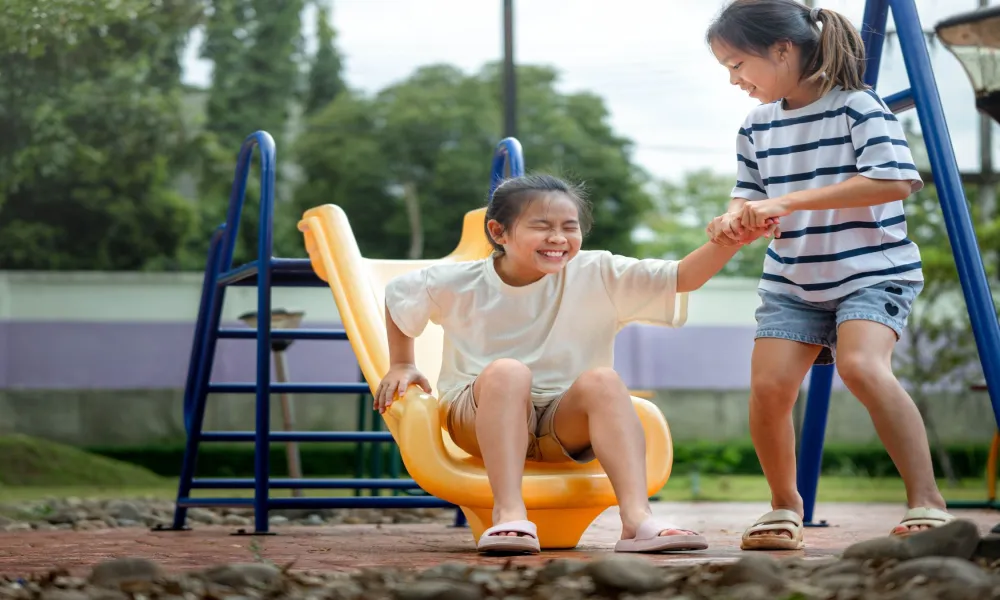

A new study found that youngsters from communities spanning Europe, Africa and South America were remarkably willing to assist a peer facing a problem, although cultural traditions influenced how they chose to help.
Researchers led by Sapienza University of Rome and the Max Planck Institute for Evolutionary Anthropology observed 336 children aged four to nine from six communities across three continents. Their findings suggest that helping behaviour is a common feature of childhood, regardless of where children grow up.
A simple game with a global reach
Previous research has often focused on toddlers helping adults, usually parents or caregivers. This study took a different approach by examining how children help one another.
Participants came from a wide variety of cultural backgrounds, including the Wichí of Argentina, the ≠Akhoe Hai||om of Namibia, the Samburu of Kenya, the Quechua of Bolivia, the Kikuyu of Kenya and families from Germany.
Local researchers first taught groups of children how to open a set of puzzle boxes. Each child was then paired with another child of the same age and gender for a game involving marbles.
During the activity, one child encountered two types of problems. In one scenario, they struggled with a puzzle box they had never learned to open, while their partner knew the solution. In another, marbles spilled from a container with a hidden opening.
The observing child could respond by offering an explanation, providing hands-on assistance, or combining both approaches.
Helping when it matters most
Across all six communities, the majority of children chose to help.
The likelihood of a child assisting with the puzzle box ranged from 75% among Kikuyu participants to 88% among Quechua children. Assistance was less common when marbles spilled, ranging from 45% to 76%, depending on the group.
Researchers found a consistent pattern: children were more inclined to help when their partner genuinely needed assistance.
Age also played an important role. While willingness to help with the puzzle box remained stable between the ages of four and nine, helping behaviour related to the spilled marbles declined as children got older.
This suggests that older children become more selective, focusing their efforts on situations where another person cannot easily solve the problem alone.
Lead researcher Henriette Zeidler said the result was surprising given the wide differences in children's daily experiences.
"It was surprising to see just how similar they behaved in our study."
Older children become teachers
Younger children tended to solve problems themselves, physically helping their partner complete a task.
Older children, however, increasingly relied on verbal explanations instead of direct intervention.
Although the overall rate of helping remained largely unchanged, the type of assistance evolved with age. From roughly age five and a half onward, children were noticeably more likely to explain how to solve the puzzle box than to physically step in.
Verbal guidance was rarely used for the marble-spill situation, where direct help was often the simpler solution.
Culture shapes the style of helping
The most notable cultural differences emerged in how children offered assistance.
German children were significantly more likely to combine explanation and demonstration. Researchers estimated there was a 34% chance that a German child would both show and explain how to open the puzzle box, compared with just 7% to 12% among the other groups.
Kikuyu children were the most likely to offer explanations without taking over the task themselves.
According to Zeidler, these differences reflect local learning traditions.
In many rural communities, children learn by observing adults and participating in daily activities, often with little verbal instruction. In contrast, children in Germany are more likely to receive a mix of hands-on demonstrations and detailed explanations from parents and teachers.
Notably, boys and girls helped in broadly similar ways, and the cultural differences observed were relatively small.
Can parents encourage helping?
The study suggests that helpfulness emerges naturally in children, but parents can still nurture it.
Zeidler recommends giving children opportunities to participate in everyday tasks, even when their first attempts are not particularly effective.
She also believes helping should be treated as a normal part of family life rather than something that earns rewards.
Offering praise is useful, she said, but turning helpful behaviour into a transaction by offering treats or gifts may be less effective.
Mixed-age groups can also encourage cooperation, allowing younger children to learn from older peers and eventually take on helping roles themselves.
Questions still to answer
The study examined how often children helped and the methods they used, but it did not explore their underlying motivations.
Researchers say future work will focus on observing children in real-life settings to determine whether the same patterns emerge outside structured games.
They are also interested in understanding how children help adults compared with how they assist their peers, as relationships between children and adults vary significantly across cultures.
For now, the findings suggest that while culture influences the form helping takes, the basic impulse to assist others may be a deeply shared human trait.
The full study was published in the journal Proceedings of the National Academy of Sciences.