
By Maria Georgiou, Communications Consultant
Somewhere on the outskirts of Nicosia, far from the noise of the city, there is a school that should, by all accounts, be invisible. Two pupils. One teacher. A building that blends into the landscape. And yet, in recent years, Kambos has quietly become something no one had planned for: a school that makes noise.
Seven years of an idea
Christiana Christoforou arrived at Kambos Primary School seven years ago. She knew what awaited her: few pupils, distance from urban centres, geographical isolation. What she did not know was how far a school could go if it refused to accept isolation as its fate.
From the very first year, her work followed a clear axis: bringing the world to the children – scientists, specialists, classmates from other schools – since the children themselves could not easily go out into the world. Every collaboration, every programme, every invitation she sent was a small breach in that isolation.
“We are a school where children do not have the opportunity to interact with peers their own age. From the beginning, the goal was to create collaborations with scientists and specialists, to become an open school, so that children could have experiential and authentic learning,” said Christoforou, teacher and head of Kambos Primary School.
Mars, robotics and first prize
In February 2025, the two pupils, Panayiotis and Dimitra, travelled to Limassol for the Youth Tech Festival. They formed a team with Nefeli from another school. Their name: Next Gen Martians.
Their project focused on survival on Mars. A robot called W.I.S.E. Roby – Water Ice Spy Expert – designed to detect moisture, melt ice with a heated drill and produce water through electrolysis. Alongside it, a wind turbine to harness Martian winds and a photovoltaic panel for solar energy. The code was written by the children themselves. From a school with two pupils.
They won first prize, competing against schools and robotics academies from across Cyprus. In March that year, they travelled to Greece to represent Cyprus at an international competition involving 12 countries.
It was not their first distinction. In 2024, they won third prize at the sCyence Fair in Nicosia, competing against 62 schools, with a project on local herbs that evolved into handmade soaps, drawing on knowledge passed down by grandparents.
The email nobody expected
During a summer educational programme, Christoforou met Dr Gernot Grömer, an analogue astronaut and director of the Austrian Space Forum, one of the people involved in designing missions to Mars. She asked if he would speak to the children online. He said yes.
The next step was bolder. She sent him another message, inviting him to come in person. To Kambos. To a rural school in Cyprus with two pupils. Dr Grömer said yes again – and, according to Christoforou, with great enthusiasm.
If you do not ask, you do not learn. What the teacher did was simple, human and entirely unusual: she dared to ask.
The day Kambos filled with stardust
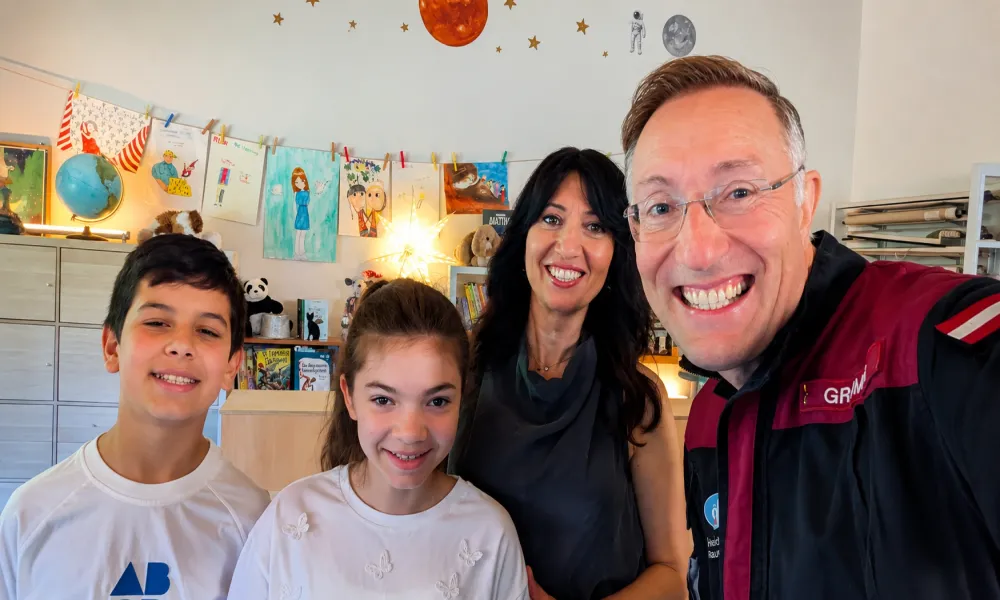
In spring 2025, Dr Grömer arrived in Kambos. He spoke to the children for three hours about how stars are born, about Mars and about what it means to send a mission to another planet. He answered every question. He did not look at his watch.
And at the end of the day, in the courtyard of the smallest school in Cyprus, an analogue astronaut played basketball with two pupils.
“He spoke to the children for three hours, answered their questions, we played basketball together in the yard and spent a wonderful day,” Christoforou wrote, visibly moved.
Returning to Austria, Dr Grömer wrote: “I just returned from Cyprus, having the awesome opportunity to talk with elementary school kids about space exploration. We had a stellar camera crew with us that accompanied the teacher Christiana Christoforou and her lovely students. One could literally feel the sparks and stars in the eyes of this generation! wow! What an unforgettable chapter in a much bigger journey!”
2026: Kambos back at the centre
This year, Dr Grömer returned. And with him came something the children of Kambos had always wished for: classmates. Nearly 100 children from neighbouring schools, along with their teachers, turned Kambos into what every school should be for a day – full of voices, questions and movement.
For a few hours, Panayiotis and Dimitra were not the only children in the yard. They were the hosts of an experience no one who lived it will forget.
A film crew was present during both visits. The material is currently being edited. The teacher remains in contact with Dr Grömer. The journey is not over.
Dimitra once said she wished children would come every Monday so they could play together. Panayiotis said he would like “a few more children, so we could make new friends”. It may be the most honest description of what a school like this lacks – and at the same time the strongest proof that within it are children who know how to dream in concrete terms.
This story is not about robotics, nor about the astronaut, nor even about awards. It is about a teacher who decided that distance is not a problem, but a challenge. And about two children growing up believing that the world cares about them – because it has shown them that it does.
An astronaut came from Austria to Kambos because a teacher dared to ask. And when she asked a second time, he came again. Whatever you imagine can happen, as long as you do not stop asking.