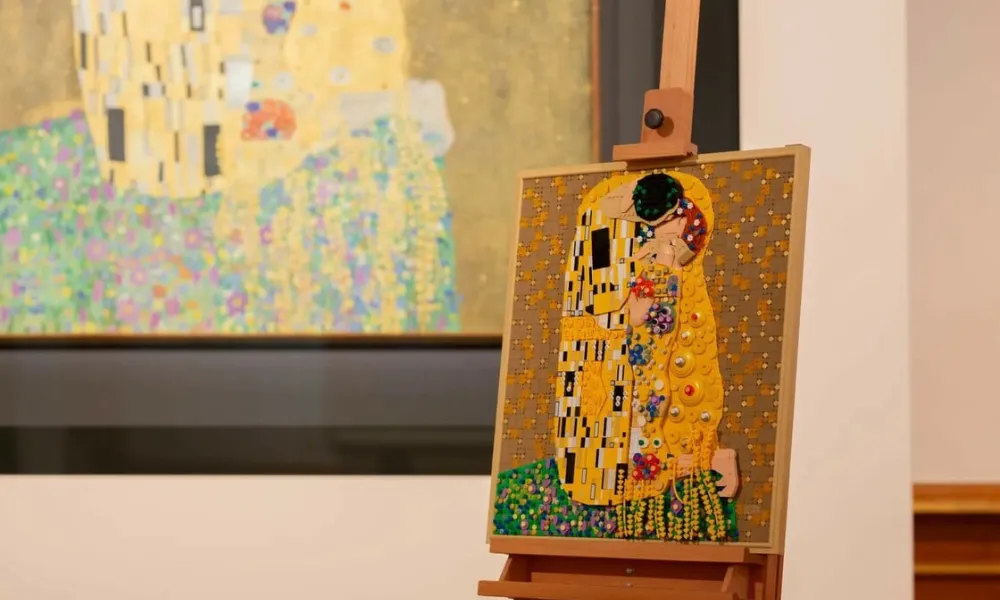

The most famous kiss in art history can now be assembled by hand. Lego has unveiled Gustav Klimt – The Kiss, a 4,000-piece reconstruction of the Austrian painter's iconic work, designed in collaboration with the Belvedere Museum in Vienna, where the original hangs.
The largest painting in the Lego Art series
The set, numbered 31221, belongs to the Lego Art series and launches on 1 August for Lego Insiders members, with general release following on 4 August.
It is the largest build in the series dedicated to a painting masterpiece to date, measuring approximately 60 centimetres in height, 54 centimetres in width and 4 centimetres in depth. The finished piece is designed to hang on the wall, positioned more as a decorative object for adults than a children's toy.
Translating gold into bricks
Rather than simply reproducing the image in plastic, the set works with a relief surface, gold elements, specially decorated pieces and varied textures to capture the shine, density and ornament of the original. Painted in 1907 to 1908during Klimt's golden period, The Kiss is almost square, gilded, sensual and decorative at once, and has become one of the most reproduced images in the history of art.
The Belvedere's role
The Vienna museum was closely involved in the process. Curator Stefanie Auer has described the collaboration as a rare experience, involving discussions on Klimt's symbolism, ornamental language and techniques, and how these could be translated into bricks. The challenge is considerable, as Klimt's work is not only an image but texture, surface, gold, pattern, and bodies that almost dissolve into decoration.
Art as a hands-on object
The Lego Art series has already turned works by Leonardo da Vinci, Claude Monet, Keith Haring and Robert Indiana into builds for adults. With Klimt, the choice carries particular weight, as The Kiss already occupies a near-decorative place in the collective imagination, gold, romantic and instantly recognisable. An image reproduced countless times on posters, postcards and calendars now asks its audience to rebuild it, piece by piece. The Kiss is no longer only to be looked at. It is to be assembled.
With information from Lego, Belvedere and Wallpaper