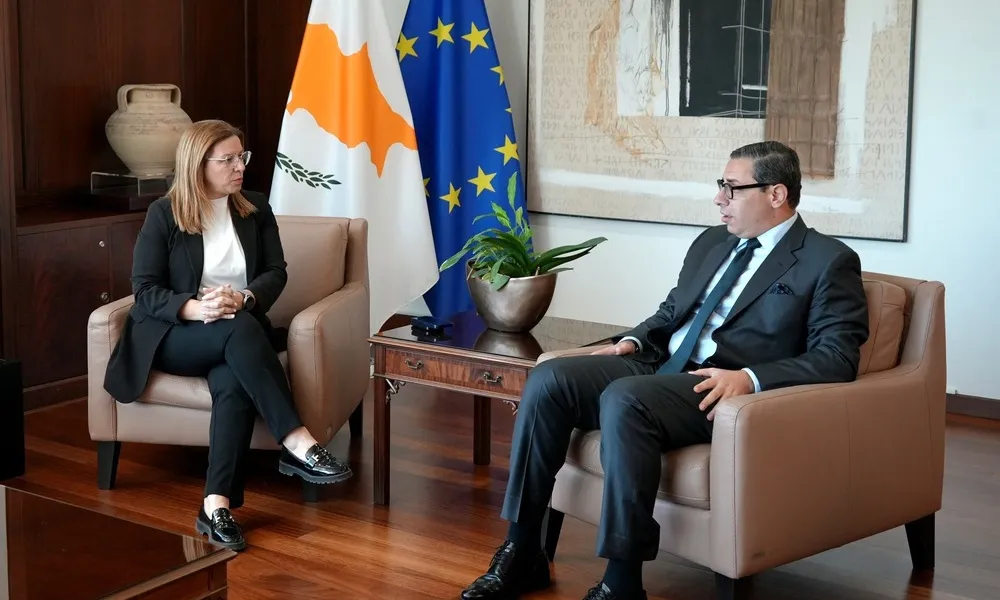

At a time of intense geopolitical realignments, armed conflicts and the search for new trade and energy routes, Cyprus is seeking to strengthen its role as a bridge between Europe, the Middle East and the Indo‑Pacific. The government views the hosting of the Informal Meeting of EU Foreign Ministers (Gymnich) in Limassol – also attended by the foreign ministers of India and Saudi Arabia – as a successful step in that direction.
Foreign Minister Constantinos Kombos speaks to Politis about Nicosia’s strategy, the prospects of the India-Middle East-Europe Economic Corridor (IMEC), cooperation with India and Saudi Arabia, and the challenges posed by the fluid security environment in the wider region. He also explains how Cypriot diplomacy seeks to turn international developments into opportunities to enhance the country’s geopolitical footprint.
The Gymnich meeting
Does the presence of the foreign ministers of India and Saudi Arabia in Cyprus for the Informal Meeting of Foreign Ministers (Gymnich) represent an upgrade of the country’s geopolitical footprint? What does this participation practically signify for Cypriot foreign policy?
First of all, the successful organisation of the Informal Meeting in Limassol required an enormous collective effort on the organisational level. I would like to thank everyone who worked at the Ministry of Foreign Affairs – our diplomats, staff and personnel who served as liaisons with the delegations – as well as the Secretariat of the Cypriot Presidency under Deputy Minister Marilena Raouna, the Press and Information Office and the Cyprus Broadcasting Corporation. We were able to see the result of this excellent cooperation, and everyone involved deserves warm congratulations.
At our initiative, as you rightly note, invitations were extended to my counterparts from India and Saudi Arabia – two important partners both for Cyprus and for the European Union more broadly – to attend the Informal Gymnich meeting. We had the opportunity for an open and frank exchange of views on current geopolitical developments, both in our region and internationally.
We discussed the situation that has emerged in the Middle East and how we move forward from here. In other words, which weaknesses of the international trading system have been identified, particularly in relation to supply chains, and how these issues might be addressed in the future. This also relates to the issue of India–Middle East–Europe connectivity within the framework of IMEC. It is also linked to the fact that a number of additional ideas have begun to be discussed much more intensively as a result of the war in the region.
We therefore considered it very important to highlight these possibilities at the level of the European Union as well. This ties in directly with what preceded it at the Informal European Council, when leaders from our neighbourhood were present. The argument that Cyprus acts as a bridge to the region is a continuation of that Informal European Council. This time, however, we expanded the scope of that neighbourhood, reaching as far as Saudi Arabia and India.
After all, the expansion of our geopolitical footprint has been a declared central objective of our foreign policy since President Christodoulides assumed office.
IMEC
Can Cyprus realistically serve as a bridge between Europe, the Middle East and the Indo‑Pacific? How does this translate into concrete strategic partnerships rather than diplomatic rhetoric?
IMEC is a highly ambitious concept – an idea that has not yet reached the stage of becoming an implementable project, for many different reasons. The crisis in the Gulf region affects various dynamics, and it is clear that the creation of trade corridors – and in particular the existence of multiple such corridors – is extremely important.
There needs to be continuity and consistency in discussions on these issues. India is, unquestionably, the starting point of this corridor.
Another conclusion arising from the current crisis is that states with the right geographical position, a very strong maritime community and the necessary infrastructure – not only existing infrastructure, but also infrastructure that can be developed to increase their capacity to handle maritime traffic – are countries that will be able to capitalise on whatever advantages may emerge.
Cyprus and India
Given India’s growing interest in connectivity and trade routes to Europe, is a substantive role for Cyprus within the IMEC economic corridor being discussed? And what did we secure during the recent visit to India?
Our ambition is for Cyprus to be one of the entry points – and I use the plural deliberately, because we are not talking about exclusivity – into Europe. This is an effort that must take concrete form.
India is the world’s most populous country, the fourth‑largest economy globally, with enormous potential, and it pursues a foreign policy that is highly pragmatic and absolutely clear in the way it approaches issues. At the same time, it is an important partner for Europe and a significant bilateral partner for the Republic of Cyprus.
For quite some time now, significant investments have been taking place between Cyprus and India at all levels. There are also very close political ties between the two countries. With regard to IMEC, we believe that these relationships work to our advantage.
In any case, on the issue of IMEC, Cyprus benefits from being involved in the discussion, whatever the final outcome of the overall undertaking may be.
Turkey’s role
At a time when Turkey is also seeking rapprochement with states in the Middle East, how does Nicosia ensure that its own diplomatic activity acquires substantive content?
As I have repeatedly stated, we do not view the exercise of our foreign policy as a zero‑sum game. We are not competing with anyone, while remaining realistic in our reading of geopolitical realities.
We certainly seek for our ongoing diplomatic activity to deliver concrete results and tangible outcomes that serve the interests of the state and the Cypriot people. Unfortunately, it is the neighbouring country that operates through exclusions.
Saudi Arabia
Saudi Arabia is repositioning itself internationally, both in energy and political terms. What are Nicosia’s main objectives in strengthening relations with Riyadh?
Through systematic effort, we have built a strong bilateral relationship based on shared objectives and convergence of interests on issues of stability, peace and security. We are continuing this effort consistently, including through the development of trade and economic relations, particularly in the area of connectivity, and with both countries committed to multilateral and regional cooperation.
Further effort is required on the commercial side, including the involvement of the private sector, so that it matches the excellent political level of the relationship.
Relations with the Arab world
Cyprus often states that it can act as a reliable interlocutor with the Arab world while also maintaining close relations with Israel. How difficult has this balance become recently?
If one looks at the density of our contacts and the depth of our relationships, particularly with countries in our region, it is clear that there is an extremely strong cooperative relationship with the Arab world. We recently had the President of the Republic’s visit to the United Arab Emirates. I myself have travelled twice to the Gulf region since the outbreak of the war. I visited Saudi Arabia, Bahrain, Qatar and the United Arab Emirates.
I can refer to the desalination issue with the United Arab Emirates, the implementation of the ‘Amalthea’ plan for Gaza, and the abundance of positive statements from all countries in the Middle East and the Gulf. This is therefore a relationship in which we believe that, at this particular moment – when these countries themselves are under strain – we had an obligation to be present and to express our solidarity in practical ways.
There is also a strategically important relationship with Israel. This allows us to be honest and to convey the real picture as it is shaped on the ground.
The balance you refer to does not concern our own relations with Israel. It concerns, more broadly, the stance of the European Union as a whole. At the same time, claims of supposed distrust are something we occasionally see being artificially raised, for example by Turkey, in an attempt to cultivate such an impression. This impression is countered by the real data reflected in our actions and in the response we receive from all countries in the region.
As the Presidency of the Council, we had set as priorities an emphasis on the wider region as well as on maritime issues. Developments have shown that the priorities we set are now at the centre of what is happening in Brussels and beyond. We are therefore in a position to raise these issues in a timely manner and to try to deliver positive results for the benefit of the European Union itself – through the participation of countries from our region in the work of the Presidency, both at the Informal European Council and at Gymnich.