
The Cyprus problem is often viewed as a conflict between Greek Cypriots and Turkish Cypriots, an issue of invasion and occupation, or a dispute involving Greece and Turkey. While all of these dimensions remain fundamental, they do not fully explain why the issue remains unresolved more than half a century after the island's division.
Today, Cyprus sits at the intersection of two broader geostrategic projects.
On one side is Turkey's ambition to establish itself as an autonomous regional power in the Eastern Mediterranean and the Middle East. On the other is a network of partnerships involving Greece, Cyprus, Israel, Egypt and France, supported politically and strategically by the United States.
The competition extends beyond natural gas. It encompasses maritime zones, trade and energy routes, ports, military infrastructure, undersea cables and transport corridors linking Europe with the Middle East, Asia and Africa.
Turkey's strategic depth
For Ankara, Cyprus is not merely a national issue or a matter of protecting Turkish Cypriots. It is a key component of Turkey's effort to shape developments in the Eastern Mediterranean and prevent the emergence of a regional security and energy architecture from which it is excluded.
By maintaining influence in the northern part of the island, Turkey gains strategic depth. The arrangement enables Ankara to assert a role in maritime disputes, hydrocarbon development and the region's future security architecture.
Turkey argues that regional partnerships and energy initiatives developed without its participation amount to geopolitical exclusion. In response, it has advanced its own maritime claims, promoted a two-state solution in Cyprus and sought to demonstrate that no major strategic or energy project in the region can proceed without Turkish consent.
A competing framework
Opposing this approach is a network of cooperation centred on Greece, Cyprus, Israel and Egypt.
France has expanded its role in pursuit of a stronger European strategic presence in the region, while the United States has encouraged cooperative frameworks designed to strengthen energy security and Western influence.
A notable example is the East Mediterranean Gas Forum, which brings together Cyprus, Egypt, France, Greece, Israel, Italy, Jordan and Palestine.
While not a military alliance, the forum has created a framework of regional cooperation from which Turkey is absent, reinforcing Ankara's perception that energy is being used to construct a broader political and strategic bloc.
The significance of major gas discoveries, including Zohr in Egypt, Leviathan in Israel and Aphrodite in Cyprus' exclusive economic zone, lies not only in reserves but also in their potential to support infrastructure, export routes, interconnections and wider commercial networks.
Cyprus as a field of competition
One of the central paradoxes of the Cyprus problem is that the island's growing strategic value may make a settlement more difficult to achieve.
The Republic of Cyprus has sought support through partnerships with influential states, using its geographic position and energy resources as diplomatic assets. Yet every such move has been met by efforts from Ankara to deepen the political, economic and military dependence of the north.
As a result, both communities remain trapped within a conflict that increasingly extends beyond their own priorities.
Greek Cypriots continue to live with the realities of occupation and the risk of permanent partition. Turkish Cypriots face international isolation, economic dependence and diminishing ability to shape their own political future.
Can the European Union help?
The European Union may be the only institutional framework capable of transforming the current zero-sum rivalry into one based on mutual interests.
The entire island is legally part of the EU, although the acquis communautaire remains suspended in areas outside the effective control of the Republic of Cyprus.
The EU possesses tools that neither the United Nations nor regional powers can offer. It can link progress on Cyprus to issues such as the EU-Turkey customs union, trade, investment, energy transition, infrastructure and broader regional integration.
A future settlement could potentially be accompanied by Turkey's participation in cooperative energy arrangements, while revenues from Cyprus' energy resources could be shared through agreed institutional mechanisms benefiting both communities.
The EU cannot impose a solution. Member states remain divided over Turkey, and any settlement will ultimately depend on agreement between the two communities.
However, the Union could alter the political and economic calculations of all parties by making cooperation more attractive than continued confrontation.
The real question
The Cyprus problem will not be resolved simply because negotiations resume.
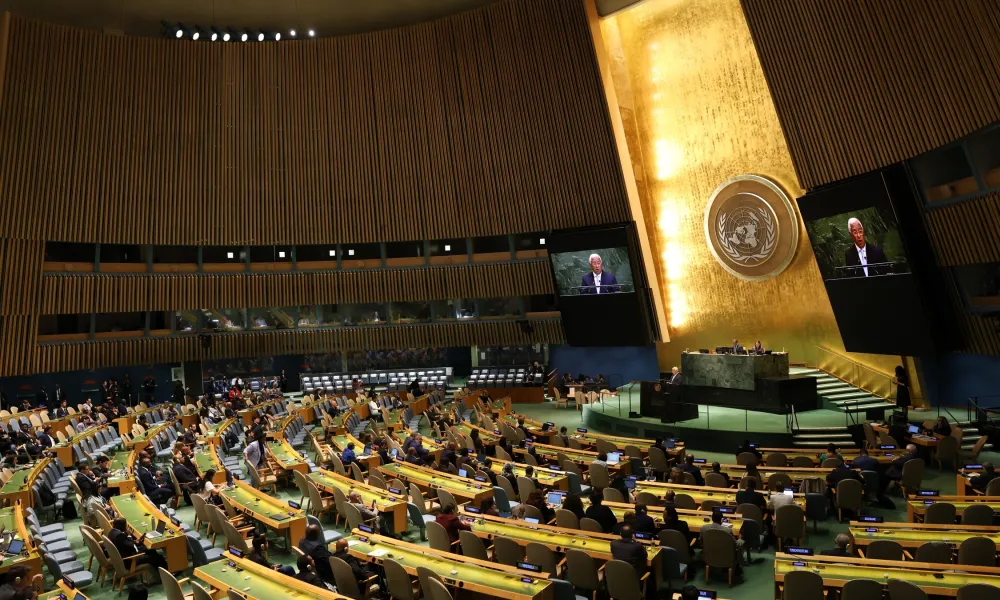
Antonio Guterres' visit represents a renewed attempt to advance the peace process, but it does not eliminate the deeper geopolitical tensions surrounding the island.
The central question is whether Cyprus will remain a frontier between two competing strategic systems or whether a bridge can be built between them.
A sustainable settlement cannot be based on the triumph of one geostrategic vision and the defeat of another. It requires a framework in which Turkey does not feel excluded from the Eastern Mediterranean while the Republic of Cyprus is not expected to accept diminished sovereignty under the shadow of superior power.
The European Union offers no guarantee of success. Yet it remains the only existing institution capable of linking security with law, energy with cooperation and a Cyprus settlement with a broader regional agreement.
Without such a synthesis, Cyprus risks remaining valuable to every geopolitical actor, but never free enough to determine its own future.